Official blog for historical novelist Nancy Bilyeau, author of the Joanna Stafford trilogy, Dreamland, The Blue, and The Orchid Hour
Thursday, August 23, 2018
Cover Reveal for 'The Lost History of Dreams'
Ta da! Here's the cover reveal for Kris Waldherr’s THE LOST HISTORY OF DREAMS, which Touchstone Books will publish on April 9, 2019! In this captivating debut novel in the gothic tradition of Wuthering Heights and The Thirteenth Tale, a post-mortem photographer unearths dark secrets of the past that may hold the key to his future.
Learn more or preorder here: https://tinyurl.com/y9mp9uwc
Read an exclusive interview about the cover design: https://tinyurl.com/losthistoryreveal
Share this post for a chance to win one early copy from Touchstone! US residents only.
Sunday, June 3, 2018
My Conversation with Ruth Ware
I was delighted to have the chance to profile Ruth Ware for the cover of The Big Thrill. Her new novel, The Death of Mrs. Westaway, is exactly the kind of mystery I enjoy reading.
Sharing my story here:
BETWEEN THE LINES: RUTH WARE
A Classic With Delicious Twists
The eerie Manderley estate of Daphne du Maurier’s novel Rebecca has mesmerized not only decades’ worth of readers but also novelists—and for Ruth Ware, the Cornwall estate of Menabilly, which inspired du Maurier, has very particular meaning. The British suspense author, whose novel THE DEATH OF MRS. WESTAWAY is winning acclaim, said that Menabilly “was the main reason I chose to set my novel in Cornwall, as a tribute to her fabulous settings.”
Ware explained, “I tend to think of the settings for my novels as another character in themselves. I have to find the right place for my novels, just as much as I have to find the main characters, and they play off each other.”
In THE DEATH OF MRS. WESTAWAY, the “character” in question is a Cornwall house called Trespassn, and it’s much more than a slightly crumbling estate of wealth and dark secrets. It’s a property that the novel’s main character, Hal, may or may not be entitled to. Hal is a near-destitute tarot card reader with a stall on the Brighton Pier when she receives a letter saying that her grandmother has recently died and she may be due an inheritance. The problem? Hal believes her grandmother to be long dead. Should she decide to attend the funeral of the mysterious Mrs. Westaway, it’s those abilities to “read” people refined through tarot-reading that could set her own future.
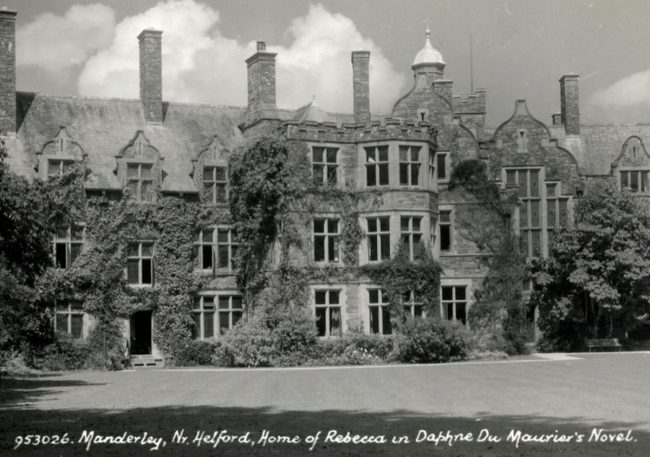
The Cornwall estate Menabilly that served as the inspiration for Daphne du Maurier’s “Rebecca”
The author of the psychological thrillers The Woman in Cabin 10, In a Dark, Dark Wood, and The Lying Game said the strikingly original character of Hal did not come as a product of exhaustive research. “Hal is very much straight out of my imagination,” Ware explained. “Most of my characters are—occasionally I’ll steal a small quirk or a figure of speech off a real person, but I try not to magpie too much from real life, it feels a little disrespectful and I fear my friends might start to rebel. She probably has a good dose of me, though. Most of my characters are me to some extent.”
And even though tarot plays a key role in the novel, Ware said, “I knew very little about tarot before I started writing the novel. I had seen the cards of course, and always found them beautiful and evocative, but I had no idea about what they symbolized and how to conduct a reading. I went into it thinking it was a load of old cobblers, to be totally honest —I’m not a natural believer in anything supernatural, and I tend to dismiss anything that isn’t provable in a sequence of peer reviewed double blind trials. But I emerged from the research process rather impressed, and more inclined to use tarot in my own life. Like Hal, I don’t think the cards themselves have any particular predictive power—but I do think that any process that encourages you to ask yourself questions about your motives and hopes and fears is probably healthy. Ultimately the cards are just a way of making you consider things from different angles, and analyze what forces might be acting on your life. I wouldn’t encourage people to take them too literally—like Hal, I think they can become a crutch. But as a means of enabling self reflection, I think they’re quite useful.”
Whatever her creative method, it’s clearly working. THE DEATH OF MRS. WESTAWAY is winning glowing reviews, from “Expertly paced and crafted” in Kirkus to “tense, twisty modern
The Washington Post in particular delighted in the novel’s charms, saying in its review, “A classic never goes out of style. Consider the confident simplicity of the dry martini, the Edison lightbulb and Meghan Markle’s wedding dress. Now, add to that list Ruth Ware’s new novel, THE DEATH OF MRS. WESTAWAY.”
The glories of the classic Rebecca aside, there was another du Maurier book that influenced Ware in her novel’s creation. “I re-immersed myself in My Cousin Rachel last year, having not read it for years, and I had forgotten quite how brilliant it is.“
The plot of THE DEATH OF MRS. WESTAWAY is definitely filled with twists and well timed revelations, and some instances of clever misdirection. Yet Ware said she is not an author who plots a book in detail ahead of time. “I work mostly by instinct,” she said. “I knew what the switch was going to be in this novel from fairly early on, but exactly how it pans out and how Hal discovers the truth was something I only figured out by writing. Of course there’s a fair amount of tweaking goes on after I deliver—I rely on my editors to tell me if I’ve revealed too much or have signaled too little. They are very good at being a test reader.”
One thing that is not present in the novel is a romance for Hal, interestingly. Ware admits, “It wasn’t something I set out to consciously do or not do—just how it turned out. But I’d written a couple of books in succession where the main character’s romantic problems were a sort of counterpoint or backdrop to the mystery playing out in the foreground, so I suppose perhaps unconsciously I wanted to do something different this time round.”
Ware’s work is being compared to that of Agatha Christie, whose mysteries are so adept with questions of identity, especially when it comes to money. “Yes, some of her best books are about this topic,” Ware said. “I would also encourage anyone who enjoys those themes to read Peril at End House and Brat Farrar by Josephine Tey, to both of which I owe an undoubted debt of inspiration.”
As for Menabilly, which Daphne du Maurier leased for years, Ware said, “I have never been to the real Menabilly, which is in private hands. I would love to visit, but part of me worries that it could never be as glorious and atmospheric as the fictional versions.”
Sharing my story here:
BETWEEN THE LINES: RUTH WARE
A Classic With Delicious Twists
The eerie Manderley estate of Daphne du Maurier’s novel Rebecca has mesmerized not only decades’ worth of readers but also novelists—and for Ruth Ware, the Cornwall estate of Menabilly, which inspired du Maurier, has very particular meaning. The British suspense author, whose novel THE DEATH OF MRS. WESTAWAY is winning acclaim, said that Menabilly “was the main reason I chose to set my novel in Cornwall, as a tribute to her fabulous settings.”
Ware explained, “I tend to think of the settings for my novels as another character in themselves. I have to find the right place for my novels, just as much as I have to find the main characters, and they play off each other.”
In THE DEATH OF MRS. WESTAWAY, the “character” in question is a Cornwall house called Trespassn, and it’s much more than a slightly crumbling estate of wealth and dark secrets. It’s a property that the novel’s main character, Hal, may or may not be entitled to. Hal is a near-destitute tarot card reader with a stall on the Brighton Pier when she receives a letter saying that her grandmother has recently died and she may be due an inheritance. The problem? Hal believes her grandmother to be long dead. Should she decide to attend the funeral of the mysterious Mrs. Westaway, it’s those abilities to “read” people refined through tarot-reading that could set her own future.
The author of the psychological thrillers The Woman in Cabin 10, In a Dark, Dark Wood, and The Lying Game said the strikingly original character of Hal did not come as a product of exhaustive research. “Hal is very much straight out of my imagination,” Ware explained. “Most of my characters are—occasionally I’ll steal a small quirk or a figure of speech off a real person, but I try not to magpie too much from real life, it feels a little disrespectful and I fear my friends might start to rebel. She probably has a good dose of me, though. Most of my characters are me to some extent.”
And even though tarot plays a key role in the novel, Ware said, “I knew very little about tarot before I started writing the novel. I had seen the cards of course, and always found them beautiful and evocative, but I had no idea about what they symbolized and how to conduct a reading. I went into it thinking it was a load of old cobblers, to be totally honest —I’m not a natural believer in anything supernatural, and I tend to dismiss anything that isn’t provable in a sequence of peer reviewed double blind trials. But I emerged from the research process rather impressed, and more inclined to use tarot in my own life. Like Hal, I don’t think the cards themselves have any particular predictive power—but I do think that any process that encourages you to ask yourself questions about your motives and hopes and fears is probably healthy. Ultimately the cards are just a way of making you consider things from different angles, and analyze what forces might be acting on your life. I wouldn’t encourage people to take them too literally—like Hal, I think they can become a crutch. But as a means of enabling self reflection, I think they’re quite useful.”
Whatever her creative method, it’s clearly working. THE DEATH OF MRS. WESTAWAY is winning glowing reviews, from “Expertly paced and crafted” in Kirkus to “tense, twisty modern
gothic” in Publishers Weekly.
The Washington Post in particular delighted in the novel’s charms, saying in its review, “A classic never goes out of style. Consider the confident simplicity of the dry martini, the Edison lightbulb and Meghan Markle’s wedding dress. Now, add to that list Ruth Ware’s new novel, THE DEATH OF MRS. WESTAWAY.”
The glories of the classic Rebecca aside, there was another du Maurier book that influenced Ware in her novel’s creation. “I re-immersed myself in My Cousin Rachel last year, having not read it for years, and I had forgotten quite how brilliant it is.“
The plot of THE DEATH OF MRS. WESTAWAY is definitely filled with twists and well timed revelations, and some instances of clever misdirection. Yet Ware said she is not an author who plots a book in detail ahead of time. “I work mostly by instinct,” she said. “I knew what the switch was going to be in this novel from fairly early on, but exactly how it pans out and how Hal discovers the truth was something I only figured out by writing. Of course there’s a fair amount of tweaking goes on after I deliver—I rely on my editors to tell me if I’ve revealed too much or have signaled too little. They are very good at being a test reader.”
One thing that is not present in the novel is a romance for Hal, interestingly. Ware admits, “It wasn’t something I set out to consciously do or not do—just how it turned out. But I’d written a couple of books in succession where the main character’s romantic problems were a sort of counterpoint or backdrop to the mystery playing out in the foreground, so I suppose perhaps unconsciously I wanted to do something different this time round.”
Ware’s work is being compared to that of Agatha Christie, whose mysteries are so adept with questions of identity, especially when it comes to money. “Yes, some of her best books are about this topic,” Ware said. “I would also encourage anyone who enjoys those themes to read Peril at End House and Brat Farrar by Josephine Tey, to both of which I owe an undoubted debt of inspiration.”
As for Menabilly, which Daphne du Maurier leased for years, Ware said, “I have never been to the real Menabilly, which is in private hands. I would love to visit, but part of me worries that it could never be as glorious and atmospheric as the fictional versions.”
This story ran on The Big Thrill on June 1.
Saturday, May 19, 2018
Earl of Sussex: "Right trustie and right well beloved cousin"
With Prince Harry and Meghan Markle taking the titles of Duke and Duchess of Sussex, it made me think of a person who bore the title of Sussex and played a crucial part in the life of Elizabeth I.
His name was Thomas Radclyffe, and he was the third Earl of Sussex.
Throughout her whole life, Elizabeth turned to and trusted the relatives on the side of her mother, Anne Boleyn. Thomas Radclyffe was part of the Howard clan. Anne Boleyn's mother. Elizabeth Howard, was his aunt.
Although Sussex signed the document agreeing to the accession of Lady Jane Grey, which was what Edward VI wanted, he was one of the courtiers who broke away early on and rode to the camp of Princess Mary, Henry VIII's oldest daughter, to offer her support in taking the throne. Mary made him her commander-in-chief during the time when it looked as if she would have to wage a battle. Sussex had Catholic sympathies and Mary's efforts to return the country to the Old Religion must have appealed.
Sussex, at that point 28 years old, became an important councilor to Mary after she'd officially ousted Jane Grey. But it was after the Wyatt Rebellion, when those who opposed Mary's marriage to the Catholic Prince Philip, that Sussex's loyalty to his cousin Elizabeth became clear as well. Elizabeth was arrested under suspicion of conspiring against Mary, and a deputation of lords that included Sussex came to take Princess Elizabeth to the Tower of London on Saturday, March 17.
Elizabeth protested being taken to the Tower, asking to see the Queen, her half-sister. She was told no. She then asked to write a letter to the Queen and that too was refused. Elizabeth was by all accounts very upset.
But it was at that point Sussex came forward.
Sussex fell to his knees before Elizabeth and said, "You shall have liberty to write your mind and, as I am a true man, I will deliver your letter to the Queen and beg an answer, whatsoever comes there of."
Elizabeth wrote a pleading, eloquent letter, protesting her innocence, which Sussex then took to Queen Mary. She was enraged that Elizabeth was allowed to write to her and said, "Such a thing would never have been allowed in my father's time!"
Elizabeth survived her ordeal in the Tower, when she came closest to execution than any other time in her life, and it was in part due to the intervention of Sussex. There was no hard evidence against Elizabeth, and a leading nobleman in the realm being willing to risk the Queen's wrath to support her sister may well have slowed down the movement to proceed against Elizabeth.
Sussex continued to support her throughout Mary's reign, and when Elizabeth I became Queen in 1558, he was one of her most important courtiers. Sussex always distrusted Robert Dudley, earl of Leicester, but even though he vigorously opposed her marrying Dudley and criticized him at every turn, Elizabeth never punished him for it.
In her letters to him, Elizabeth addressed Sussex in a 1570 letter as her "right trustie and right well beloved cousin," and he was a key councilor for the rest of his life.
Sussex is without a doubt an admirable title.
Friday, May 18, 2018
The Crown in the Czech Republic
I'm excited to report that my first novel, The Crown, sold well in the Czech Republic. Its publisher was Euromedia Group--I still have the facebook post from a few years ago on how excited I was to get them as my twelfth foreign publisher for the book, when the deal was first made.
Its title is Koruna. And my name becomes Nancy Bilyeauova :)
I think part of the reason the book is doing well is its dramatic cover:
What do you think?
Its title is Koruna. And my name becomes Nancy Bilyeauova :)
I think part of the reason the book is doing well is its dramatic cover:
What do you think?
Wednesday, May 16, 2018
Cover Reveal Day for "The Blue"!
Today is the day to share with everyone the cover of "The Blue," my historical thriller set in the 18th century that asks the question: What would you do for the most beautiful color in the world?
The cover was created by designers at Endeavour Quill, my UK-based publisher for the novel. I think they did a great job!
I can also share the very first endorsement blurb: ‘Bilyeau’s sumptuous tale of mystery and intrigue transports the reader into the heart of the 18th century porcelain trade—where the price of beauty was death.’ E.M. Powell, author of the Stanton & Barling medieval mystery series.
In this book, I plunge into the luxury-obsessed Georgian society of the 1750s, when someone would go bankrupt collecting porcelain. But it was also the time of a war with France, and spying between the two countries was flourishing. In "The Blue," these two worlds intersect, with a heroine, Genevieve Planche, drawn from the Huguenot Spitalfields neighborhood.
This book is a big departure for me, based on years of research, and I worked to develop some multi-faceted characters.
I need your support :) Please go to my brand new Goodreads page, and mark the novel "Want to Read." I'd be extremely grateful :)
The book will be published this Fall, in print and on digital in the UK and US. Details to follow...
Thursday, May 10, 2018
Walter Mosley's "Unto the Sea"
This review ran in the June issue of The Strand.
Down the River Unto the Sea
By Walter Mosley
New York: Mulholland, 2018. $27.00
A man seeking justice after he's been wrongly accused and imprisoned is a time-honored story line, with revenge savored deeply in classics such as The Count of Monte Cristo (1844) and other novels. In Walter Mosley's new stand-alone, Down the River Unto the Sea, the damage done to the protagonist, Detective First Class Joe King Oliver, is nearly as horrifying as what happens to Edmond Dantès at Château d'If.
King is a shrewd and resourceful investigator with the NYPD, but he isn't perfect--and someone knows it all too well. Playing on his weakness for women, a trap is set, and after a fling with a "modern day Tallulah Bankhead, with the husky voice, quick wit, and that certain something," the married King is arrested for assault. In his first thirty-nine hours in the Rikers Island Jail, King is attacked by four convicts, but that's just a warm-up for what the guards have in store for him.
The charges are dropped, but King's marriage and career are over. He's a broken man who needs years to rebuild himself back up to the point where he's strong enough to become a private investigator, with his loyal teenage daughter running the front office. To King's shock, a letter arrives in the mail one day from "Tallulah," now a born-again Christian living in Minnesota. She admits, "I was forced to entrap you," and asks for forgiveness. At about the same time, King gets a new case to investigate: a radical black journalist accused of killing two corrupt off-duty cops. As these two threads intertwine, King finds himself threatened and hunted by those willing to kill to keep their secrets hidden. No matter the danger, though, he's driven forward.
Hidden enemies emerge from King's past, but so do allies, none more memorable than Melquarth Frost, "the most dangerous criminal I had ever come across," a man who is determined to help King in his hour of need. In Mosley's skilled hands, Frost is a ruthless murderer, yes, but the harrowing pain that formed his pathology is made plain, and Frost's every moment in the novel is vivid. Throughout the book, those who have been abused and broken are described with clear-eyed compassion. Theirs is a gritty and sad world, but Mosley's poetic descriptions of New York City and his character's deepest souls elevate the story to beauty. Although the characters, major and minor, are all compelling, in the end it is King's story to tell, as he struggles to decide how much he's willing to risk to get the truth. As Mosley writes, "A man can live his whole life following the rules set down by happenstance and the cash-coated bait of security-cosseted morality; an entire lifetime, and in the end he wouldn't have done one thing to be proud of." --Nancy Bilyeau
Saturday, April 21, 2018
My Tribute to Philip Kerr, a Superb Novelist
By Nancy Bilyeau
Over the last two years, I've discovered the fiction of Philip Kerr. His Bernie Gunther series was both a suspenseful, intelligent mystery series and an example of finely told, atmospheric historical fiction, set in 20th century Germany.
As the editor of the monthly digital magazine The Big Thrill, I pursued an interview with Kerr. He agreed. But on the eve of the interview, Philip Kerr died. Here is the story I wrote:
So opens the novel GREEKS BEARING GIFTS, the 13th in the Bernie Gunther series, written by Philip Kerr. Through the publicist for Putnam, his U.S. publisher, Kerr, a London resident, agreed to his first interview with The Big Thrill, a story that was planned for this month's "International Thrills" column. Before the interview could be completed, Kerr died of cancer on Friday, March 23rd.
His long-time editor Marian Wood said, "Working with Philip Kerr was the kind of experience all editors hope to have. In the twenty-plus years we worked together I found him responsive, funny, brilliant, and totally committed to his writing and hence, to being edited as long as he thought the editing was serious. He was an amazing human being and I will always miss him. At the moment, there is a huge hole in my life. I suspect it will stay with me as long as he lives in my memory—which means, as long as I live. He was special. More people might do well to learn that from his work and his ways."
Nearly 30 years ago, Philip Kerr’s novel March Violets introduced the character of Bernie Gunther, a sardonic, hard-drinking detective. What made Gunther a bold choice of character was that in the series he is a detective working in Nazi and post-war Germany. Gunther always loathes the Nazis and is known for his defiant, abrasive nature. But he is also a survivor. When no less a Nazi than Reinhard Heydrich of the SS orders him to serve as "his number one trouble shooter" within the police, he has no choice but to agree. Gunther solves murder cases in the midst of war, whether in Berlin, the city that owns his soul, or on the edges of battlefields, in prisons, at Nazi retreats, or, later, in German communities in Argentina, France, and Cuba. Mysteries in which the crimes of individual murder are solved within a time of horrific war casualties have been written before, as in the excellent Foyle's War series. Bernie Gunther, however, is always in a state of conflict over his feelings for his own country: He loves Germany while feeling shame, bitterness, and a certain incredulity that he has survived as long as he has.
Over the last two years, I've discovered the fiction of Philip Kerr. His Bernie Gunther series was both a suspenseful, intelligent mystery series and an example of finely told, atmospheric historical fiction, set in 20th century Germany.
As the editor of the monthly digital magazine The Big Thrill, I pursued an interview with Kerr. He agreed. But on the eve of the interview, Philip Kerr died. Here is the story I wrote:
Philip Kerr
"That's the thing about real life; it all looks so implausible right up until the moment when it starts to happen. I have my experiences as a police detective and the events of my own personal history to confirm this observation. There's been nothing probable about my life. But I've a strong feeling that it's the same for everyone. The collection of stories that make us all who we are only looks exaggerated or fictitious until we find ourselves living on its stained and dog-eared pages."
So opens the novel GREEKS BEARING GIFTS, the 13th in the Bernie Gunther series, written by Philip Kerr. Through the publicist for Putnam, his U.S. publisher, Kerr, a London resident, agreed to his first interview with The Big Thrill, a story that was planned for this month's "International Thrills" column. Before the interview could be completed, Kerr died of cancer on Friday, March 23rd.
His long-time editor Marian Wood said, "Working with Philip Kerr was the kind of experience all editors hope to have. In the twenty-plus years we worked together I found him responsive, funny, brilliant, and totally committed to his writing and hence, to being edited as long as he thought the editing was serious. He was an amazing human being and I will always miss him. At the moment, there is a huge hole in my life. I suspect it will stay with me as long as he lives in my memory—which means, as long as I live. He was special. More people might do well to learn that from his work and his ways."
Nearly 30 years ago, Philip Kerr’s novel March Violets introduced the character of Bernie Gunther, a sardonic, hard-drinking detective. What made Gunther a bold choice of character was that in the series he is a detective working in Nazi and post-war Germany. Gunther always loathes the Nazis and is known for his defiant, abrasive nature. But he is also a survivor. When no less a Nazi than Reinhard Heydrich of the SS orders him to serve as "his number one trouble shooter" within the police, he has no choice but to agree. Gunther solves murder cases in the midst of war, whether in Berlin, the city that owns his soul, or on the edges of battlefields, in prisons, at Nazi retreats, or, later, in German communities in Argentina, France, and Cuba. Mysteries in which the crimes of individual murder are solved within a time of horrific war casualties have been written before, as in the excellent Foyle's War series. Bernie Gunther, however, is always in a state of conflict over his feelings for his own country: He loves Germany while feeling shame, bitterness, and a certain incredulity that he has survived as long as he has.
Subscribe to:
Posts (Atom)