Showing posts with label historical thriller. Show all posts

Thursday, March 20, 2025

Cover Reveal of 'The Versailles Formula'

 I am so excited to share the cover of my third novel in the 18th-century Genevieve Planche series: 'The Versailles Formula.'


Genevieve Sturbridge has left the dangers of London for a quiet life in the countryside with her husband and young son. But when she is invited to a dinner party at Sir Horace Walpole’s magnificent Gothic estate, she is drawn into a terrifying web of deception, espionage and murder.

At the mysterious dinner party Genevieve makes a shocking discovery — a secret pigment of the deepest, purest blue is being produced once more. The formula is so rare, it’s the obsession of chemists, royalty, and spies.

Some will kill to possess it. Others will kill to keep it buried.

Only Genevieve can recognise the formula and stop it falling into the wrong hands. But when a ghost from her past resurfaces, Genevieve must determine who she can trust. Years ago, this secret nearly cost her and her husband their lives. Now, someone is willing to kill for it once more.

Genevieve must discover the truth before time runs out, because this time the price of failure will cost more than just her own life.

---------------------------------------------------------------------------------------------------------------------------------------

You can preorder the book today!


Thursday, February 3, 2022

Enter the Goodreads Giveaway

Good news!


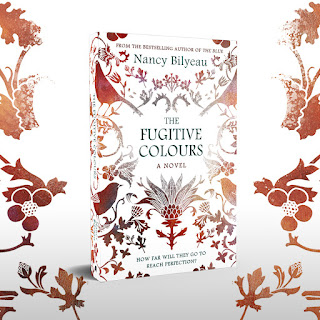
My publisher is giving away 10 copies of 'The Fugitive Colours.' The book will be published in May, but you can read it much sooner :)

To enter the giveaway competition, go here.

Here's an early review from a reader:

rated it it was amazing
"The Fugitive Colours is a sequel to Blue, a fascinating glimpse into the world of colour and porcelain painting in France before the revolution. I would highly recommend reading the first book as the background is important to fully understand the events taking place in the second book.

We are transported to 1764 England, where Genevieve Sturbridge is mistress of her own silk design workshop. A talented painter in her own right, she employs two other painters who help her produce designs that are more beautiful and original that any other designer at the time.

London is dirty, the air is foul and walking the streets is dangerous. Earning enough to support her household is becoming increasingly difficult. She has still not fully recovered from her traumatic experiences in France and she becomes alarmed when a serious of encounters with characters from her past begin to threaten the peace she has worked so hard for. Her experience as a former spy are crucial to her investigation of events unfolding around her as she feels her control slipping away, both with her work and her household.

Beautifully descriptive with believable characters, this is another one of those absorbing stories that will keep you up late at night."


Friday, December 31, 2021

Nancy's 2021 List: Historical Fiction and Suspense

I told a friend recently that I don't find enough time to read historical fiction, my favorite genre. The reason: I have a fulltime job, kids, and my own books to write. But after making this declaration, I took another look at my Kindle list and at the books stacked by my bed. And you know what? That statement is not in every respect accurate, as Ong Chi Seng said in one of my favorite films, Bette Davis's The Letter.

I've actually read quite a few historical novels in 2021! Now not all of them were published in this calendar year. But that's OK. People don't confine their reading to the year of publication.

So I decided to share my first-ever end-of-year reading list. And I have three reasons. 

First, I want to shine the light on these amazing authors. Some are big bestsellers, and some are with small publishers and frankly need more attention paid. 

The second reason is I realize that I walk a particular line in my reading. I like classic historical novels of queens and kings and soldiers and spies. But I also like murder mysteries and thrillers set in the past.

The third reason is I realize after examining my 2021 list that I read books set in "popular" eras: World War II and the Tudor era. But I enjoy stories in many, many other periods too, from 11th century England to 20th century Mexico and India. 

So without further ado, here is my list of fiction set in the past that I read in 2021...


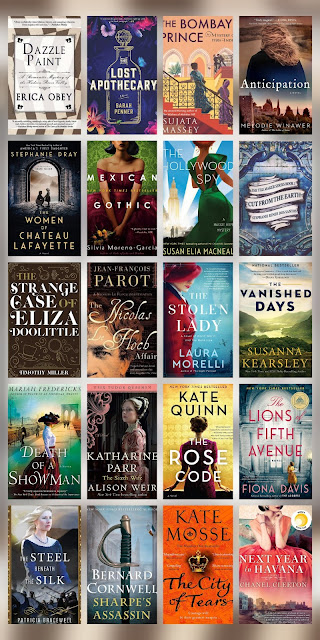
Dazzlepaint, by Erica Obey. A layered murder mystery set in Woodstock in 1919 that draws on some deliciously eerie legends of the Catskills. 

The Lost Apothecary, by Sarah Penner. This page turner kept me up past 2 a.m. because I had to know what was going to happen to the characters in both 1791 London and the modern day city.

The Bombay Prince, by Sujata Massey. The third book in one of my favorite historical mystery series being written today. Bombay solicitor (and Zorastrian) Perveen Mistry is a fantastic protagonist!

Anticipation, by Melodie Winawer. I love it when science enters the story, and this thriller weaves medical mysteries and mystical possibilities into the rich history of Greece. 

The Women of Chateau Lafayette, by Stephanie Dray. You just have to stand back and applaud the skill of a novel running on different time tracks that manages to pull you into characters' lives like this.

Mexican Gothic, by Silvia Moreno-Garcia. I know I'm a little late to the party here, but I was blown away by the atmosphere and dark tension in this imaginative novel.

The Hollywood Spy, by Susan Elia MacNeal. I don't miss a Maggie Hope mystery. And this installment took Maggie to one of my favorite settings of fiction and film: 1940s Los Angeles. Superb pacing.

Cut From the Earth, by Stephanie Renee Dos Santos. This novel really gets at the drive to create art--and what it could cost someone in past centuries. I loved the "trip" to 18th century Lisbon.

The Strange Case of Eliza Doolittle, by Timothy Miller. A delightful reimagining of a Sherlock Holmes adventure, this is the first in a new series. Lots of surprises here!

The Nicholas le Floch Affair by Jean-François Parot. Yes, it was written in 2009. But I've just discovered this translated series set in pre-Revolutionary France thanks to the fantastic (and sexy) TV series running on MHz.

The Stolen Lady: A Novel of World War II and the Mona Lisa, by Laura Morelli. If somehow you didn't realize that art could be at the heart of page-turning mystery and emotional turmoil, then drop everything and start reading.

The Vanished Days, by Susanna Kearsley. I'm a longtime fan of this author, who always manages to marry haunting stories of love and loss to magnificent history. Here it's Scotland in the late 17th and 18th centuries.

Death of a Showman, by Mariah Fredericks. Gilded Age mysteries don't get much better than this series featuring resourceful lady's maid Jane Prescott. Here Jane dives into Broadway misdeeds.

Katharine Parr, the Sixth Wife, by Alison Weir. One of my favorite historians writing a novel about my favorite wife of Henry VIII? Irresistible. Weir's series found fresh angles to The Six.

The Rose Code, by Kate Quinn. When I hear the words "Bletchley Park," I come running. But it turns into a sprint when the book is by Quinn, who pens such stirring and beautifully researched historical stories.

The Lions of Fifth Avenue, by Fiona Davis. How could I not devour a novel set in one of my favorite buildings in all New York City--the New York Public Library? I loved the strong female protagonist.

The Steel Beneath the Silk, by Patricia Bracewell. Any fan of The Vikings or The Lost Kingdom needs to read this amazing series about the 11th century's Emma of Normandy.

Sharpe's Assassin, by Bernard Cornwell. Paris right after the Battle of Waterloo yields a fantastic setting for espionage and adventure. I interviewed Cornwell  for BookTrib on his writing career.

The City of Tears by Kate Mosse. An author who has deeply inspired me with her blend of suspense, historical atmosphere and richly drawn characters. And here she's writing about the Huguenots!

Next Year in Havana, by Chanel Cleeton. I was late to discovering this 2018 novel, but wow, this author knows how to write compelling characters and ripped-from-the-pages history. (And romance.)

I fear I may have left someone out from my reading list of the year and for that I fervently apologize!!

Head's Up: There are so, so many historical novels and mysteries coming out in 2022. I'm already looking forward to Garden of Sins by Laura Joh Rowland, The Strange Case of the Dutch Painter by Timothy Miller, The Next Ship Home by Heather Webb, And By Fire by Evie Hawtrey, The Prophet's Wife: A Novel of an American Faith by Libby Grant, and Unnatural Creatures by Kris Waldherr.

Wednesday, May 16, 2018

Cover Reveal Day for "The Blue"!


Today is the day to share with everyone the cover of "The Blue," my historical thriller set in the 18th century that asks the question: What would you do for the most beautiful color in the world?

The cover was created by designers at Endeavour Quill, my UK-based publisher for the novel. I think they did a great job!


I can also share the very first endorsement blurb: ‘Bilyeau’s sumptuous tale of mystery and intrigue transports the reader into the heart of the 18th century porcelain trade—where the price of beauty was death.’ E.M. Powell, author of the Stanton & Barling medieval mystery series.


In this book, I plunge into the luxury-obsessed Georgian society of the 1750s, when someone would go bankrupt collecting porcelain. But it was also the time of a war with France, and spying between the two countries was flourishing. In "The Blue," these two worlds intersect, with a heroine, Genevieve Planche, drawn from the Huguenot Spitalfields neighborhood.

This book is a big departure for me, based on years of research, and I worked to develop some multi-faceted characters.

I need your support :) Please go to my brand new Goodreads page, and mark the novel "Want to Read." I'd be extremely grateful :)

The book will be published this Fall, in print and on digital in the UK and US. Details to follow...


Saturday, February 17, 2018

Historical Novel Society: Announcement of My 18th Century Thriller


I'm so pleased that Historical Novel Society, in it quarterly publication Historical Novel Review, released the news of my upcoming novel, The Blue. I'm moving from the 16th century to the 18th century with this book, which revolves around a woman artist, a French Huguenot living in London, who gets caught up in a spying conspiracy to steal the formula for a new shade of the most beautiful color in the world.


The publication date right now is Fall 2018. Exact date to follow!

From HNS:

"Endeavour Ink, a new imprint of Endeavour Press, has bought Nancy Bilyeau's fourth novel, The Blue, a suspense novel set in the porcelain-workshop race for supremacy in 18th century England and France, for publication in the UK and US in print and digital formats." :):


2018 is going to be exciting. I will be sharing all sorts of things for the rest of the year--an extra chapter of The Tapestry that was cut from the book, one that contains Princess Mary; a prequel to the trilogy I've written; and special advance tidbits of The Blue. I'll release all of the information on how to get the goods through my newsletter, so if you haven't already, please sign up here. It will take just a minute. :) 

And stay tuned!!


Friday, August 5, 2016

Five Myths About the Man Who Died With Cromwell

by Nancy Bilyeau

The fall of Henry VIII's minister Thomas Cromwell was swift, deeply cynical and brutal to the point of savagery. And yet the worst part of it may have been that Cromwell saw it coming--and could not save himself.

Months before his arrest, Cromwell gathered his many servants and told them "what a slippery state he stood and required them to look diligently and circumspectly into their order and actions, lest, through their default, any occasion might arise against them."

Thomas Cromwell

Just as the nobility hated Cromwell's humbly born patron, Cardinal Thomas Wolsey, they loathed and envied the self-made man whom the king relied on through the 1530s, the man who had risen from blacksmith's son and mercenary soldier to Lord Privy Seal and Earl of Essex. Joining nobles such as Thomas Howard, Duke of Norfolk, in their hatred of Cromwell were the religious conservatives, led by Bishop Stephen Gardiner. Wolsey fell because he could not extricate Henry VIII from his marriage to his first wife, Catherine of Aragon. And once it became clear that the King wanted out of his marriage to fourth wife, Anne of Cleves, and Cromwell was not hastening to do so, the pack of enemies smelled blood.

Cromwell was arrested on June 10, 1540, in a way meant to cause as much humiliation as possible. The Duke of Norfolk ripped the Order of St. George from around Cromwell's neck while the Earl of Southampton tore the Order of the Garter insignia from his gown. "Traitors must not wear the garter," shouted Norfolk. Cromwell was then hustled directly to the Tower of London; within two hours, the treasurer of the royal household had emptied Cromwell's house of valuables while others ransacked his papers.

There was no trial. Cromwell was condemned of treason and "abominable heresies" and executed on July 28, 1540.

An execution on Tower Hill in the 1550s

But Cromwell did not die alone.

Following Thomas Cromwell to the scaffold erected on Tower Hill (not Tyburn, as some historians have written) was Sir Walter Hungerford. The decision to behead two men that day was unusual, though not unprecedented. Two noblemen that Cromwell had targeted for destruction--Henry Pole, Lord Montague, and Henry Courtenay, Marquess of Exeter--died together in late 1538. But those two men, condemned without trial for treason, were lifelong friends, distantly related, and requested a joint execution.

Why was Sir Walter Hungerford chosen for this ghastly honour? Cromwell was the author of the Reformation, a brilliant and ruthless statesman. His enemies sent Hungerford on the same path, from Tower of London cell to scaffold. It's a mystery that still swirls around that hot, pitiless day. In this post, I examine the myths, the theories and evidence.

True or False: Hungerford Was a Nobody

One theory is that Sir Walter Hungerford was an obscure and debauched criminal, so despicable that it would taint Cromwell to share a scaffold with such a creature.

Hungerford was a man of dark secrets, it would seem. But he was not a nobody.

Although some followers of Tudor history may not have heard of Hungerford, his family was a distinguished one with generations of service to the royal family. Sir Thomas Hungerford was steward to John of Gaunt in the 14th century and built the grand Farleigh Hungerford Castle in Somerset.

A reconstruction of Farleigh Hungerford Castle in its heyday

His son, Sir Walter, fought at Agincourt, served as an admiral and became Speaker of the House of Commons. The Hungerfords sided with the Lancastrians in the Wars of the Roses and accumulated much wealth, establishing a London house on the Thames near Westminster Abbey. Nonetheless, the family had an unpleasant reputation: "..their record for dishonesty, vice and violence seems to have been exceptional even in the unsqueamish age in which they flourished," reports one chronicler.

The Sir Walter Hungerford of our tale was born in 1503 and served as a squire of the body to Henry VIII. In May 1536, he was a member of the jury that heard the case of the accused lovers of Anne Boleyn--Mark Smeaton, Henry Norris, Francis Weston, and William Brereton. The King and Cromwell made it clear what verdict they expected to hear, and Sir Walter Hungerford delivered. Guilty, on all counts.


Anne Boleyn

On June 8, 1536 he was summoned to Parliament as Lord Hungerford of Heytesbury. By this time Hungerford owned estates all over Wiltshire, especially in Heytesbury parish. He was a man on the rise.

True or False: Hungerford an Important Cromwell Ally

Sir Walter married three times (more on his unhappy marriages later). In 1532, his father-in-law, Sir John Hussey, wrote to Cromwell, saying that Sir Walter "much desired" an introduction. To make the best possible impression, Hungerford sent Cromwell "a patent of five marks a year." In other words, he bribed him. Through serving on the jury condemning Anne Boleyn's lovers and paying his patent of marks, Hungerford must have pursued his goal in just the right way, for soon after, Hungerford became Sheriff of Wiltshire, an important position. By all accounts, he then dedicated himself to enforcing the law and rounding up traitors to the King.

So yes, Hungerford was known to be a Cromwell client and ally, but there were many other men who fulfilled more important roles in the kingdom. Hungerford's influence did not extend beyond Wiltshire. He was by no means a principal supporter, nor was he a royal councilor. So why kill him with Cromwell?

True or False: Hungerford was a Dangerous Traitor

One of the most striking things about Sir Walter Hungerford was how marital unhappiness, if not violence, surrounded him. Either his stepmother, Agnes, or one of his wives was found guilty of murder and hanged.  His marriage to Elizabeth, daughter of John, Lord Hussey of Sleaford, suffered when his father-in-law rebelled against Henry VIII in the religious rebellion known as the Pilgrimage of Grace. One of the aims of the pilgrimage was the removal of Cromwell. The rebellion failed; Hussey was executed. At around the same time, according to Elizabeth, her husband, Lord Hungerford, imprisoned her in the family castle and tried to do away with her.


After Cromwell's arrest, among all the letters found, was the one by Elizabeth accusing Lord Hungerford:
Here I have been for three or four years past, without comfort of any creature, and under custody of my lord's chaplain, which hath once or twice poisoned me, as he will not deny under examination. He hath promised my lord that he 'would soon rid him of me,' and I am sure he intendeth to keep his promise.
In the same letter, she said she refused to eat or drink anything the chaplain brought her, claiming that food donated by "poor women" was "brought to my window in the night."

Was the letter genuine? It's hard to know--after her husband's death, Elizabeth married the courtier Sir Robert Throckmorton and gave birth to four daughters.

The treason charges against Sir Walter Hungerford are also mixed up with the Pilgrimage of Grace. According to his indictment, in October 1536, Hungerford pretended to arrest a vicar sympathetic to the rebels, William Bird. Instead, he employed him as chaplain for "several months." (This was not the same chaplain as the man who supposedly imprisoned his wife; Hungerford had a large household.)

But even if true, was this enough to condemn a man to death?

True or False: Hungerford was a Witch


The second crime that Hungerford was accused of was witchcraft.


A 17th century witch

Supposedly, on March 22, 1537, at Farleigh Castle, Hungerford called upon two men, Sir Hugh Wood and Dr. Maudlin, to use magic to predict how long Henry VIII would live. The spring of 1537 was a dangerous time. The Pilgrimage of Grace was suppressed, but it had been a frightening struggle for Henry VIII and Cromwell. Their enemies were being rounded up and executed.

At that time, Prince Edward had not yet been born; Henry VIII had no male heir. It wouldn't have been surprising if some people had questions about the future of the kingdom. But using prophecy to forecast the length of the life of the sovereign was high treason. This was the same charge that brought down Edward Stafford, the Duke of Buckingham in 1521, also for supposedly employing minor religious figures to gaze into the King's future in his private castle. The similarity of the charges is striking--and suspicious.

True or False: Hungerford was a Moral Criminal

The third crime Hungerford was accused of was "the abominable and detestable vice and sin of buggery" with several servants. The Buggery Act was an act of Parliament passed in 1533, sponsored by none other than Thomas Cromwell. It was thought that he meant to use it to confiscate the property of monks accused of the crime.

Despite being married several times and fathering four children, was Hungerford gay? It's possible. Hungerford was the only person to be executed for the accused crime in the entire Tudor period. (Let me emphasize that being gay is not a crime at all!)

Another possibility exists. It's believed that in 1536, Anne Boleyn was charged with incest with her brother George as a shock tactic, the crime concocted to make it easier to condemn her on the shakier charges. Hungerford's enemies--whoever they were--might have tried the same thing in 1540.

July 28, 1540

A great many soldiers appeared on Tower Hill the day of the execution, in case of some last-minute defense of Cromwell. The chronicler Edward Hall said he was greatly mourned by the "common people." But there was no outcry on his behalf that day. Sir William Kingston, who listened to Anne Boleyn's terrified rambling while she was imprisoned, was still the constable. Perhaps it was Kingston who led Hungerford and Cromwell out to the hill and formally handed them over to the jurisdiction of the city of London for execution.

Eyewitnesses agree that Hungerford panicked before the crowd. Some modern historians refer to Sir Walter as well known for insanity. But the pragmatic letters he wrote to Cromwell just a couple of years earlier attest to Hungerford's being well able to function in society. It is likely that, during his weeks of interrogation and with the knowledge he would soon die on the block, Hungerford had a nervous breakdown, like Jane Boleyn would in late 1541.

Hungerford "seemed so unquiet that many judged him rather in a frenzy than otherwise," said one observer. Cromwell, who was about to make his final remarks to the crowd, took aside Sir Walter and said to him:
There is no cause for you to fear. If you repent and be heartily sorry for what you have done, there is for you mercy enough for the Lord, who for Christ's sake will forgive you. Therefore be not dismayed, and though the breakfast we are going to be sharp, yet, trusting in the mercy of the Lord, we shall have a joyous dinner.
Cromwell was the first to die, in a bungled beheading infamous for its ghastliness. Hungerford followed. Both bodies were carted to the nearby Church of St. Peter ad Vincula, within the Tower walls. Their graves are a few feet from Anne Boleyn's. As Macaulay wrote, "In truth there is no sadder spot on earth than that little cemetery."

Because he was a traitor, Hungerford's estates and homes were claimed by the crown. Henry VIII gave Farleigh Hungerford Castle to his brother-in-law, Sir Thomas Seymour. It was not a small acquisition. Which is perhaps as good a reason as any for the destruction of Sir Walter Hungerford.

The ruins of Farleigh Hungerford Castle today

~~~~~~~~~~~~~

Nancy Bilyeau is the author of the award-winning historical trilogy The CrownThe Chalice and The Tapestry, published by the Touchstone imprint of Simon & Schuster. The protagonist is Sister Joanna Stafford, a Dominican novice. The Crown was an Oprah pick; The Tapestry was a finalist for the Daphne du Maurier Award for Best Historical Suspense for 2016. To learn more, go to www.nancybilyeau.com


Tuesday, March 22, 2016

'The Tapestry' Goes On Sale as a Paperback Today!


I'm delighted to tell you that today, March 22nd, The Tapestry is available in paperback. The entire trilogy, The Crown, The Chalice and The Tapestry, is out in paperback, hardcover, ebook and audiobook.

Yes, I'm feeling emotional. This all began with the publication in 2012 of my debut, The Crown, which was fortunate enough to be an Oprah pick and earn reviews in Oprah, Parade, Entertainment Weekly, and Woman's Day. It's been a lot of work and, if you'll excuse the cliche, a roller-coaster ride: thrilling highs and teary lows. I'm very grateful to the team at Touchstone (S&S) and to the friends who supported me and the experts who helped me with fact checking. 

 Now it's the turn of The Tapestry!


About THE TAPESTRY:


April 1540: Henry VIII's Palace of Whitehall is the last place on earth Joanna Stafford wants to be. But a summons from the king cannot be refused! After her priory was destroyed, Joanna, a young Dominican novice, vowed to live a quiet life. That all changes when the king takes an interest in her tapestry talent. With a ruthless monarch tiring of his fourth wife and amoral noblemen driven by hidden agendas, Joanna becomes entangled in Tudor court politics. Her close friend, Catherine Howard, is rumored to be the king's mistress, and Joanna is determined to protect her from becoming the king's next wife—and victim. All the while, Joanna tries to stay ahead of a plot against her own life, directed by men in the shadows with power and access. Who can she trust—the constable who once saved her life or the friar she can’t forget? Wife or nun, subject or spy, Joanna must finally choose her fate.


Reviews:


“Nancy Bilyeau's passion for history infuses her books and transports us back to the dangerous world of Tudor England. Vivid characters and gripping plots are at the heart of this wonderful trilogy, and this third book will not fail to thrill readers. Warmly recommended!” (Bestselling author Alison Weir)


“Bilyeau’s rendering of the court and its diverse personalities and the very smells and sounds of the streets are intensely evoked. A lot of fun, and highly recommended.” (Historical Novel Society, Editor's Choice)

“Fans of the Tudor era, you’re in for a treat!” 
InStyle magazine

“Illuminated by Bilyeau’s vivid prose, minor players of Tudor England emerge from the shadows.”
Kirkus Reviews

"This final book in the Joanna Stafford series brings more mystery, danger and intrigue in Tudor England. Readers familiar with the story of Henry VIII and his many wives will recognize some of the events. However, Bilyeau gives us more. She provides historical detail of conditions in England and Europe and treats us to lesser-known possibilities and motives for the tragic events that unfold. Bilyeau creates a fascinating framework for this story of a popular historical period." 
Romantic Times review

"This is a true historical thriller. It's a Tudor novel full of suspense, intrigue, brutality, and death, It's a well researched page turner. If you're looking for an exciting historical read, this will be on your list."
—medievalists.net review 

“A master of atmosphere, Nancy Bilyeau imbues her novel with the sense of dread and oppression lurking behind the royal glamour; in her descriptions and characterizations . . . Bilyeau breathes life into history.”(Laura Andersen, author of The Boleyn King


"A rip-roaring Tudor adventure from Nancy Bilyeau! Novice nun turned tapestry weaver Joanna Stafford returns to the court of Henry VIII. She's that great rarity of historical fiction: a fiercely independent woman who is still firmly of her time. A mystery as richly woven as any of Joanna's tapestries." (Kate Quinn, author of Lady of the Eternal City)

"The Tapestry takes its history seriously, but that doesn't stop it from being a supremely deft, clever and pacy entertainment. This is Nancy Bilyeau's most thrilling - and enlightening - novel in the Joanna Stafford series yet." (Andrew Pyper, International Thriller Writers Award winner of The Demonologist and The Damned)


-------------------------------------------------------------------

The trilogy is on sale in the U.S., Canada, Great Britain, and Australia. The Crown and The Chalice are on sale in Germany, Spain, the Czech Republic, the Netherlands and Poland, with publication of The Tapestry coming soon in Germany.

Tuesday, July 7, 2015

Who Was the Real Mother Shipton?


In the spring of 1881, families across England deserted their homes, too distraught to sleep in their beds. They slept in fields or prayed in churches and chapels for God to spare their lives in the apocalypse that was foretold: "The world to an end shall come; in eighteen hundred and eighty one."

The author of their terror was Mother Shipton, also known as Ursula Shipton, a woman whose prophecies had been circulating through England and beyond for centuries. The first famous man whose life she prophesied was Cardinal Thomas Wolsey, the minister to Henry VIII until 1530. In often cryptic verse, the crone-like seer predicted wars, rebellions and all matter of natural disasters. After London burned in 1666, Samuel Pepys wrote in his diary: "Mother Shipton's word is out." Her prophecies were published in one form or another over 20 times between 1641 and 1700. In the 1800s, her predictions grew even more terrifying: The end-of-the-world was foretold in a book published in 1862. Its other prophetic verse included: "A carriage without a horse shall go; Disaster fill the world with woe; In water iron then shall float; As easy as a wooden boat."

The world did not end in 1881. People began sleeping in their beds once more. It was not the first time that fear of a Mother Shipton prediction convulsed a nation and it would not be the last.


Today there is considerable skepticism that a voluble prophetess named Mother Shipton ever existed. Many of her written predictions are, after all, confirmed forgeries, created to sell greater numbers of chapbooks and almanacs. Her 1684 "biographer" spun spooky details of her birth and existence; the 1881 end-of-the-world prophecy was debunked when the Victorian editor Charles Hindley publicly confessed to concocting the verses himself.


Entrance to Shipton Cave
Nonetheless, belief in Mother Shipton persisted. Today a thriving tourist attraction called Mother Shipton's Cave, at Knaresborough, North Yorkshire, features the cave where she was born and the petrifying well where objects can turn to stone. There's also a shop selling mugs, tea towels, thimbles, and wishing-well water in dark pink, ruby red and kelly green.

But just because Mother Shipton has become the label on kelly- green wishing-well water does not mean that she has no basis in fact. Like Robin Hood or King Arthur, it's believed that if we were able to trace the myth-making back to the very beginning, a living, breathing person could be identified


There are no written references to Mother Shipton in the 1500s. That name does not appear in print until 1641. But a mention of a "witch of York" in a chilling letter written by King Henry VIII himself could be the elusive source of the legend.

The context of the letter is critical. It was written to Thomas Howard, duke of Norfolk, while the duke was in the middle of a clean-up operation following the Northern rebellion against the king known as the Pilgrimage of Grace. Thousands of commoners and a fair number of nobles rose up against the reforms in religion forced on the country by Henry VIII. The rebels were particularly aggrieved by the fresh taxes and the closing of the monasteries, which in the poorer regions of the North were needed sources of food, shelter, and medical care. The Duke of Norfolk had easily defeated this 1537 outbreak, which followed the main rebellion of 1536, and he was now imprisoning and then executing people without trial, imposing martial law. He wrote his king that he hanged more than 70.


A watercolor of the rebellion showing, somewhat inaccurately,  that the army was led by priests and monks
Henry VIII dictated the following letter to Norfolk in response:
“We shall not forget your services, and are glad to hear also from sundry of our servants how you advance the truth, declaring the usurpation of the bishop of Rome… We approve of your proceedings in the displaying of our banner, which being now spread, till it is closed again the course of our laws must give place to martial law; and before you close it up again, you must cause such dreadful execution upon a good number of inhabitants, hanging them on trees, quartering them, and setting their heads and quarters in every town, as shall be a fearful warning, whereby shall ensue the preservation of a great multitude... You shall send up to us the traitors Bigod, the friar of Knareborough, Leche, if he may be taken, the vicar of Penrith and Towneley, late chancellor to the bishop of Carlise, who has been a great promoter of these rebellions, the witch of York and one Dr. Pykering, a canon. You are to see to the lands and goods of such as shall now be attainted, that we may have them in safety, to be given, if we be so disposed, to those who have truly served us..."

"The witch of York"...could this be a contemporary reference to a woman who not only caused enough trouble to incite the wrath of Henry VIII but also transformed into Mother Shipton? Her legend grew and grew in the 1600s, in published almanacs: Ursula was born in a cave in 1488, the child of an orphan servant girl and an unknown father--perhaps Lucifer himself. She was singularly ugly, called "Devils Bastard" and "Hag-face." Nonetheless, Ursula married a builder named Toby Shipton and lived quietly with him, never prosecuted for witchcraft though regularly uttering prophecy. "Her stature," wrote her biographer, "was larger than common, her body crooked, her face frightful; but her understanding extraordinary." How much of this describes the same "witch of York" cited by Henry VIII is unknown.

Cardinal Thomas Wolsey
The fact that Mother Shipton's first known prediction concerned the fate of Cardinal Wolsey is significant. According to Wolsey's gentleman usher and later biographer, George Cavendish, Wolsey, near the end of his life, was disturbed by a prophecy heard. Cavendish wrote: " 'There is a saying, quoth he, 'that When this cow rideth the bull, then priest beware thy skull." According to Tudor-court interpretation, the cow was Anne Boleyn, who in her holding sway over Henry VIII and convincing him to divorce his queen to marry her, triggered the break with the Catholic Church. Mother Shipton was not attributed to this prophecy by Cavendish. But in the future, her soothsaying would intertwine with Wolsey's fate.

Belief in prophecy ran through every level of Tudor society. It reached a fever pitch during the dangerous 1530s, when queens and courtiers were beheaded, monasteries fell, and rebels were hanged from trees across the North of England. 


Many prophecies were used for political purposes. Uprisers against Henry VII said they were following the ancient sages. The rebels of the Pilgrimage of Grace cried that Henry VIII was the ancient 'Mouldwarp,' a monster ruler foretold by Merlin who would be "cast down." Anthony Babington, who conspired to assassinate Elizabeth I, carried a prediction of Merlin's sayings. One popular prophecy during Elizabeth's time was "When HEMPE is soon, England's done." HEMPE was thought to stand for Henry-Edward-Mary-Philip-Elizabeth.  Madeleine Dodds in Political Prophecies in the Reign of Henry VIII wrote:  "Political prophecies tended to be invoked at a time of crisis, usually to demonstrate that some drastic change, either desired or already accomplished, had been foreseen by the sages of the past."


In the 1700 and 1800s, Mother Shipton's prophecies broadened to cataclysmic disasters, amazing inventions, and, of course, the end of the world. Stripped of politics, they were more potent than ever. Perhaps they filled a deep craving within to feel that everything happens by some design, even if it is drawn by an ancient mystic, sage or witch. We are all of us fulfilling an obscure and coded destiny.


It's a craving that we still see around us today. It just might be part of being human.


---------------------------------------------------------------------------------

Sunday, May 17, 2015

Four Stars From the 'British Weekly'

Very excited to share that The Tapestry received four stars from the publication The British Weekly.

"Bilyeau is masterful in creating details that move the narrative story forward and in creating real dilemmas for Joanna Stafford in this book. Bilyeau’s words transport the reader back to the English court at a time when you had to be careful what you said or risk losing your head. The author Bilyeau tries to strike a balance between the politics the King Henry VIII’s court and Joanna’s personal life. For the third book, you don’t have to read the first two books in the series, but it makes more sense if you do...."

To read the rest, go here.


Tuesday, April 14, 2015

This Takes the Cake!

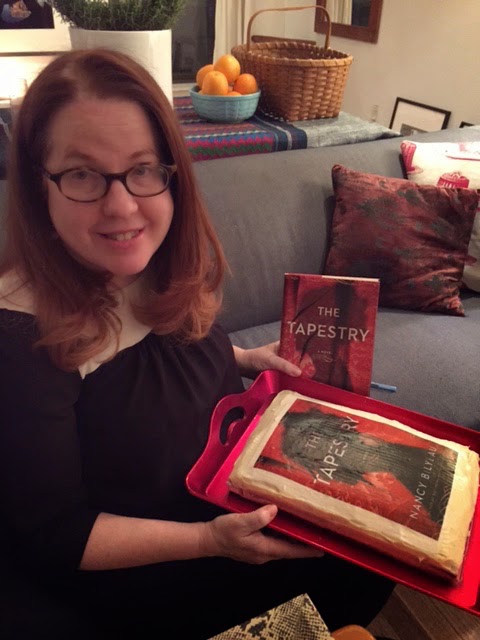
My friends from the magazine world convened in an apartment in Tribeca to celebrate the publication of The Tapestry.

I am absolutely floored by the wonderful cake my friend Donna made.


It took me five years to write my first novel, while I was employed by Ladies Home Journal followed by InStyle magazine. I am deeply appreciate of the support of my media friends!

Friday, March 6, 2015

A March Madness of Historical Fiction


According to the various online dictionaries, "March Madness" has many meanings:
    "The period of the annual NCAA college basketball tournament, with the majority of the competition set in March." Source: dictionary.com No, that's not what I mean 
    "The month of the government of Canada's fiscal year end (March 31), when departments traditionally rush to spend the remainder of their budgets in order that they not experience budget reductions the next year." Source: wikipedia. That's really not what I mean
  1. "The main part of the breeding season of the European hare." Source: wikipedia Oh, come ON
           "The most wonderful time of year." Source: urban dictionary Yes!
 For the purposes of this blog post, March Madness is a time when readers can be transported across centuries and across continents into the stories of five different women. Some are from history, some are fictional, but all are enthralling. :)

These five historical novels constitute a very special March madness. Among your choices, an empress, a queen, a fashion designer, a witch and a nun:


Lady of the Eternal City, by Kate Quinn. (Go to Quinn's website here.) Publishes March 3rd

Rome, 2nd Century: Elegant, secretive Sabina is the wife of Hadrian, Rome's brilliant and sinister Emperor, and she must struggle to keep the peace between her husband and the battered warrior Vix, who was her first love.


"An epic, sexy romp," Publishers Weekly 

"A feast for historical readers," RT Reviews


Rebel Queen, by Michelle Moran. (Go to Moran's website here.) Publishes March 3rd.

India, 19th century: The story of Queen Lakshmi--India's Joan of Arc--who against all odds defied the mighty British empire. The novel is told from the viewpoint of Sita, the queen's most favored companion and most trusted soldier in the all-female army.

"Filled with fascinating historical details about a subject that is not often portrayed, the novel looks at both the rights of women and the conflict between the British army and India"-- Library Journal

"A riveting and addictive glimpse of that era"--Historical Novel Society


Mademoiselle Chanel, by C.W. Gortner (Go to Gortner's website here) Publishes March 17th

France, 20th century: A novel of the life of Coco Chanel, the ambitious, gifted laundrywoman's daughter who revolutionized fashion, built an international empire and became one of the most influential and controversial figures of the 20th century. 

"Gortner brings history to life in a fascinating study of one woman's unstoppable ambition," Booklist

"In this deliciously satisfying novel, C.W. Gortner tells the rags-to-riches tale of how this brilliant, mercurial, self-created woman became a legend." -- Christina Baker Kline


The Witch of Painted Sorrows, by M.J. Rose (Go to Rose's website here.) Publishes March 17th

France, 19th century:  A woman named Sabine flees to her grandmother's Paris mansion to escape an abusive husband, but what she finds there is even more menacing. Sabine explores the forbidden night world of Paris, discovering both an occult underworld and her true nature as artist and lover.

"Rose's new series offers her specialty, a unique and captivating supernatural angle, set in an intriguing belle epoque Paris, a perfect match for the author's lush descriptions, intricate plot, and mesmerizing storytelling" -- Kirkus

"A haunting tale of possession" -- Publishers Weekly


The Tapestry, by Nancy Bilyeau (Yes, this is me! And you can find my website home page here) Publishes March 24th

England, 16th century: Joanna Stafford, an aristocrat and former novice of the Dominican Order, is summoned to the court of King Henry VIII because of her talent at the tapestry weave. Struggling to stay ahead of a formidable enemy, she becomes entangled in court politics when she tries to free her beautiful young friend, Catherine Howard, from the king's tightening web.

"Up to her ears in court intrigues, religious persecutions, beheadings galore and Henry VIII's volatile nature, Joanna shines, remaining ever vigilant." -- Historical Novel Society

"Fans of Ken Follett will devour Nancy Bilyeau's novel of political treachery and courageous love, set amid the endlessly fascinating Tudor landscape." -- Erika Robuck


------------------------------------------------------------------------------------------------------------

Thursday, November 20, 2014

The Day the Box Arrives...

I always get emotional when the box of Advance Reading Copies lands on my doorstep (or in my case, the apartment lobby mailbox).

I think that this cover is the most effective of the three, mingling beauty with menace. Very grateful to the art department of Touchstone Books!


Looking forward to hearing from my readers!

Sunday, November 9, 2014

The Mysterious Life & Horrific Death of Mary Jane Kelly

On November 9th, 1888, a 25-year-old woman known as Mary Jane Kelly was found murdered with incomprehensible savagery in her room at 13 Miller's Court, off Dorset Street, dubbed "the worst street in London.

In my post I explore the enigma of Mary, believed to be the last victim of Jack the Ripper...


Go here to read it: http://bit.ly/1AM68kg


Thursday, September 4, 2014

Cover Reveal: The Tapestry

I am proud to share with you the cover of The Tapestry, the third book in the Joanna Stafford trilogy. The novel goes on sale March 24, 2015.

I think this cover truly represents the beauty and the darkness of Joanna's Tudor England world...


Sunday, August 31, 2014

Knights Templar: Fact and Fiction

I learned about the fiction of Dominic Selwood by reading a piece of riveting nonfiction--an article in the Daily Telegraph titled "How a Protestant Spin Machine Hid the Truth About the English Reformation." (Read it here.) In the nearly 10 years I've been researching England's break from Rome, the backdrop to my historical thrillers, I'd come to many of the same conclusions about Henry VIII and Cromwell's actual agenda as this writer. I "etroduced" myself on twitter, and soon learned that apart from being a historian and former criminal solicitor, Dominic too was writing fiction. His thriller, set in modern times, is called The Sword of Moses.

To read my interview with Dominic, go here.


Sunday, August 10, 2014

Medmenham Abbey: Heaven and Hell

In my blog post for English Historical Fiction Authors, I researched an abbey ruin like no other: Medmenham, a Cistercian community in Buckinghamshire.

Many people have vaguely heard of a Hellfire Club. The one most written about was formed by a rich English aristocrat, Sir Francis Dashwood, and met in the abbey he'd leased in the 18th century. He wanted privacy for his various misdeeds, whether just drunken silliness or actual depravity is up for debate.

Francis Dashwood, by Hogarth


But before it was a meeting place for the "Monks of Medmenham," it was an actual monastery, founded on lands granted by a very different sort of aristocrat, a medieval heiress. To learn about the history of this fascinating place, go here: http://englishhistoryauthors.blogspot.com/2014/08/the-infamous-monks-of-medmenham-abbey.html


Sunday, March 30, 2014

A Conversation with Bruce Holsinger on The Daily Beast


I am excited to share my story on The Daily Beast, posting today. The brilliant Bruce Holsinger, author of A Burnable Book, and I talked about writing historical thrillers: our research, our love of history, and whether it's easier to research the daily life of a medieval transvestite prostitute or a Dominican nun!

Please read: http://www.thedailybeast.com/articles/2014/03/30/historical-fiction-a-conversation-between-bruce-holsinger-and-nancy-bilyeau.html


Tuesday, January 14, 2014

The Secrets of the Westminster Gatehouse Prison

I had one of my research "Aha!" moments while chasing down facts about Westminster Hall and Whitehall Palace, where my Joanna Stafford spends pivotal chapters in The Covenant.


I learned that in the reign of Edward III a gatehouse quite close to Westminster Abbey was converted into a prison. I couldn't stop reading about the people who were kept there, from Sir Walter Ralegh and Samuel Pepys to a Catholic-leaning dwarf to a brazen woman bigamist. The more I dug, the more stories I discovered.

To read about this fascinating prison, go to my blog.