Showing posts with label Catholicism. Show all posts

Wednesday, April 20, 2016

The Nun Who Threatened Henry VIII

By Nancy Bilyeau


The journey that Henry VIII made with Anne Boleyn to Calais in the autumn of 1532 is well known. This was when Henry presented his beloved Anne, newly elevated as Marquess of Pembroke, to the king of France, when the couple may have begun to sleep together, when by all accounts he was most deeply in love with her.


Yet just before leaving England, King Henry had a distinctly unromantic encounter with another woman. He met face-to-face with a female who was roughly Anne Boleyn’s age but was not a courtier’s daughter possessing style and Continental polish. Elizabeth Barton, humbly born, was a Benedictine nun of the Priory of St. Sepulchre, in Canterbury.


Sister Elizabeth was, like many people, loyal to the king’s estranged wife, Queen Catherine of Aragon, and did not want him to marry Anne Boleyn. But unlike the vast majority of English men and women, she was determined to do something about it.


According to a statement taken later, Sister Barton told Henry VIII “she had knowledge by revelation from God that God was highly displeased with our said Sovereign Lord…and in case he desisted not from his proceedings in the said divorce and separation but pursued the same and married again, that then within one month after such marriage he should no longer be king of this realm, and in the reputation of Almighty God should not be king one day nor one hour, and that he should die a villain’s death…”


Henry VIII’s response to Sister Elizabeth’s threat in 1532 is unknown. But less than two years later, she would be dead, the only nun executed in the reign of the king. She had no trial. The methods that the king and his ministers used to persecute and condemn her for treason set the pattern to be used on others that Henry VIII wanted to destroy. She was the first of the retaliation deaths.


Anne Boleyn

Although she presented a serious obstacle to Henry VIII’s marriage to Anne Boleyn, and was later used as an instrument to bring down the highest-ranking of the king’s critics, Cardinal John Fisher, Sister Elizabeth Barton does not appear in hardly any historical fiction (or TV series or films) taking place in the 1530s except for Wolf Hall in which she is mocked as an attention seeker. She is described dismissively in most works of nonfiction. Tudor historian Geoffrey Elton called her “that deluded prophetess” and, more recently, Geoffrey Moorhouse described her as “the somewhat deranged and visionary serving maid.”


What has undoubtedly diminished the legacy of Sister Elizabeth is the Tudor government’s propaganda machine. A long manuscript was written by Barton’s confessor; a printed tract of her life widely circulated throughout England; an illuminated letter was produced by a monk – all of these documents were destroyed. We cannot read them today. The accepted chroniclers of the 16th century, all of them Protestant, are our sources of her life story, along with a few references made by foreign ambassadors. It is hard to glimpse a view of the human being through the distortions.


Sister Elizabeth’s saga bears some resemblance to Joan of Arc’s, a century earlier. Joan was a peasant who experienced visions. Elizabeth was a servant who fell seriously ill in 1525, lost consciousness, and when she came to, made references to the health of a boy also ill whose fate she could not have had knowledge of. She shared visions that called for veneration of God. Word spread, and those living in Kent began to make pilgrimages. She is supposed to have proclaimed prophecies and performed miracles but we don’t know the details. “She told plainly of divers things done at the church and other places where she was not present, which nevertheless she seemed most likely to behold as if it were with her own eye.”

Church authorities interviewed Elizabeth early on and proclaimed her a genuine mystic. They were not eager to anoint seers; quite the opposite. She was examined rigorously by a series of priests, monks and bishops, all of them on the outlook for “trickery.” The Archbishop of Canterbury William Warham personally saw her and said her visions were genuine. In a letter he described her as a “well -disposed and virtuous woman.” Elizabeth entered the nunnery of St. Sepulchre to be either protected or controlled, depending on how you look at it. “The Holy Maid of Kent” made appearances at a church in Canterbury, and at one point up to 2,000 people jostled to surround her.


What is beyond question is that Elizabeth Barton had some sort of chronic illness for the rest of her life, whether it was physical, neurological or psychiatric. Her visions often came to her while she appeared to be suffering painful fits, writhing on the floor, or in a trance.


Much later, the next archbishop of Canterbury, Thomas Cranmer, known for his skepticism and dislike of superstition, wrote this eyewitness account of Elizabeth’s fit: “Then there was a voice heard speaking within her belly, as if it had been in a tun, her lips not greatly moving, she all that while continuing in a trance. The which voice, when it told everything of the joys of heaven, it spake so sweetly and heavenly that every man was ravished with the hearing thereof. And contrary, when it told anything of hell, it spake so horribly and terribly that it put the hearers in great fear.” In our modern minds, these bizarre breakdowns in health would hurt her credibility. But in the medieval era, holy women were often traumatically ill at the time of experiencing visions.


Elizabeth Barton became famous before Henry VIII launched his famous quest for a divorce from Catherine of Aragon. She already had enemies, though. Elizabeth called for obedience to pious works and traditional worship, tenets that were under attack in a Germany transformed by Martin Luther. All of Europe was in turmoil over the spreading religious reform. 


Henry VIII derided Luther in writing and was rewarded by the pope’s proclaiming him “Defender of the Faith.” What’s hard for us to grasp is that, before 1527, it was unthinkable to the world that the king of England would discard his longtime queen or that he would break with Rome. He was an orthodox ruler, an obedient son of the church. Reformer and scholar William Tyndale, living in exile, called Elizabeth a “false, dissembling harlot.” (Protestant opponents often accused Barton of sexual misconduct, without any foundation whatsoever.) Since Henry VIII opposed, hunted down, persecuted and finally killed Tyndale--who died in the flames crying, “Lord, open the king of England’s eyes”—Henry Tudor and Sister Elizabeth Barton were on the same side.
Until they weren’t.


The "Holy Maid” did not publicly prophesy against the king. She repeatedly tried to warn him against his course of action, first to his ministers and finally to him in person. In 1528, Barton told Cardinal Wolsey that God commanded her to tell him that if he furthered the king’s marriage to Anne Boleyn he would be “utterly destroyed.” (Wolsey was disgraced after he failed to get the king his divorce and died on way to trial.) John Fisher, the churchman who supported Catherine of Aragon, wept with joy when he heard Sister Elizabeth’s visions. Sir Thomas More was more cautious, telling her that her words were “reckless.” Catherine of Aragon herself was careful to never meet or corresponded with Elizabeth, her champion. The embattled queen could see the danger that Elizabeth and her many followers seemed oblivious to.
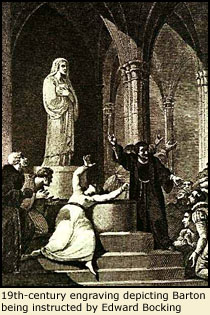


"The Maid of Kent"

Although he knew of her activities, Henry VIII did not move against the nun for a long time. During one stage he tried to pacify her, even to bribe her. He offered to make her an abbess of her own priory. She refused the offer.


Elizabeth’s fame and influence continued to grow. She met with foreign ambassadors and the papal representative in England. She wrote letters to the pope, urging him to stop the king from divorcing. She had secret meetings with English nobility, including Gertrude Courtenay, the marchioness of Exeter, wife to the king’s first cousin. Collections of Sister Elizabeth’s prophecies were printed and widely circulated.


Barton herself said that she prevented Henry VIII from marrying Anne Boleyn in Calais, as he was rumored to be planning to do. When they did marry, it was in great secret.


It was widely known that Sister Elizabeth predicted if Henry VIII wed Anne, he would soon lose his kingdom and die. After several months had passed and he was very much alive, the king moved against her. Barton and her most devoted followers were arrested and harshly questioned in late 1533. There is no proof of torture, although another woman, Anne Askew, would be racked nearly to death for her religious “crimes” a decade later.


Whatever the means of persuasion, Elizabeth Barton supposedly told her captors what they wanted to hear. She recanted her visions and said, Cranmer wrote, “all was feigned of her own imagination, only to satisfy the minds of them which resorted unto her, and to obtain worldly praise.” This did not save her. Henry VIII directed Parliament to pass a special act condemning her for treason without a hearing. The punishment was death.


Elizabeth Barton, around 30 years of age, was hanged and then beheaded on April 20, 1534, her head fixed on Tower Bridge, the only woman known to be so displayed after death. The head of Cardinal Fisher was later mounted as a warning to others when he was executed for treason, in part because he was charged with conspiring with Elizabeth Barton. Five men were executed with her the same day, all of them priests, monks or parsons who had believed in her prophecies.


This same spring of 1534 was when Henry VIII demanded that the church and the people follow him into schism with Rome. The terms of the Act of Succession were proclaimed everywhere. People were warned that if they said or wrote anything against the king’s marriage to Anne Boleyn or his lawful heirs by her, they would be guilty of treason, punishable by death.


All the records of Sister Elizabeth’s confession come from the crown. In 1536, Queen Anne Boleyn would also be turned into a nonperson after execution: letters, documents, portraits destroyed. Because her daughter grew up to be a great queen, Anne’s reputation was restored. This never happened with Elizabeth Barton. She is usually dismissed as a tool of religious plotters, or mentally ill. The possibility that this was a young woman who felt compelled to have a say in the affairs of the kingdom, and possessed the courage to try to interfere, is rarely acknowledged.


-----------------------------------------------------------------------

Nancy Bilyeau is the author of the Tudor mystery trilogy The Crown, The Chalice and The Tapestry, on sale in North America, the United Kingdom, German, Spain, and Russia. The main character is Sister Joanna Stafford, a Dominican novice.

Sunday, August 10, 2014

Medmenham Abbey: Heaven and Hell

In my blog post for English Historical Fiction Authors, I researched an abbey ruin like no other: Medmenham, a Cistercian community in Buckinghamshire.

Many people have vaguely heard of a Hellfire Club. The one most written about was formed by a rich English aristocrat, Sir Francis Dashwood, and met in the abbey he'd leased in the 18th century. He wanted privacy for his various misdeeds, whether just drunken silliness or actual depravity is up for debate.

Francis Dashwood, by Hogarth


But before it was a meeting place for the "Monks of Medmenham," it was an actual monastery, founded on lands granted by a very different sort of aristocrat, a medieval heiress. To learn about the history of this fascinating place, go here: http://englishhistoryauthors.blogspot.com/2014/08/the-infamous-monks-of-medmenham-abbey.html


Tuesday, March 11, 2014

Rufford Abbey: Errant Monks and a Stuart Ghost


By Nancy Bilyeau


A carved stone head on the abbey grounds

Ever since I began my series on the monastic ruins of England, "In Lone Magnificence, a Ruin Stands," I've been struck by how unpredictable the stories are. The crumbled walls and hollow spires of the abbeys don't always give clues to the dramas that unfolded centuries earlier. Weddings now take place at the Manor Gatehouse of Dartford—who could guess that a priory of sisters of the Dominican order walked the same ground from 1346 to 1539? I wrote about that incongruity when I traveled to Kent to research my first book, The Crown, which largely took place at a priory.

Having said that, Rufford Abbey in Nottinghamshire saw more drama than most.

King Stephen
The Founding  Rufford Abbey was born out of violence. In 1148, Gilbert de Gaunt, a wealthy nobleman who had fought on the side of King Stephen in his war over the succession with Queen Mathilda, established the abbey, dedicating it to the Blessed Virgin.

He did it as a gesture of atonement. While still fighting for Stephen, Gilbert de Gaunt burned down the priory of Pontefract and the pope excommunicated him for it. After Queen Mathilda won, and Gilbert de Gaunt married and was made earl of Lincoln, he set aside 30 acres on the banks of the Trent. The abbey was built using red sandstone and limestone. Cistercian monks came over from Rievalux Abbey, one of England's most glorious monasteries, to fill it.

In 1156, the English pope, Adrian IV, "confirmed all the donations and privileges of Rufford." Shortly afterward, the abbey's lands expanded and the villagers of Cratley, Grimston and Rufford, Inkersall were reportedly evicted to make room. A new village took in some of the displaced people. But this may have led to some lingering ill feeling...

The Order The Cistercians, called "the white monks," were a force to be reckoned with in the 11th and 12th centuries. William the Conqueror and his Norman lords supported and endowed the Cistercians more enthusiastically than the Benedictines. After all, the Benedictines had been there long before the Normans, and some of their abbots were on the wrong side of the Battle of Hastings.The Cistercians said they sought a simpler way of life than the older orders, "far from the haunts of men." It was of great importance to practice manual labor and farm the land. However, some medieval communities' needs exceeded the grants and tithes provided. Time and again, the Cistercians of Rufford turned to the neighboring Sherwood Forest.

Sherwood Forest today

The land grants tell the story:

In 1233, "the king licensed the abbot and monks to enlarge the courts of their house by taking in an acre of the king's wood without any interference from the forest ministers..."
In 1251, Henry III "confirmed to the monks the rights in Sherwood Forest granted them by Henry II and approved...forest justice, namely license to take green or growing wood throughout the forest so far as it was necessary...and to have their own forester to guard their own wood."
In 1291, "license was granted...to fell and sell the wood growing on 40 acres of his wood within Sherwood Forest."
In 1358 the abbot of Rufford seemed to go too far. He was charged with "completely laying waste to the wood of Beskhall, cutting down and selling the oaks over 20 acres and 3 roods of land." The abbot pointed to royal charters and was eventually allowed to keep the money, which was just over 400 pounds. But the forest grab was nothing compared to a charge of robbery in the same century:
"An apparent outrage was participated in by two of the monks of this house in 1317, as to which we have only the statement of complaint. On 10, December 1317 a commission was appointed to inquire into the charge made against Andrew le Botiller, Richard de Balderton, John de Rodes, Thomas de Rodes, together with Brother William Sausemer and Brother Thomas de Nonyngton, monks of the house of Rufford, of gathering to them a multitude of men and seizing Thomas de Holme, as he was passing through the abbey of Rufford and the grange of Roewood, robbing him of his goods, and taking him to some unknown place and there detaining him until he should satisfy them with a ransom of 200 pounds."
History does not record what happened to the accused brothers.


The Dissolution: Rufford Abbey, like every other monastery in England, was under pressure during Henry VIII's split from Rome. Men sent by Thomas Cromwell investigated the abbeys, charged with "reform." It is a matter of great dispute how much financial impropriety or moral corruption was actually discovered.

The infamous royal commissioners Thomas Legh and Richard Layton reported six monks of Rufford guilty of "disgraceful offenses." Morever, the abbot, Thomas Doncaster, was charged with being "incontinent with two married and four single women." The abbey was closed in 1536, and Abbot Doncaster pensioned off with twenty-five pounds a year. But within two months, the government appointed him to the rectory of Rotherham and voided the pension, making his string of seductions highly unlikely.

The Nobility: Henry VIII gave most of the abbeys' property and lands to courtiers loyal to him. He awarded Rufford to the Talbot family in October 1537. George Talbot, sixth earl of Shrewsbury and a passionate builder, demolished some of it and began the long process of converting it into a grand country estate.

Part of the abbey remained, and was to be the site of a secret wedding leading to one of the Stuart family's most poignant tragedies.

Bess of Hardwick

The wedding came from a tangled family alliance. Talbot's second wife was the dynamo Bess of Hardwick, who had already given birth to numerous children by her second husband, among them a lovely girl named Elizabeth. When Mary Queen of Scots fled to England and ended up in genteel confinement, one of her unofficial jailers was the earl of Shrewsbury. The Scottish queen was allowed guests, and in 1573 Margaret Douglas, granddaughter of Henry VII, visited with her son Charles Stuart, the earl of Lennox and the younger brother of  Lord Darnley. It may seem incredible, but Mary Queen of Scots had cordial relations with her mother-in-law at that time--incredible since Mary was accused of plotting to kill her husband, Lord Darnley, oldest son of Margaret Douglas. Charles Stuart and Elizabeth Cavendish, thrown together, fell in love.  They married at the chapel at Rufford, without the knowledge of Queen Elizabeth. Because Charles Lennox had a claim to the throne, the queen was furious.


Arabella Stuart
Charles and Elizabeth died of disease when Arabella Stuart was a child. Bess of Hardwick raised her, and in some  eyes she was a natural heiress to Elizabeth I, her first cousin twice removed. But the queen never warmed to her, and her male councilors believed that Arabella's cousin, King James VI of Scotland, was a much better candidate.

Queen Elizabeth would not allow Arabella to marry, despite interest from suitors in England and Europe. The king of Poland sent an ambassador to ask for her hand--refused. Elizabeth did not want Arabella's claim to the throne to be strengthened through marriage.

Arabella, 28, may have hoped she would be given more freedom when her male cousin succeeded to the English throne in 1606. Sadly, King James distrusted her even more than Elizabeth. When Arabella fell in love with William Seymour, also descended from Henry VII, permission to marry was denied. They wed in secret in 1610 and tried separately to flee the country. Arabella's ship was captured before it reached Calais and she was imprisoned in the Tower of London.

Arabella Stuart, 1590
Arabella Stuart never saw her husband again. She died in the Tower on Sept. 25, 1615 after refusing food for a prolonged period. She left behind a great many letters, collected in the 1994 book The Letters of Lady Arbella Stuart, published by Oxford University Press. In the letters, Stuart, a "talented Renaissance thinker," expressed her anguish over her constricted life and longing for independence.

Arabella Stuart is buried in Westminster Abbey in the tomb of her aunt, Mary Queen of Scots.

As for Rufford Abbey and its adjoining estate, it passed from the Talbot family to the Saviles in the early 17th century. The Saviles were passionate royalists. Lady Anne Savile held Sheffield Castle against the rebels: "This gallant lady, famous for her warlike actions beyond her sex, had been besieged by the rebels in Sheffield Castle, which they battered on all sides by giant guns, though she was big with child." After she finally surrendered the castle, Lady Savile marched out with full military honors and gave birth the next day.

Sir George Savile, 1st marquis of Halifax
The main home of the Saviles, Thornhill in Yorkshire, was burnt down during a siege in 1648 and Rufford became the family seat. The family was deeply involved in plans to bring Charles II back to England, and when the Stuart king returned, he made George Savile the Marquis of Halifax. The family became rich and Rufford Hall grew and grew. George Savile, the 7th baronet, built a bathhouse and garden pavilion on the estate in 1729.

Sir Henry Savile, who inherited the estate in the mid-19th century and was a close friend of Edward, Prince of Wales, bred racehorses at Rufford. His great success was Cremorne, a thoroughbred that won 19 of his 25 races.

Cremorne, painted in 1872 by Harry Hall


In 1872, Cremorne became the second of six horses to win both the Epsom Derby and the Grand Prix de Paris. Incredibly, the horse had a reputation for laziness and overeating. When Sir Henry Savile died in 1881, his prized thoroughbred followed the next year. Cremorne was buried at Rufford.

The Saviles managed to hang onto Rufford Hall into the twentieth century but sold it in 1938. During the Second World War, the house was taken over by the army and much woodland sold.  The main buildings' structural damage was so severe, the Nottinghamshire County Council, which took it over, had to demolish part of the property. English Heritage now owns the house.

Rufford Hall, adjoining the abbey ruins

The Ghosts: Rufford has had quite a few ghost sightings. In Edwardian times, the mother of author Vita Sackville West, visiting the Savile family, said she was awoken in the middle of the night by a strange clamminess, like touching cold skin. She was told the next day that the ghost of a murdered child sometimes crept into people's beds.

The other ghost reported by many is the White Lady--the figure of a woman flitting among the abbey ruins who some say is the unhappy Arabella Stuart. This was the place where her fragile parents found brief happiness. One visitor even snapped a picture of a flash of movement in a dark archway and insists that it shows a misty shape, wearing jewelry.

A type of white rose grown in the Rufford garden is also named after the White Lady.

The preservation: Rufford House and 150 acres of country park can be visited much of the year. Visitors may tour parts of the country house originally built by the earl of Shrewsbury and added on to by the Saviles, including "Brick Hall," once a grand reception area. Still intact are the original monks' cellar and refractory. Walk there to absorb a sense of the Cistercian monks'  existence, all those centuries ago.

For more information, visit the English Heritage site and Nottinghamshire Council information site.

--------------------------------------------------------------------------------------------------------------

"In Lone Magnificence, a Ruin Stands" is contained in The Ruins of Netley Abbey, by 18th century poet George Keate.

Read the earlier posts in my series on monastic ruins:

Searching for the Lost World of Blackfriars 

The Beauty and Tragedy of Furness Abbey

Tintern Abbey: A Treasure of Wales

Thetford Priory: A Duke's Quest

The Haunting Power of Whitby Abbey


Friday, February 14, 2014

The Truth About St. Valentine


By Nancy Bilyeau

Believe me, I would like to be able to deliver a sweet and touching historical anecdote. I tried. I really did. But you don't find hearts and flowers when you get to the beginning of the story of Valentine. You find martyrdom, imprisonment, plague, and death by clubbing. It's hard to conceive of anything less romantic than death by clubbing.

The Catholic Church distanced itself from St. Valentine's Day a while ago, and not because of any sort of distaste for chocolate hearts or hand-holding. The evidence that there really was a person who committed acts worthy of sainthood is fragmentary. Valentine is one of the "saints whose cult is larger than themselves, so to speak," according to Richard McBrien's Lives of the Saints. In 1969, the Pope quietly dropped Valentine's Day from the official calendar of saints' days.

The consensus seems to be that Valentine is based on a Christian priest of that name who lived in Rome when the official religion was still pagan, during the reign of Claudius Gothicus, from 268 to 270 AD. 

This was not a proud time in the history of the empire. Rome did not decline steadily from the glorious reigns of Julius and Augustus Ceasar to the crumbling under Honorius in 423 AD. There were peaks and valleys. This was a valley. Emperors rapidly succeeded each other through assassination in the mid-Third Century. There was death by poison, death by strangulation, death by hanging, death by being dragged naked from the back of a chariot through the streets. The year 238 AD saw six different emperors.

Claudius Gothicus
Claudius Gothicus, the Ceasar who would, legend has it, confront Valentine, was born a peasant in what is now Bosnia and rose rapidly through the ranks of the army. He was popular with the soldiers, a very tall man who liked to fight. His specialty was knocking out the teeth of an opponent, including, once, an opponent's horse. He played a key role in the assassination plot that eliminated Emperor Gallenius in Milan. The Rome that Claudius took charge of was near-bankrupt, with rebel populations causing lots of trouble in German and France in the West, and Syria in the East. Claudius desperately needed more soldiers in the Army, and he tried to officially discourage men from marrying. 
Valentine and the Virgin

As the story goes, Claudius heard that the  priest Valentine was busy marrying Christian couples, in defiance of the emperor, and ordered him arrested. Pressure was put on Valentine to abandon his faith; he refused. The emperor decided to visit Valentine in prison. During this meeting, instead of being meek and obliging, Valentine tried to convert Cladius to Christianity. Disgusted, the emperor ordered his execution. Valentine was clubbed to death and then beheaded.

Lupercalia
Three centuries later, long after Claudius died of the plague, a pope declared February 14th Valentine's day. One theory is that the Catholic leaders really wanted to banish the mid-February fertility celebration of Lupercalia. (What happened during Lupercalia? Let your imagination run wild and you still haven't come close.) Naming the day in honor of the martyred Valentine seems a wee random today. Nonetheless, the new holiday stuck, and in medieval times, all sorts of romantic stories were told. 

Shrine in Dublin
Did any of these sweet tales have anything to do with the Third Century Valentine? Only one--that the night before the rebellious priest was to be executed, he wrote a letter to the daughter of his jailer, and signed it "Your Valentine." The first Valentine's Day card was born.

To see some interesting images from history on St. Valentine, check out my board on Pinterest: http://www.pinterest.com/tudorscribe/historical-images-of-st-valentine/

Sunday, May 5, 2013

Catholic Herald: "My poignant journey in search of the martyrs"

I wrote an article for the Catholic Herald in England about writing my historical thriller.

"When I decided to create a 16th-century Dominican novice as the main character of my debut novel The Crown, my motive was to find a new way into the era. Queens, princesses and ladies-in-waiting, living in royal palaces, dominated Tudor fiction. For my planned thriller, I wanted to open the door to a different world and a new sort of female protagonist. Eight years of research and two books later, I feel a complex tumble of emotions – intrigued, humbled, exhilarated, saddened and outraged – over what I learned about England’s lost monastic life....


I began my journey as a life-long Tudor history addict but fairly ignorant of the specifics of the religious orders. I had no spiritual agenda; I was raised by agnostic parents in the American Midwest. But after I learned a family secret when I was 19, I felt increasing curiosity about the Catholic Church. In the last month of her life, my grandmother told my mother that while she and my grandfather, Francis Aloysius O’Neill, babysat me as an infant, they took me to a priest in Chicago, Illinois, for baptism. The first priest they approached for baptism without the parents being present said no; the second one said yes. I was baptised in the Catholic Church but for nearly 20 years did not know it."

To read the rest, go to: http://www.catholicherald.co.uk/features/2013/04/30/my-
poignant-journey-in-search-of-the-martyrs/

Tuesday, February 26, 2013

WELCOME TO THE PREMIERE OF THE TRAILER


"A curse to kill a king, a fight to save a nation."


On March 5th, The Chalice, the sequel to The Crown, will be published in North America. Once again, Joanna Stafford comes up against the most powerful men of the land. Based on detailed research into the tumultuous late 1530s, it's a mystery, an untangling of the political threads of the deadly court of Henry VIII, a poignant romance and a race-against-the-clock conspiracy tale. Think Day of the Jackal meets The Tudors.


Screenwriter Christie LeBlanc and filmmaker Norman LeBlanc, two extraordinarily talented people, created a book trailer for The Chalice that captures its adventurous yet eerie mood.


Without further ado, the Book Trailer! (Hit full screen, far right, to get the full impact.)


Isn't that intriguing?

To find out more about the book, read my interview with International Thriller Writers,  the book's earliest review from Kirkus and a recent review from respected British author M.M. Bennetts.

As for this wonderful book trailer, I asked Christie to share how she created it. The first step...I mailed her one of the first advance galleys of The Chalice. :)

Says Christie: "My aim was to make something visually cool on a shoestring budget that didn't allow for live action. Armed with Adobe Creative Suite and just barely enough knowledge to be dangerous, I pieced together stock footage and photos, and mixed in a dash of original material.  Then I hunted down some fabulous music! When I wasn't happy with the result, I used Norman's amazing skills without mercy. He finessed it until we ended up with a final product we both loved and hoped would do justice to a fine book."

Christie is one talented writer--and don't take my word for it. Follow her on The Single Screenwriter.

And remember: The clock is ticking...The Chalice is almost here!


Thursday, September 6, 2012

Sister Joanna’s Home

By Nancy Bilyeau


In the town of Dartford, a 40-minute train ride south of London Charing Cross, is a building called the Manor Gatehouse. Inside you will find a registration office to record the births, marriages, and deaths that occur in Kent. This handsome red-brick building, fronted by a garden, is also a popular place to book a wedding reception. “It looks amazing in the official pictures,” gushed one satisfied bride in a website testimonial.

But when I first walked up that path to the Gatehouse, I was filled with awe, and definitely not because I was planning a wedding. I was thinking of who stood on this same piece of ground six centuries ago. Because it was then a Catholic priory—a community of women who constituted the sole Dominican order in England before the dissolution of the monasteries—and it is where I chose to tell the story of The Crown.
The Gatehouse of Henry VIII's Manor


This is where Sister Joanna Stafford, my half-English, half-Spanish protagonist, prayed, and sang, and wept, and struggled.

I didn't create a Catholic novice as a protagonist for my book because of a religious or political agenda. A lifelong Tudor fanatic, I felt I had no choice but to set a story in the 16th century. I wanted to write about someone different, and so I plunged into researching the life of a young nun at the most tumultuous time in the Dissolution of the Monasteries. What would it be like to have your way of life taken from you--would you try to stop the destruction, or accept the inevitable? 


At one time, like many others, I accepted a series of "truths" about life in the time of Henry VIII: people did not often live to old age; women were rarely educated outside of the royal family or high aristocracy; women outside of the court of the king, and the carnal grasp of the king, were not as interesting to our modern sensibilities; the monastic life was in decline, most likely corrupt, and deserved to be ended; and nuns were either forced to take vows or ended up in convents because they were not as "good" as the women who married--ie, they were rejects. 

My years of research revealed to me how wrong all of those stereotypes were.

The true story of one woman's life, Prioress Elizabeth Cressner, illuminates some of the complex truths.   A "good and virtuous woman," she was the leader of the priory in Dartford for 50 years; she died in December 1536 at somewhere between 75 and 80 years of age, just as Henry VIII was putting intense pressure on the monasteries to submit to his will.

Edward III
Dartford Priory had been founded with great care by Edward III, although the idea of establishing a house for Dominican sisters is attributed to Edward II. Did he feel some obligation to carry out the wish of his deposed father? Impossible to know. Once the pope approved the founding of the order, four Dominican sisters were recruited from France, for whose expenses 20 pounds was paid from the Exchequer.

The English priory soon established a reputation for "strict discipline and plain living." Dartford was known for the value put on education and contained a library of books. It also drew aristocratic nuns, even royalty, most famously Princess Bridget of York, the daughter of Edward IV and Elizabeth Woodville.

Prioress Elizabeth Cressner took on her tasks with great energy and a bold temperament. She executed wills for people in the community and appointed priests to celebrate Mass in the parish church and masters to oversee the local almshouse for the poor. She administered much of the property owned by the priory, even though it was technically the job of the friars assigned there.

In the 1530s, Thomas Cromwell was turning a speculative eye on the monasteries. Undaunted, Prioress Elizabeth sent Henry VIII's minister a series of firm letters over a recent appointment of a certain Friar Robert Stroddel as president at the Dartford community. The prioress found him unkind and even dishonest.

The prioress wrote Cromwell:
"And now of late I understand {Stroddel} hath purchased letters of your good lordship under our most gracious founder's seal to be president here the term of his life, by feigned and untrue suggestion, for as much as he hath governed the office so well, as he himself reporteth."

Despite such fiery letters, the prioress was unable to dislodge Friar Stroddel. When Elizabeth Cresssner died, the convent at Dartford was still intact. There was no corruption found at the priory by the king's investigators. But her successor, Joan Vane, was forced to surrender it just the same to the king, and all of the nuns were expelled with small pensions and no place to go.


 The king did not award the priory to a favored courtier, as he usually did. He took the priory for himself, ordered it demolished and a luxurious manor house raised on the property. Henry VIII never slept there, though his ex-wife, Anne of Cleves, lived there for a time.

The manor house was given to Sir Robert Cecil by King James I, and passed through various hands before being demolished by the 19th century. All that remains is the red-brick gatehouse, although that was built by Henry VIII. Nothing is left of the priory itself, except for the stone wall that ran along its perimeter.


The priory wall, seen at right
One a cloudy afternoon, I walked the perimeter of the centuries-old wall, as the cars whizzed by. There are no Dartford Priory gift shops, as exist at the carefully preserved Tower of London. No mugs for sale bearing the face of Prioress Elizabeth Cressner. But her life was significant all the same.

I paid her homage on my solitary walk.

Sunday, January 1, 2012

International Thriller Writers Interview with Nancy Bilyeau

Oprah Magazine named Nancy Bilyeau’s THE CROWN (January 2012, Simon & Schuster) one of the “16 Books to Watch for in January 2012,” because “the real draw of this suspenseful novel was its juicy blend of lust, murder, conspiracy, and betrayal.”

When Joanna Stafford, a young novice, Dominican nun, learns her cousin is about to be burned at the stake for rebelling against King Henry VIII, she makes a decision that will change not only her life, but quite possibly the fate of a nation. Charged with a mission to find a hidden relic believed to possess a mystical power that has slain three Englishmen of royal blood in the last 300 years, Joanna and a troubled young friar, Brother Edmund, must seek answers across England. Once she learns the true secret of her quest, Joanna must finally determine who to trust, and how far she’s willing to go to protect her life, her family and everything she holds dear.

I recently chatted with Nancy about her debut novel, THE CROWN.

Q: You have an extensive professional writing background. Why write a novel now? 

A: Yes, I’ve worked as an editor and writer at a series of newsstand magazines—INSTYLE, GOOD HOUSEKEEPING, ROLLING STONE, ENTERTAINMENT WEEKLY. But I felt this craving to create my own characters. I wanted to tell a story. For me, that’s magical. To invent a world and then beckon readers to join me, as if I were a magician.

Q: Why this novel? Why did you believe this story was the one to launch your novel career?

A: I didn’t know if it would launch anything—although I hoped it would, of course. I had no agent, no editor waiting to read. It was just what I wanted to write more than anything else—a historical thriller from the point of view of a woman living in my favorite time period: Tudor England.

Q: Tell us the genesis story of Johanna Stafford?

A: I knew I wanted to set my book in the reign of King Henry VIII. But I wasn’t as sure of my main character. I wanted to write a woman but I didn’t want to depict a queen or princess or lady in waiting. I just felt that many writers had already done that. I pondered what kind of woman would lead an interesting life of some independence—or as much as would be possible in that time—in the middle of conflict, of turbulence. I came up with a Catholic novice during the Dissolution of the Monasteries. I decided to place her in a real family, and after some research I selected the Staffords: an aristocratic family with a history of spectacular self-destruction. Both the second and third Stafford dukes of Buckingham were executed for treason.

Q: What is the most interesting thing you discovered about King Henry VIII, while writing this story?

A; I had not realized the extent of the violence and terror the king inflicted on the Catholic monastics who resisted his break from Rome. The sense we have now—certainly the sense you get in the film, TV series and most historical fiction—is of a country moving away from the corrupt and exhausted Catholic faith and toward Protestantism. But the number of martyrs is troubling, and I’m not talking about famous ones like Sir Thomas More. The Carthusian monks of the Charterhouse were hanged, drawn and quartered for refusing to obey the king over the pope. Near the end of the Dissolution, the prior of Glastonbury Abbey, an old and sick man, was executed and literally chopped into pieces for resisting the king. There are many examples of people executed and persecuted for their beliefs.

Q: What did you learn about yourself as a novelist?

A; That I benefit from patience with myself. When I first started writing my book I was frustrated because what was on the page was not what I envisioned in my mind. I learned that I could use my comfort with revision—that is what we are always doing as magazine editors—to know that if a fictional passage isn’t working in the first draft, I can come back to it, I can brainstorm, I can be inspired to improve it.

Q: What myth about novel writing was debunked once you became published?

A: “Write what you know.” I wrote a novel set five centuries ago, in a country I don’t live in, about a religion I don’t practice.

Q: Why are you a historical thriller writer?

A: I love both thrillers and historical fiction—I couldn’t think of anything more fun than to fuse them.

Q: Give me a comparative of two books that are similar to THE CROWN? Why are they also different?

A: My book has been compared to ANGELOLOGY, a wonderful novel by Danielle Trussoni, because both have nuns in the center struggling to solve a mystery with mystical elements. But ANGELOLOGY runs on two time tracks—modern day New York and World War II-era Europe—and THE CROWN’S plot exists only in the 1530s. Also my book is populated only by humans! Umberto Eco’s classic THE NAME OF THE ROSE tells a story of mysterious murders in a 14th century abbey. But Eco’s novel dwells in a community of men; mine is a community of women (though I have strong male characters too). And learning the identity of a murderer is just one element of the plot of THE CROWN—there is also a search for something of enormous importance. My entire plot takes place in a time when the priories and abbeys were literally disintegrating in England; THE NAME OF THE ROSE is set during a time of Catholic preeminence.

Q: What do you hope readers will experience while reading THE CROWN?

A; I hope they will be absorbed, entertained, enlightened. I have a number of big twists and turns in the plot—I really hope readers enjoy them.

Q: Why are relics and Christian iconography so important in 16th Century Europe? Why is it important to the story?

A: Religion was woven through everyday life in the early 16th century on a level that is hard to comprehend today. The liturgy, the Mass, the saints’ days, the feast days—they provided structure and meaning and comfort too in a time of rampant disease and poverty and early death. People were enthralled by the saints—they thought if they could get closer to the saints, they were closer to an understanding of God. Relics of those saints were a tangible way to do that. I am fascinated by the multiple meanings of many Christian symbols during this time, and I decided to make decoding these meanings part of the story. There are symbols embedded in the very stones of Dartford Priory—and my characters struggle to understanding the symbols to reach their goals.

Q: What makes this story a thriller?

A: It is a story of heightened suspense in which a main character has to reach an objective—overcoming many, many obstacles—or else something terrible with happen within a finite amount of time.

Nancy Bilyeau is a magazine editor who has worked on the staffs of INSTYLE, ROLLING STONE, and ENTERTAINMENT WEEKLY. She was born in Chicago and grew up in Michigan, attending University of Michigan-Ann Arbor. Her screenplays have reached finalist stage in national competitions—she was a semi-finalist in the Nicholl Competition. She lives in New York City with her husband and two children.