Showing posts with label Anne Boleyn. Show all posts

Saturday, November 22, 2025

Tudor History Podcasts: Hits and Misses on Elizabeth I

History Podcasts on the Tudors   

My Substack about these podcasts got such an enthusiastic response, I wanted to share that section here on my author website blog.


After enjoying two episodes from different podcasts on Henry VIII in recent weeks, I was excited to see that the long-running podcast The Rest Is History was releasing a series of episodes devoted to Elizabeth I. I’ve enjoyed the witty and erudite talks by Tom Holland and Dominic Sandbrook, especially their mini seasons devoted to Lord Byron and the French Revolution. 


This is why I was dismayed to hear so many mistakes and misinterpretations in “Elizabeth I: The Fall of the Axe,” the episode about her parents. After beginning reasonably well on the background of Henry VIII and his first marriage, I’m told that Elizabeth I’s mother, Anne Boleyn, “was not even really an aristocrat.” 

Oh?

She was the granddaughter of the Duke of Norfolk and spent her childhood and teenage years as a maid of honour at the courts of Brussels and Paris, two of the most prestigious in Europe. No other Englishwoman in the early 16th century had such a heady start. 

We’re also told that Anne’s father, Thomas Boleyn, was a country squire who loved horses, akin to Major Ferguson, Sarah Ferguson’s father.
 
What?

Boleyn, proficient in Latin and French, was England’s ambassador to France, nothing like the “galloping major.”

 Things got worse. They say Anne Boleyn miscarried of nearly a full-term son in 1534, Henry VIII formed a liaison with Jane Seymour in 1534, and Henry Norris, executed for adultery with Anne in 1536, defended her on the scaffold. The historical record does not support any of these “facts.” 

 What makes it so baffling is that in the YouTube version, you can see the men reading from notes. Where on earth did they get these notes? It’s not as if the life of Anne Boleyn is obscure! The Tudors and The Other Boleyn Girl get more history right than this. I’m baffled. 


 Nonfiction Book to the Rescue 

I don’t think I will be listening to the rest of The Rest of History’s episodes on Elizabeth I. Which is a shame, because it feels like these days historians are putting the Late Elizabethan court under greater scrutiny than the usual “Armada-Shakespeare-James I Succession” golden haze.

 Five years ago, I was drawn to the end of Elizabeth’s reign and wrote “Elizabeth I: The Final Days of the Great Queen” for English Historical Fiction Authors. When researching it, I felt like Elizabeth’s naming of her successor, the Scottish king who was her first cousin twice removed, carried the whiff of the apocryphal. Supposedly, while dying and unable to speak, she pointed to her head when James’ name was spoken.  But I wasn't aware of anyone challenging it. Until now.

 I have just finished reading a full-length book that delves deeply into this fascinating subject: The Stolen Crown: Treachery, Deceit and the Death of the Tudor Dynasty. The author is Tracy Borman, Chief Historian for Historic Royal Palaces, the charity that manages Hampton Court Palace, the Tower of London, Kensington Palace, Kew Palace, and more. Borman’s research makes a strong case that Elizabeth I never named James; instead, Elizabeth’s closest counselors engaged in a dangerous conspiracy with James, up in Scotland, to smooth the way for him to succeed. Years after he took the English throne, James was so sensitive on this subject that he pressured William Camden, writing a book about Elizabeth I, to distort the tale of the succession sequence. Borman reports that examining Camden’s handwritten manuscript proves that key passages were pasted over and rewritten to make James I look better. 

 James I is very much a mixed bag. Undeniably intelligent, he was obsessed with a fear of witchcraft and personally wrote Demonology, a treatise meant to justify witch trials and executions. Elizabeth’s councillors were taken aback to realize that, unlike the last Tudor monarch, he was not interested in hands-on running of the country or financing world explorers. When not ranting about witches, he wanted to go hunting and have affairs with beautiful young men. The miniseries Mary & George depicts an ambitious woman from a second-rate gentry family, played memorably by Julianne Moore, scheming to get her handsome son, played by Nicholas Galitzine, into the bed of the new King of England. 

One bone I have to pick with Borman’s book is the title. James “stole” it from…who? He had no serious competition for the English throne. That's one of the chief reasons the Tudors were followed by the Stuarts. His tragic first cousin, Arabella Stuart, seems to have struggled with severe emotional problems and behaved erratically, Borman writes. Other relatives with a strain of Tudor or Plantagenet blood were not persuasive candidates. He was the strongest in a weak field. 

While she took great pains not to name him officially, Elizabeth maintained a steady correspondence with young James, giving him a “master class in monarchy” that, in a pique of misogyny, he ignored his whole reign, Borman writes. James didn’t want to work with Parliament or create a majestic presence that the public could admire, as the Virgin Queen had done. Instead, he was obsessed with the “divine right of kings,” a concept unconnected to leadership, which he unfortunately instilled in his son, the future headless Charles I. 

The Stuart father and son’s conviction that God had put them on a higher plane than mere mortals didn’t go down well in the 17th century. Today, reading about disgraced Andrew Windsor-Mountbatten’s demand that he be given a cook, housekeeper, gardener, and a butler before agreeing to hide himself away on the vast Sandringham estate, you have to wonder what delusions of innate superiority are still being inculcated by the royal family. Can a more severe punishment be imposed on Andrew? This isn’t the 15th century, when Edward IV could order his brother, the duke of Clarence, to be drowned in a barrel of Malmsey. As Tina Brown pointed out in The Interview, released yesterday, it’s risky to make Andrew and Fergie’s lives so horrible that they have nothing left but to sell their secrets...

---------------------------------------------------------------------------------------------------------------------

If you want to read more of my reviews of historical podcasts and nonfiction as well as historical fiction, subscribe to my new, free substack, "History, Horror & Headlines."


Saturday, February 25, 2017

Henry VIII, Anne Boleyn and the Lost Palace of Whitehall

by Nancy Bilyeau

At about 4 p.m. on January 4, 1698, during the reign of King William III, a fire broke out in the Palace of Whitehall. The possible cause was linen left to dry by a fireplace. The "devouring flame," in the words of James Vernon, destroyed the king's and queen's lodgings and most of the rest of the sprawling complex. "Except the banqueting house and the great gate, all is burnt down or blown up." The scene was chaotic, with court officials desperately trying to retrieve their possessions as the "gates were locked up to prevent the mob coming in."

The Palace of Whitehall, seen from
St. James Park in a painting from 1675.

This was the end of Whitehall as a royal residence, the palace where Henry VIII and Charles II died, where Elizabeth I entertained the French prince come to court her, where The Tempest was first staged for James I, where Hans Holbein designed a gatehouse and Inigo Jones a banqueting house, where Charles I was beheaded. Years after the fire, Queen Anne, the last Stuart monarch, said she wanted to rebuild Whitehall, but it came to nothing.

Today little remains above ground of the royal residence that covered 23 acres in Westminster, on the edge of London. The name "Whitehall" is synonymous with the British government and its civil service. Yet present-day Downing Street once was part of Henry VIII's royal entertainment grounds, with the street's first known house leased by Elizabeth I to a favorite, Sir Thomas Knyvet. The Tudor roots are strong.

Not everyone mourned the palace's destruction in the late 17th century. The duc de Saint-Simon said in his memoirs "a fire destroyed Whitehall, the largest and ugliest palace in Europe."

But Whitehall, the obsession of royal lovers Henry VIII and Anne Boleyn, had once been thought beautiful.

It was Cardinal Thomas Wolsey, Henry VIII's lord chancellor, who turned a bishop's residence on the Thames, just a short distance from Westminster Abbey, into a place of splendor. Since Wolsey held the bishopric of York, he was entitled to make use of York Place, as it had been known since the 13th century. Wolsey borrowed money and devoted his considerable energies to expanding it "most sumptuously and gorgeously." Banquets were held there, and elaborate "masques and mummeries."

Cardinal Wolsey

On March 1st, 1522, Cardinal Wolsey looked on as an elaborate entertainment was performed at York Place after supper. A "Chateau Vert" was raised, with the King and his friends masqued to storm the castle, occupied by costumed ladies, including a young brunette named Anne Boleyn, who was named "Perseverance" and had "black and beautiful eyes."

Anne Boleyn

Five years later, Henry VIII made public his quest to divorce his longtime wife, Catherine of Aragon, and marry Anne Boleyn. It was a struggle with momentous consequences, among them the downfall of Cardinal Wolsey, whom, the king felt, didn't work hard enough to win his master the annulment.

On Oct. 19, 1529, Wolsey was deprived of the great seal and he threw himself on the king's mercy. Hampton Court, York Place--the palaces became Henry's. A week later, Henry VIII arrived at York Place for a royal walk through, accompanied by Anne Boleyn, her mother Elizabeth, and the courtier Henry Norris. (Norris would be executed for adultery with Queen Anne in 1536, but that's another story.) The king found "the present more valuable even than he expected." No one gave a thought to Cardinal Wolsey, who would the following year die, arrested and alone, on his way to the Tower of London.

Turning York Place into a palace fit for a king and his future queen was no simple matter. Wolsey's residence revolved around a great hall, privy chamber and a receiving room, a cloister and a chapel, and kitchens; there were no lodgings for the vast number of people who lived in a Tudor royal residence. No tiltyard for jousting or ornamental garden. On one side was the Thames. On the other was a large marsh that once contained a leper hospital. Not a lot of room for expansion.

Yet expand it did.

During the same tumultuous years that Henry VIII fought for his annulment, breaking with the Pope and alienating those still loyal to Queen Catherine and her daughter the Princess Mary, he was personally directing the legal procedure of seizing the surrounding land for the new Whitehall. He inspected each building plan before it went forward. Anne Boleyn was as involved as the king in overseeing the design of the new palace, taking tremendous interest in its architecture as well as the stylish details. Anne possessed the sort of sophisticated taste that came from serving the French queen as a teenager. She and Henry shared a fondness for French and Italian decor. Anne liked "antique" touches, such as classical columns and ceilings and patterned grotesque work.

The Spanish ambassador Eustace Chapuys wrote that the king concentrated on Whitehall "to please the lady who prefers that place for the king's residence to any other." Perhaps planning their new home was an escape from stress for the embattled couple.


Henry VIII ordered his people to survey the surrounding property, purchase the leases and then demolish buildings. This caused "great discomfort" to those who still lived in Westminster, but the king wasn't concerned. At one point, the up-and-coming Thomas Cromwell drew up a list of the leases. When Cromwell accompanied Henry and Anne to France to meet the French king, an official left behind wrote a reassuring letter that "there is as much speed as can be made there."

Whitehall had to be everyone's priority!

In his detailed book, Whitehall Palace: An Architectural History of the Royal Apartments, 1240 to 1699, Simon Thurley wrote about the astonishing lengths taken to build a wall along the river.
The whole area was low lying and prone to flooding from high tides...In July 1531 a pump was installed in the foundations at Lamb Alley and leather buckets were also in use to bail out the waterlogged trenches. To keep the works dry torches were provided so the pumpers and diggers could work through the night, and in reward forty barrels of beer, forty dozen loaves and four whole cheeses were distributed to the workers.

Sheriffs, bailiffs and constables were informed that at absolutely any time the king's representatives could seize workmen for the "speedy furnishing and building of our new manor." Anyone who refused to relinquish bricks and other materials was subject to arrest.

New galleries and chambers were built, extensive gardens, jousting and tennis yards, a bowling green, cock-fighting pit and, of course, the magnificent Holbein gatehouse, with its checkered pattern and fleur de lis. Historians believe that on the upper floor of this gatehouse, in January 1533, Henry and Anne married in secret. Now she would reside in the palace as the king's wife.

Expansions and renovations Whitehall continued for much of Henry VIII's life. But Anne Boleyn never saw the completion of their cherished plans, since she was beheaded three years after their wedding. Some have speculated that the king did not reside in Whitehall as much after her death out of a sense of guilt, and he seems to have gone to great lengths to obliterate her memory there. But he definitely was at Whitehall at important moments: Henry VIII married Anne's successor, Jane Seymour, in the Whitehall chapel. The famous mural of the king and his family painted by Holbein shows Jane at his side, displayed in the privy chamber of Whitehall. And Henry seems to have deliberately chosen Whitehall as the place where he wanted to die.

Holbein's mural in Whitehall, from a copy made in
early 17th century. The original mural burned in 1698.

Today it's nearly impossible for us to inhabit--to imagine--the dazzling Whitehall palace that Henry VIII was so obsessed with. The Banqueting House that survived the fire was built by the Stuarts, after all. But there is one 16th century room that remains. Underneath the Ministry of Defence is a preserved chamber referred to as Henry VIII's Wine Cellar. It may be named for the Tudor monarch, but the stone-ribbed, brick-vaulted chamber was built by Wolsey.

In that, the cardinal had the last word.

Queen Mary, widow of George V,
insisted the Tudor wine cellar be preserved

~~~~~~~~~~~~~

Nancy Bilyeau is the author of the historical mystery trilogy The Crown, The Chalice and The Tapestry, published by Simon & Schuster and available in North America, the United Kingdom and Germany. The Crown was an Oprah magazine pick. Much of the third novel, The Tapestry, takes place in the palace of Whitehall in 1540. The Tapestry was a finalist for the Daphne du Maurier Award for Best Historical Suspense.
Amazon

Wednesday, April 20, 2016

The Nun Who Threatened Henry VIII

By Nancy Bilyeau


The journey that Henry VIII made with Anne Boleyn to Calais in the autumn of 1532 is well known. This was when Henry presented his beloved Anne, newly elevated as Marquess of Pembroke, to the king of France, when the couple may have begun to sleep together, when by all accounts he was most deeply in love with her.


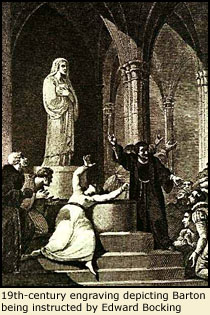
Yet just before leaving England, King Henry had a distinctly unromantic encounter with another woman. He met face-to-face with a female who was roughly Anne Boleyn’s age but was not a courtier’s daughter possessing style and Continental polish. Elizabeth Barton, humbly born, was a Benedictine nun of the Priory of St. Sepulchre, in Canterbury.


Sister Elizabeth was, like many people, loyal to the king’s estranged wife, Queen Catherine of Aragon, and did not want him to marry Anne Boleyn. But unlike the vast majority of English men and women, she was determined to do something about it.


According to a statement taken later, Sister Barton told Henry VIII “she had knowledge by revelation from God that God was highly displeased with our said Sovereign Lord…and in case he desisted not from his proceedings in the said divorce and separation but pursued the same and married again, that then within one month after such marriage he should no longer be king of this realm, and in the reputation of Almighty God should not be king one day nor one hour, and that he should die a villain’s death…”


Henry VIII’s response to Sister Elizabeth’s threat in 1532 is unknown. But less than two years later, she would be dead, the only nun executed in the reign of the king. She had no trial. The methods that the king and his ministers used to persecute and condemn her for treason set the pattern to be used on others that Henry VIII wanted to destroy. She was the first of the retaliation deaths.


Anne Boleyn

Although she presented a serious obstacle to Henry VIII’s marriage to Anne Boleyn, and was later used as an instrument to bring down the highest-ranking of the king’s critics, Cardinal John Fisher, Sister Elizabeth Barton does not appear in hardly any historical fiction (or TV series or films) taking place in the 1530s except for Wolf Hall in which she is mocked as an attention seeker. She is described dismissively in most works of nonfiction. Tudor historian Geoffrey Elton called her “that deluded prophetess” and, more recently, Geoffrey Moorhouse described her as “the somewhat deranged and visionary serving maid.”


What has undoubtedly diminished the legacy of Sister Elizabeth is the Tudor government’s propaganda machine. A long manuscript was written by Barton’s confessor; a printed tract of her life widely circulated throughout England; an illuminated letter was produced by a monk – all of these documents were destroyed. We cannot read them today. The accepted chroniclers of the 16th century, all of them Protestant, are our sources of her life story, along with a few references made by foreign ambassadors. It is hard to glimpse a view of the human being through the distortions.


Sister Elizabeth’s saga bears some resemblance to Joan of Arc’s, a century earlier. Joan was a peasant who experienced visions. Elizabeth was a servant who fell seriously ill in 1525, lost consciousness, and when she came to, made references to the health of a boy also ill whose fate she could not have had knowledge of. She shared visions that called for veneration of God. Word spread, and those living in Kent began to make pilgrimages. She is supposed to have proclaimed prophecies and performed miracles but we don’t know the details. “She told plainly of divers things done at the church and other places where she was not present, which nevertheless she seemed most likely to behold as if it were with her own eye.”

Church authorities interviewed Elizabeth early on and proclaimed her a genuine mystic. They were not eager to anoint seers; quite the opposite. She was examined rigorously by a series of priests, monks and bishops, all of them on the outlook for “trickery.” The Archbishop of Canterbury William Warham personally saw her and said her visions were genuine. In a letter he described her as a “well -disposed and virtuous woman.” Elizabeth entered the nunnery of St. Sepulchre to be either protected or controlled, depending on how you look at it. “The Holy Maid of Kent” made appearances at a church in Canterbury, and at one point up to 2,000 people jostled to surround her.


What is beyond question is that Elizabeth Barton had some sort of chronic illness for the rest of her life, whether it was physical, neurological or psychiatric. Her visions often came to her while she appeared to be suffering painful fits, writhing on the floor, or in a trance.


Much later, the next archbishop of Canterbury, Thomas Cranmer, known for his skepticism and dislike of superstition, wrote this eyewitness account of Elizabeth’s fit: “Then there was a voice heard speaking within her belly, as if it had been in a tun, her lips not greatly moving, she all that while continuing in a trance. The which voice, when it told everything of the joys of heaven, it spake so sweetly and heavenly that every man was ravished with the hearing thereof. And contrary, when it told anything of hell, it spake so horribly and terribly that it put the hearers in great fear.” In our modern minds, these bizarre breakdowns in health would hurt her credibility. But in the medieval era, holy women were often traumatically ill at the time of experiencing visions.


Elizabeth Barton became famous before Henry VIII launched his famous quest for a divorce from Catherine of Aragon. She already had enemies, though. Elizabeth called for obedience to pious works and traditional worship, tenets that were under attack in a Germany transformed by Martin Luther. All of Europe was in turmoil over the spreading religious reform. 


Henry VIII derided Luther in writing and was rewarded by the pope’s proclaiming him “Defender of the Faith.” What’s hard for us to grasp is that, before 1527, it was unthinkable to the world that the king of England would discard his longtime queen or that he would break with Rome. He was an orthodox ruler, an obedient son of the church. Reformer and scholar William Tyndale, living in exile, called Elizabeth a “false, dissembling harlot.” (Protestant opponents often accused Barton of sexual misconduct, without any foundation whatsoever.) Since Henry VIII opposed, hunted down, persecuted and finally killed Tyndale--who died in the flames crying, “Lord, open the king of England’s eyes”—Henry Tudor and Sister Elizabeth Barton were on the same side.
Until they weren’t.


The "Holy Maid” did not publicly prophesy against the king. She repeatedly tried to warn him against his course of action, first to his ministers and finally to him in person. In 1528, Barton told Cardinal Wolsey that God commanded her to tell him that if he furthered the king’s marriage to Anne Boleyn he would be “utterly destroyed.” (Wolsey was disgraced after he failed to get the king his divorce and died on way to trial.) John Fisher, the churchman who supported Catherine of Aragon, wept with joy when he heard Sister Elizabeth’s visions. Sir Thomas More was more cautious, telling her that her words were “reckless.” Catherine of Aragon herself was careful to never meet or corresponded with Elizabeth, her champion. The embattled queen could see the danger that Elizabeth and her many followers seemed oblivious to.


"The Maid of Kent"

Although he knew of her activities, Henry VIII did not move against the nun for a long time. During one stage he tried to pacify her, even to bribe her. He offered to make her an abbess of her own priory. She refused the offer.


Elizabeth’s fame and influence continued to grow. She met with foreign ambassadors and the papal representative in England. She wrote letters to the pope, urging him to stop the king from divorcing. She had secret meetings with English nobility, including Gertrude Courtenay, the marchioness of Exeter, wife to the king’s first cousin. Collections of Sister Elizabeth’s prophecies were printed and widely circulated.


Barton herself said that she prevented Henry VIII from marrying Anne Boleyn in Calais, as he was rumored to be planning to do. When they did marry, it was in great secret.


It was widely known that Sister Elizabeth predicted if Henry VIII wed Anne, he would soon lose his kingdom and die. After several months had passed and he was very much alive, the king moved against her. Barton and her most devoted followers were arrested and harshly questioned in late 1533. There is no proof of torture, although another woman, Anne Askew, would be racked nearly to death for her religious “crimes” a decade later.


Whatever the means of persuasion, Elizabeth Barton supposedly told her captors what they wanted to hear. She recanted her visions and said, Cranmer wrote, “all was feigned of her own imagination, only to satisfy the minds of them which resorted unto her, and to obtain worldly praise.” This did not save her. Henry VIII directed Parliament to pass a special act condemning her for treason without a hearing. The punishment was death.


Elizabeth Barton, around 30 years of age, was hanged and then beheaded on April 20, 1534, her head fixed on Tower Bridge, the only woman known to be so displayed after death. The head of Cardinal Fisher was later mounted as a warning to others when he was executed for treason, in part because he was charged with conspiring with Elizabeth Barton. Five men were executed with her the same day, all of them priests, monks or parsons who had believed in her prophecies.


This same spring of 1534 was when Henry VIII demanded that the church and the people follow him into schism with Rome. The terms of the Act of Succession were proclaimed everywhere. People were warned that if they said or wrote anything against the king’s marriage to Anne Boleyn or his lawful heirs by her, they would be guilty of treason, punishable by death.


All the records of Sister Elizabeth’s confession come from the crown. In 1536, Queen Anne Boleyn would also be turned into a nonperson after execution: letters, documents, portraits destroyed. Because her daughter grew up to be a great queen, Anne’s reputation was restored. This never happened with Elizabeth Barton. She is usually dismissed as a tool of religious plotters, or mentally ill. The possibility that this was a young woman who felt compelled to have a say in the affairs of the kingdom, and possessed the courage to try to interfere, is rarely acknowledged.


-----------------------------------------------------------------------

Nancy Bilyeau is the author of the Tudor mystery trilogy The Crown, The Chalice and The Tapestry, on sale in North America, the United Kingdom, German, Spain, and Russia. The main character is Sister Joanna Stafford, a Dominican novice.

Tuesday, April 5, 2016

The Bishop's Poisoner

By Nancy Bilyeau

On April 5, 1531, hardened London spectators of public punishment gathered at Smithfield, joined by others too curious to stay away. An execution had been announced of a type that none had witnessed in their lifetimes, nor ever heard of.  The condemned man, Richard Roose, was to be boiled alive.

Roose was not of the magnitude of criminal that usually met his end at Smithfield, located just beyond the London Wall. This was the ground where the English executed the Scottish rebel William Wallace: hanged, drawn and quartered in 1305. Wat Tyler, the leader of the Peasant's Revolt, was run through with a sword at Smithfield in 1381, in the presence of young Richard II.

Roose, the prisoner of our true story, was convicted of high treason, yet had not sought to harm King Henry VIII nor his queen, Catherine of Aragon, nor any royal councilor. He had not tried to overthrow the kingdom's government nor change its religious policies. Roose, a cook, was accused of murder by poison. His two victims were an obscure gentleman in the household of Bishop John Fisher, Bennet Curwen, and a destitute widow who accepted the bishop’s charity, Alyce Tryppytt. The target of the poisoning was assumed to be Fisher himself, the Bishop of Rochester. Ironically, Fisher did not eat the soup—sometimes described as porridge—that Roose prepared and so was unharmed.

Roose admitted to the poisoning but claimed it was a joke gone wrong, an accident.  There is no testimony for us to examine, because Roose had no trial, by command of the king.
In the words of the Greyfriars Chronicle of London, a contemporary document: “This year was a cook boiled in a cauldron in Smithfield for he would have poisoned the bishop of Rochester Fisher with divers of his servants and he was locked in a chain and pulled up and down with a gibbet at divers times until he was dead."

Roose's crime, the legal method of his condemnation and finally the form of punishment create a bizarre chain of events that, in a more modern age, might well have raised questions of motive in several parties, including that of Henry VIII. Although there is no question of who did the killing, this is still a tantalizing Tudor murder mystery, and reveals some of the peculiarities of the early modern age, when laws existed and homicide was considered a heinous crime, but there was no trained police force nor forensic science.


Why did Henry VIII demand this punishment of a lowly cook? Why was Roose executed as a traitor when his crime was murder of commoners? The answer lies in the King's complex feelings for Bishop Fisher.


John Fisher, a devoted patron of Cambridge, served the King's family in three generations: He was the chaplain of the King's pious grandmother, Margaret Beaufort. He was made bishop of Rochester by the King’s father, Henry VII, in 1504. Fisher performed the funeral services for mother and son when they died, within months of each other, in 1509. In the first 20 years of the reign of Henry VIII, Fisher was considered “the greatest Catholic theologian in Europe, without any rival,” writes Eamon Duffy. The English king was proud of his Bishop's fame, and once asked a young Reginald Pole, then an English scholar at the University of Padua, whether “in all the cities and places where learned and good men might be best known, I had found such a learned man as the bishop of Rochester.”
But by the time of the crime in question, King Henry was no longer proud of Bishop Fisher, 62 years of age. It would be safe to say he considered him an enemy. And it would have made the King's life much easier if Fisher had lost his—if he had consumed the soup.
In 1527, when Henry VIII, desperate for a male heir, began his public quest for an annulment from 42-year-old Catherine of Aragon to marry the delectable Anne Boleyn, Fisher became one of his most serious obstacles. The question of the royal marriage was a theological one, and if Europe's most respected theologian had agreed in the rightness of King Henry's cause, it would have done much to bring about the annulment. But Fisher took the side of Catherine of Aragon, vigorously and openly. The marriage was legal and could not be dissolved. The king and Cardinal Thomas Wolsey put increasing pressure on him to cease his opposition—to no avail. He refused to sign a statement of support from the clergy that Archbishop of Canterbury Warham submitted to the king, and when Warham said the statement had unanimous support, Fisher said loudly, to the King's face, that that was a lie.


To understand how strained affairs must have been between king and bishop, consider the chronology leading up to February 18th, 1531, the day of the poisoning:
*In 1529, Bishop Fisher announced at the legatine trial of the royal marriage that it would impossible to die more gloriously than in the cause of marriage, as John the Baptist did.
* In that same year, when a proposal came to Parliament to dissolve the smaller abbeys—the beginning of Henry VIII's destruction of the Catholic monasteries as part of his break from Rome—Fisher “openly resisted it with all the force he could.”
* In 1530 he devoted himself to writing books defending the cause of the King's first wife. He would publish seven in all.
* In December 1530, Fisher was summoned to the house of Archbishop Warham and there, with a compliant bishop and two of the King's legal advisers, ordered to retract his writings and take the King's side. He did not.
* In January 1531, Henry VIII received letters from the Pope telling him that he must order Anne Boleyn from the court and that if he were to marry her before a divorce from Catherine of Aragon was decided, he would face excommunication.
The quest for a divorce was not going well.

Enter one Richard Roose. One of Fisher's earliest biographers, Richard Hall, wrote in 1655 the most complete account of the poisoning. He is the only source to say that Roose was not the chief cook in Fisher's household, which is significant:

“After this the Bishop escaped a very great danger. For one Richard Rose came into the Bishop's kitchen, being acquainted with the cook, at his house in Lambeth-marsh, and having provided a quantity of deadly poison, while the cook went into the buttery to fetch him some drink, he took his opportunity to throw that poison into a mess of gruel, which was prepared for the Bishop's dinner. And after he had waited there a while, he went on his way.
“But so it happened that when the Bishop was called into his dinner, he had no appetite for any meat but wished his servants to fall to and be of good cheer, and that he would not eat till toward night. And they that did eat of the poisoned dish were miserably infected. And whereof one gentleman, named Mr. Bennet Curwen and an old widow, died suddenly, and the rest never recovered their health till their dying day."
An inquiry began at once. Although a trained, salaried police force did not yet exist in England, criminal investigation was taken seriously. Justices of the peace, appointed by the monarch, received and investigated complaints; coroners viewed dead bodies and ordered arrests. Now if a suspect was bound over for trial, freedom was unlikely. Defendants charged with felonies or treason were not entitled to lawyers; rules of evidence did not exist. In fact, murder trials rarely lasted more than 15 minutes.

Roose was soon apprehended, and admitted to adding what he believed were laxatives to the soup as a "jest." No one believed him.

The always skeptical ambassador Eustace Chapuys wrote a slightly different version of events to his master, Charles V, the nephew of Catherine of Aragon:

“They say that the cook, having been immediately arrested... confessed at once that he had actually put into the broth some powders, which he had been given to understand would only make his fellow servants very sick without endangering their lives or doing them any harm. I have not yet been able to understand who it was who gave the cook such advice, nor for what purpose."

We share Chapuys’ frustration. Who gave the cook these powders and told him that they would sicken and not kill? If that information was obtained, it was not shared with the public, not to mention Chapuys or any other ambassador to the court. No transparency.

Sir Thomas More, the lord chancellor, informed Henry VIII that there were rumors that Anne Boleyn and her father and brother, Thomas and George Boleyn, were involved in the poisoning attempt. The king reacted angrily, saying Anne Boleyn was unfairly blamed for everything, including unpleasant weather.
The murder motive and the question of a larger plot were soon obscured by Henry VIII's drastic actions. He decided that Roose should be condemned by attainder without a trial—a measure usually used for criminals who were at large. Roose was sitting in prison! Nonetheless, Parliament passed "An Acte for Poysoning," making willful murder by means of poison high treason even if the victim was not head of the government of the land. And boiling to death became a form of legal capital punishment. This crime was especially heinous, the king's representatives said, and thus called for such measures.

Several biographers have noted King Henry’s extreme fear of poison. Although the monarch’s paranoia became infamous in later years, there was some basis for concern. Everyone had heard the stories of murder by cantarella in Rome during the time of the Borgias. Pope Alexander VI, Rodrigo Borgia, died—perhaps of poison slipped into his food at a banquet—during the reign of Henry VII. Cantarella was believed to have been arsenic trioxide.

Did substances with poisonous properties exist in England at this time? Yes, they did, and were in the reach of the apothecaries, who acted as pharmacists and diagnosticians for most English people. Not only did the physicians recoil at the thought of an autopsy—which was forbidden by the Church—they rarely put hands on the living. Tudor doctors believed the body was ruled by the four humours, as taught by the Greek 2nd century doctor/philosopher Galen, and often used astrological charts and examined urine to determine treatment.

If poison was ever suspected as the cause of death, there was no way to scrutinize its damage within the corpse to confirm. And should the poison itself be obtained, the field of analytical chemistry was four centuries away.

Not surprisingly, rumors ran wild. Poisoning was rumored (never proven) to be the cause of the deaths of Queen Anne, Richard III’s wife; the eventual death of Catherine of Aragon; and the agonizing death of Henry’s son, Edward VI. The Tragedy of Hamlet, Prince of Denmark, written in the reign of Henry’s daughter, Queen Elizabeth I, employed poison, of course. Shakespeare wove it into five other plays too.

But there was more to this than royal terror of a poisoned dish. As historian K.J. Kesselring wrote in The English Historical Review, “This may explain the severe, exemplary punishment of boiling, but not the need to label the offense treason."

Chapuys questioned the King's actions and lack of trial in his letter to Emperor Charles. Regardless of the "demonstrations of sorrow he makes, [Henry VIII] will not be able to divert suspicion," wrote the ambassador. But no accusations were ever made, of course.


In April the crowds of Smithfield witnessed Roose's death. According to an eyewitness: “He roared mighty loud, and divers women who were big with child did feel sick at the sight of what they saw, and were carried away half dead; and other men and women did not seem frightened by the boiling alive, but would prefer to see the headsman at his work.” 

There are several addendum’s to this story.

When, after the king married Anne Boleyn, Bishop Fisher refused to swear an oath of supremacy to the king, he was arrested. The pope made Fisher a cardinal to protect him, but it only enraged the king more. Once he’d ordered a savage punishment of the man who tried to kill Fisher, and now Henry VIII wanted Fisher gone. After a difficult imprisonment, during which he was continually pressured to sign the oath and refused, Fisher was beheaded on June 22, 1535 on Tower Hill. The crowd gasped when they saw him on the scaffold for he was "nothing...but skin and bones...the flesh clean wasted away, and a very image of death." In his speech to the crowd, Fisher is said to have shown a calm dignity. As Eamon Duffy writes, "Maybe absolute integrity is destined always to fall afoul of absolute power."
Fisher's head was stuck on a pole on London Bridge, as was the custom with traitors. But then something very disturbing happened.

According to Fisher's biographer: “And here I cannot omit to declare to you the miraculous sight of his head, which after 14 days grew fresher and fresher, for that in his lifetime he never looked so well.... the face looked as if it beholdeth the people passing by and would have spoken to them. Which many took as a miracle.”

Word swept through London of the miracle of Fisher's head, drawing thick crowds to look on it, until "an executioner was commanded to throw down the head in the night time into the Thames." All of these reports were said to have greatly unnerved King Henry.

The law of attainder—condemnation of treason without trial—would be used by Henry VIII against Sister Elizabeth Barton, Chief Minister Thomas Cromwell, his fifth wife Catherine Howard, and several others.

Boiling to death was employed once again, in 1542 for a woman, Margaret Davy, “a maidservant” convicted of “poisoning three householders with whom she dwelled.”

Then, in 1547, in the reign of Edward VI, the 1531 act was quietly repealed. No one was ever lowered into a boiling cauldron again, for whatever reason, at Smithfield.

And in 1886, the Catholic Church made John Fisher a saint.

---------------------------------------------------------

Nancy Bilyeau is the author of a trilogy of books set in the reign of Henry VIII: The Crown, The Chalice and The Tapestry.


Thursday, January 14, 2016

Nicholas Carew: The Fatal Friendship of Henry VIII


Those who study the Tudor era are often astounded by how Henry VIII could spurn, exile or kill his wives, sometimes without much evidence of a conscience. But it was just as dangerous to be the king's friend.


Sir Nicholas Carew was placed in the household of Prince Henry at age six. They were close friends for almost forty years, sharing a passion for jousting. Carew was knighted by 1517, made a Knight of the Garter, and held the important post of Master of Horse. He was a member of the Privy Council and served as a trusted diplomat. His beautiful wife, Elizabeth, was rumored to be the king's mistress before Nicholas married her. Henry VIII had given her some jewelry, including diamonds and pearls.

Although related to Anne Boleyn, Nicholas Carew worked with Thomas Cromwell to turn the king against Anne and replace her with Jane Seymour in 1536. It's unclear if he was motivated by personal dislike of Anne or sympathy for Katherine of Aragon and Princess Mary. Eric Ives, Anne Boleyn's biographer, describes Carew as "one of her most bitter enemies." But whatever motivated him, he was a key member of the "Aragonese" faction. They would all of them deeply regret forming this alliance with Cromwell.  In the next few years he dedicated himself to their annhilation.

 In 1538 several of the king's relatives on his mother's Yorkist side were accused of plotting against the king. The evidence was very weak; nonetheless, Henry Courtenay, marquis of Exeter, and Henry Pole, Lord Montagu, were arrested and executed. (Pole's mother, the countess of Salisbury, was beheaded in 1541. His young son disappeared in the Tower, never to be seen again. Courtenay's son, Edward, was imprisoned until the reign of Queen Mary.)

Carew was disturbed by the arrests in the "Exeter Conspiracy" and the methods Cromwell used to destroy these men he'd known nearly as long as Henry VIII. He said, "I marvel greatly that the indictment against the lord marquis was so secretly handled and for what purpose, for the like was never seen." Around the same time Henry VIII and Carew quarreled over something, and Carew told his old friend  "an answer true rather than discreet."

On this "evidence," Carew was arrested. On Jan. 14, 1539, he was indicted, and on March 3rd he was taken to Tower Hill for execution, as had been Henry Courtenay and Henry Pole before him.

In his speech to the crowd, "he made a goodly confession, both of his folly and his superstitious faith." And with that, the king's oldest friend was killed.

--------------------------------------------------------------------------------------------------------

The Exeter Conspiracy is central to the story in my second novel, The Chalice.


Thursday, January 7, 2016

The Death of Katherine of Aragon

The first wife of Henry VIII, born a Spanish princess, married to him for more than 20 years, died this day in 1536. She was far from the court, in pain, abandoned except for those friends and servants brave enough to console her, without family by her side. The king had forbidden their daughter Mary from seeing her for years. The king himself rejoiced at her death, with his second wife, Anne Boleyn. There were many lessons in his treatment of Katherine, ones that most of his subsequent five wives chose to ignore.

She is buried at Peterborough Abbey, now Peterborough Cathedral. Her husband would not give her a queen's funeral. She was buried as the widow of his long-dead brother, Arthur Tudor.


The Peterborough Cathedral community embraces their role as the caretaker of the proud queen. This year there will be a festival throughout the month celebrating her, with services and lectures. Dr. James Foyle will give a talk on Friday January 29th on "The Forgotten Origins of the Tudor Rose." To learn more, go here.

Katherine is a character in my book The Crown, and plays a central, mentoring role in the life of my protagonist, Joanna Stafford.

A young and beautiful princess


Sunday, May 10, 2015

Recap of Wolf Hall, Episode 6 "Master of Phantoms"


What’s easy to miss in Wolf Hall is that, during his lifetime, Thomas Cromwell was feared. In the television series, based on Hilary Mantel’s two novels, Cromwell has shown himself, up until Episode 6, as both intelligent and cunning, with an easy familiarity with corruption. He has been a crook as well as a lawyer; he knows how to outsmart people. Still, he loves his family, he supports religious reform, he likes to cuddle kittens. This man is a Machiavellian with a heart of gold.


To read the rest on medievalists.net, go here.


Monday, May 4, 2015

Recap of Wolf Hall, Episode 5, "Crows"

He asked me if I would look kindly on him, if he were to write me a poem, for instance. I said yes." Henry VIII finally makes it to Wolf Hall, plus the king's famous jousting accident and the Boleyns become "desperate and dangerous."


To read the full recap, go here.


Sunday, April 19, 2015

Recap of Wolf Hall, Episode 3, "Anna Regina"


In Episode 3, “Anna Regina,” one queen is exiled and another queen is crowned. Although King Henry VIII is the husband in question, none of this could have happened without the ingenuity of Thomas Cromwell, the protagonist of Wolf Hall. “This is Master Cromwell, he used to be a moneylender, now he writes all the laws,” says an appalled Catherine of Aragon to her daughter, Princess Mary.


To read the rest of my recap, go here.


Friday, April 3, 2015

The Mysterious Life & Lonely Death of Elizabeth Boleyn


On Lambeth Road, on the south bank of the River Thames, is the elegant Garden Museum, offering visitors lush gardens to walk through and an array of horticulture tools to examine. The shop sells books, kits, soaps, embroidered bags, and thumb-pot waterers. Somewhere beneath the shop floor—no one knows exactly where, since there are no markers or plaques—lies the body of Elizabeth Boleyn, the mother of Henry VIII’s second queen and grandmother of one of England’s greatest rulers, Elizabeth I.


Her present obscurity is not a shock; there is no irony to this. Instead, her unmarked grave is the outgrowth of a life remarkable for its silence amid the noise–the style, the wit, the fiery ambition and brilliant allure of the Boleyn family.


How did Elizabeth Boleyn feel about her striving husband, Thomas; her notorious daughters, Anne and Mary; her erudite son, George? Was she proud to be mother-in-law of Henry VIII—and did that emotion flip to outrage and grief when Anne and George were beheaded in 1536, among the charges being that they committed incest? Or, perhaps, like her spouse, the Earl of Wiltshire, Elizabeth was grateful to survive the brutal coup that destroyed the Boleyn faction and even willing to court the king’s favor once more.


We don’t know as much about Anne Boleyn as we think we do. The movies and miniseries and novels and articles and twitter handles create the impression of a certain kind of woman: beautiful, witty, and bold. Someone who could steal a king from a prestigious first wife of many years’ standing. But there are surprisingly few authenticated likenesses or letters of Anne Boleyn’s, and many descriptions of her behavior come to us from the pens of her enemies.


Anne Boleyn, National Portrait Gallery. It was painted after her death.


If the facts about Anne Boleyn are minimal, they are fragmentary for her mother. One assumption is that most women’s lives from this period are not recorded. But other mothers of Henry VIII’s wives come into greater focus, with one sad exception. Queen Isabella of Castile is of course a famous figure of history; the other royal mother, Duchess Maria of Cleves, comes through in her religious choices, her relationships with her husband and children, her loyalty to her homeland. Jane Seymour’s and Catherine Parr’s mothers are present in history; we can feel their care taken for their families. Only Joyce Culpepper, wife to that ne’er do well Edmund Howard, is more of an enigma than Elizabeth Boleyn, and that is because she died before Catherine Howard reached the age of 10.

But Elizabeth Boleyn outlived Anne. She was there, in the courts of Henry VII and Henry VIII, the daughter, wife and mother of prominent courtiers. So how can there be so few mentions?


Elizabeth Boleyn does play a part in an unsavory scandal. There was a rumor that Henry VIII had an affair with her when he was young, before his marriage to Catherine of Aragon. Supposedly a gentleman said to the king about his planned marriage to Anne that it would be a blot on his conscience, “It is thought that ye have meddled both with the mother and the sister.” The king replied, “Never with the mother.” And Thomas Cromwell leaped in, “And never with the sister.” (Cromwell’s attempt to clear his master’s reputation notwithstanding, Henry VIII’s affair with Mary Boleyn is accepted by historians.)


Elizabeth Boleyn was at least 11 years older than Henry VIII and giving birth to nearly a child a year during the last decade of the reign of the old king, Henry VII. The prince was kept under close watch by his father; he married at the age of 17. So any adulterous affair between the two seems improbable.

Henry VIII, as a young man


But then the Boleyns were the subjects of many scurrilous rumors. Elizabeth Amadas, wife of the royal goldsmith, is supposed to have said, “that the king had kept both the mother and the daughter” and that Thomas Boleyn “was bawd to his wife and two daughters.”


One of the worst of the anti-Boleyn rumors was that Henry VIII fathered Anne and thus he married his own daughter. Since Anne Boleyn was born most probably in 1501, when Henry Tudor was 10 years old, this is officially ludicrous.


We do know that Elizabeth and Anne Boleyn were fairly close. Anne was sent to the Low Countries and then France when very young, to receive a fine education, but that doesn’t rule out a strong bond. Lady Boleyn sometimes accompanied Anne as chaperone when her daughter was the beloved of Henry VIII. And when Queen Anne was in the Tower of London in 1536, under arrest, alternately stunned and hysterical, she said her mother would “die of sorrow.”


Two years later, Elizabeth Boleyn died. Was it of sorrow? The answer is … perhaps.


In the beginning and in the end, Elizabeth defined herself not as a Boleyn, but as a Howard. That could be the key to understanding her.


Anne Boleyn’s aristocratic blood comes from her mother’s family. Elizabeth was the granddaughter, daughter and sister of a duke of Norfolk. The Howards are considered one of the “old” families of Henry VIII’s court, but in fact theirs was not ancient nobility. Richard III raised John Howard to the dukedom in 1483, as reward for loyalty during his struggle for the crown. John was a knight’s son and, through his mother, the grandson of a duke.


John Howard died at Bosworth alongside Richard III. His son, Thomas Howard, the earl of Surrey, was imprisoned and his lands were taken. He spent years proving himself to the Tudors and buying back Howard property. This all took place during Elizabeth’s childhood. The Howards were a close-knit family, and probably the struggle to survive royal suspicion brought them even closer.


The poet John Skelton, while a guest of the Howards, wrote a poem in tribute to several young women, including Elizabeth. The poem suggests she had a potent allure. Based on the outstanding attractiveness of Anne, Mary, and George Boleyn, it seems safe to assume that their mother was lovely.


Elizabeth married Thomas Boleyn when she was 17 or 18. He was intelligent and determined—ferociously so. He set himself to climb the ladder of Tudor society: courtier, knight, ambassador, earl, all the way to Lord Privy Seal. Elizabeth gave birth to perhaps seven children (four died young) and ran his households. She may have served both Elizabeth of York and Catherine of Aragon at important occasions, but is thought to have mostly resided in the country, in Norfolk or Kent, at the family‘s castle of Hever. Although the couple must have lived apart for long periods—Thomas Boleyn traveled to France and Burgundy repeatedly for the king—there is no impression of estrangement. Many 16th century marriages worked this way.

Hever Castle


“Most historians have felt that Anne’s father personified all that was bad about the court,” writes Eric Ives in The Life and Death of Anne Boleyn. Yet Thomas Boleyn shifts from hard to like to actively repugnant after the killing of Anne and George. He did not defend his children; in fact, he offered to serve on their jury. He left court after their deaths, yet wrote sycophantic letters to Cromwell. He lost the office of Lord Privy Seal but retained his earldom and seat on the king’s council. Incredibly, he attended the christening of Prince Edward, the child of Anne’s replacement, Jane Seymour, in 1537.


Thomas Boleyn died on March 12, 1539. He was buried in Hever Church, and King Henry VIII ordered that Masses be said for his soul. But Elizabeth was never laid to rest with him. She in fact pre-deceased him by a year; one court paper said she was “sore diseased with the cough” as early as 1536. Perhaps her children’s murders robbed her of the strength to recover and she suffered a slow decline.


Still, it was in her choice of where to die that Lady Boleyn’s voice can perhaps, finally, be heard.

She died on April 3rd, 1538. A nobleman wrote in a letter: “My lady Wiltshire was buried at Lambeth on the 7th… She was conveyed from a house besides Baynard’s Castle by barge to Lambeth with torches burning and four banners set out of all quarters of the barge, which was covered with black and a white cross.”


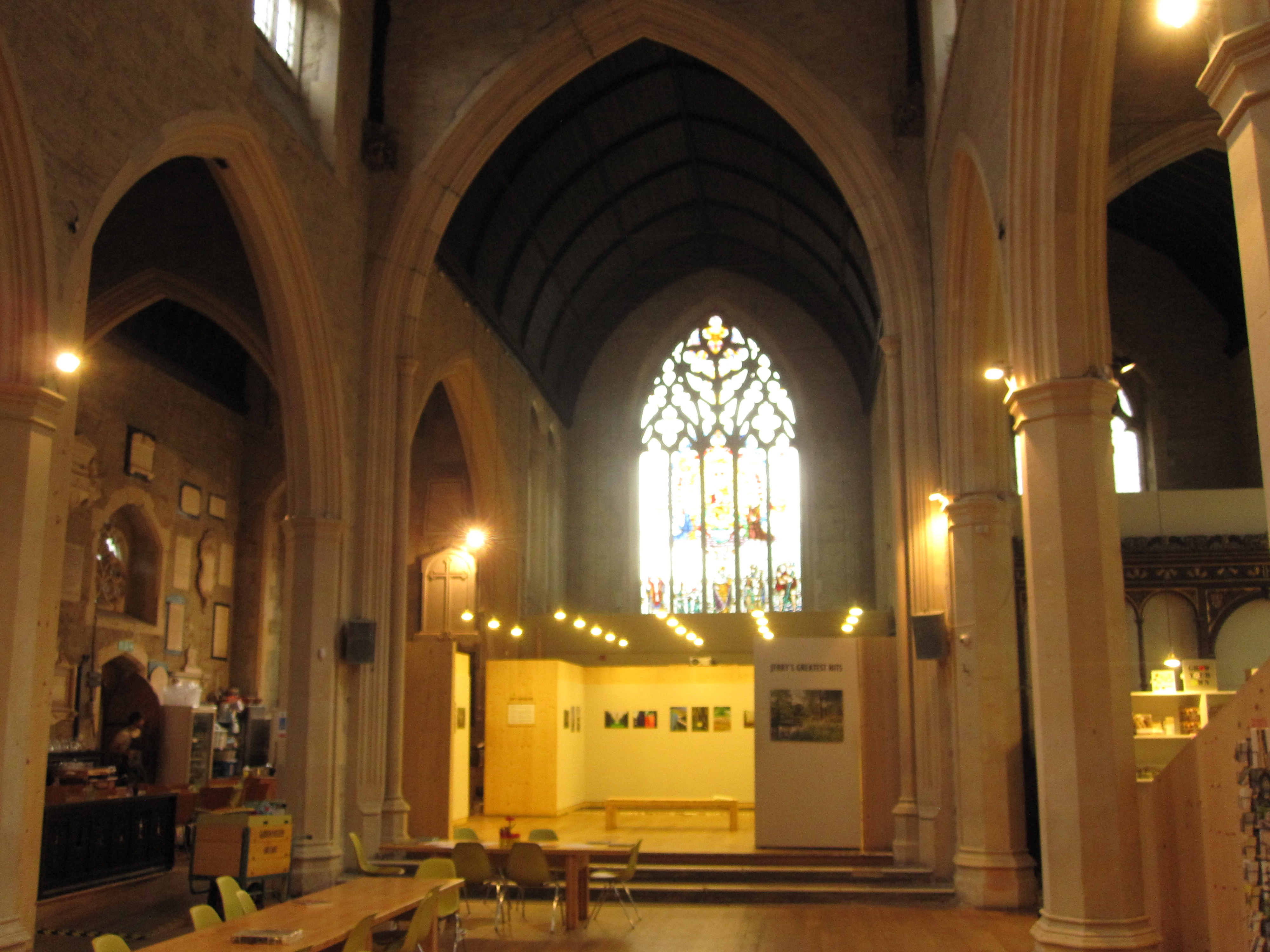
The Garden Museum is based in the deconsecrated parish church of St Mary-at-Lambeth. Photo by Mike Glaeser.


Before it was the Garden Museum, the building on Lambeth Road where Elizabeth Boleyn was buried was the Church of St. Mary’s. The church was abandoned in the 1970s, and sponsors moved forward to transform it into a museum. One person who was buried beneath its floor was John Tradescant, a famous gardener of the early 17th century. Before Tradescant lived and died, the church was the chosen resting place for some of the Howards.  It was very near to the family’s manor house of Lambeth. A memorial plaque, now lost, honored Thomas Howard and his wife, Agnes, Elizabeth’s parents. At least one of her sisters rested beside her.


Even more significantly, Elizabeth did not die at Hever, her husband at her side.  Seriously ill, she left Kent and traveled to London. Elizabeth Boleyn spent her final days in the home of Hugh Farringdon, the abbot of Reading, near Baynard’s Castle, not far from Lambeth.


Who was the abbot of Reading? Born Hugh Cook, he was a Cluniac monk who took the name of Farringdon and became abbot in 1520. Reading was one of the wealthiest abbeys in England. King Henry was the abbot’s guest in January 1521, and Farringdon later became a royal chaplain. The abbot took the king’s side during the Great Divorce, signing the Articles of Faith that acknowledged the supremacy of Henry VIII over the pope. In 1532, the king gave the abbot a New Year’s gift of twenty pounds.


Reading Abbey


It seems probable that Abbot Farringdon was known to Queen Anne Boleyn, and thus to her mother. Perhaps some sort of friendship sprang up between them and, for whatever reason, Elizabeth Boleyn turned to him when she was dying.


Certainly the other members of the Boleyn family would not have turned to a monk in their final days. Anne Boleyn, her brother and her father were all fervent supporters of church reform. The tenets of such reform were a direct connection to God in faith, without the intercession of priests, monks, and abbots. But did Elizabeth in her heart agree with this? It is possible that she did not find comfort in the church that her onetime son-in-law had created.


There is a final chapter in the life of Abbot Farringdon, and not a pretty one. Although he had conformed to the king’s will for years—unlike other monks and abbots and friars who chose martyrdom—in 1539, just after his abbey had closed, he was charged with high treason. The abbot was accused of giving money to the rebels of the Pilgrimage of Grace. This rebellion took place in 1536 and 1537, and it is inexplicable why no steps were taken against him for so long a period afterward.


Abbot Farringdon was entitled to be tried by Parliament but his death sentence was passed before trial began, by order of Thomas Cromwell. On November 14, 1539, Hugh Cook Farringdon was hanged, drawn and quartered before the gatehouse of his own abbey.

So ended the life of Elizabeth Boleyn’s friend, yet another victim in the brutal and capricious reign of Henry VIII.


------------------------------------------------------------------

Nancy Bilyeau is the author of 'Dreamland' and 'The Ghost of Madison Avenue,' set in Gilded Age New York. She is also the author of a trilogy of novels set during the reign of Henry VIII: 'The Crown,' 'The Chalice' and 'The Tapestry,' published by Simon & Schuster in North America, Orion in the United Kingdom, and seven foreign countries. 

Her novel 'The Blue' is a thriller set in the 18th century world of art and porcelain.