Saturday, June 25, 2016

'The Tapestry' a Finalist for Daphne du Maurier Award

I'm extremely proud to share the news that The Tapestry is a finalist for the 2016 award for Best Historical Romantic Suspense from the Romance Writers of America.

Daphne du Maurier was an influence on my writing from the very beginning, and I look on this as a tremendous honor.


The news on who won the award will be released in July!

Friday, June 3, 2016

Was the Duke of Buckingham Guilty?

By Nancy Bilyeau


Edward Stafford


On May 17, 1521, Edward Stafford, 43, third duke of Buckingham, was beheaded on Tower Hill outside the Tower of London, found guilty of high treason against Henry VIII.


In Shakespeare’s Henry VIII, the king said of Buckingham, “He hath into monstrous habits put the graces that were once his, and is become as black as if besmear’d in hell.”  In the miniseries The Tudors Buckingham actively plots against the king, seeking to replace him, and goes to his execution wailing in terror.

What was the actual evidence against him at trial? Separating fact from fiction, did Buckingham plot against the king? The answer: there was no proof of any plot, no actions taken against Henry VIII. But Edward Stafford was guilty nonetheless — of being too noble, too rich and too arrogant to survive in the increasingly paranoid court of Henry VIII, his cousin once removed.

Buckingham’s entire life was marked with loss and suspicion.

When he was five years old, his father, the second duke, was executed by Richard III. His father allied with Richard to seize Richard's nephew on the road to London, and the duke of Buckingham is considered a key suspect in the murders of the princes in the Tower. For whatever reason, he suddenly turned against the king, and was actively trying to overthrow him when arrested. His heir, young Edward Stafford, was hidden from Richard III in relatives’ homes, not to emerge until  Henry VII defeated the last Yorkist king at Bosworth.

Edward became a royal ward of the Tudor family, knighted at the age of seven. His closest blood tie came through the Woodville family. His mother, Catherine, was the sister of Elizabeth, wife of Edward IV and mother of Elizabeth of York. Edward Stafford was from a strong Lancaster family that recently married into the York dynasty. It should have made him a special favorite.

But as Edward grew into a proud, preening adolescent, Henry VII cooled toward him, fearing that he outshone the heir to the throne, the future Henry VIII. 

The Tudors saw the Staffords as a threat. 

The family's history was turbulent from the start. In 1347, Ralph de Stafford, a supporter of Edward III and a founding member of the Order of the Garter, built Stafford Castle. Ralph was a tough, ambitious and ruthless soldier. After his first wife died, he abducted a wealthy young heiress and married her, ignoring the outrage of her parents. When the girl's family turned to Edward III for justice, he refused to order Stafford to give up his bride. Instead, he gave the parents more titles to shut them up. 

One of the descendants of this union married a descendant of Edward III's youngest son, Thomas of Woodstock. The Staffords now had a royal stake. Humphrey Stafford, the first Duke of Buckingham, was a passionate loyalist to Henry VI and a leading Lancastrian aristocrat and commander of armies. He was known for saying such things as, "The earl of Warwick shall not come to the king's presence, and if he comes, he shall die." He died at the Battle of Northampton in 1460, defending the king's honor.

It was a fiery family legacy for Edward Stafford.

Henry VIII succeeded to the throne in 1509, unchallenged by his older cousin. In fact, the duke was lord high steward for the coronation and carried the crown. But Stafford was noticed. A foreign ambassador wrote admiringly of “my lord of Buckingham, a noble man and would be a royal ruler."

Over the next ten years he was pushed out of the center of power more and more--if he had ever occupied it, which is doubtful. As friends, Henry VIII much preferred lower-born, jovial men of the joust yard like Charles Brandon and William Compton. And the man who ran the entire kingdom was Cardinal Thomas Wolsey. There was no place for Buckingham.

In response, Edward Stafford married a noblewoman of the Percy family, fathered four children (and several illegitimate children), and withdrew to his estates, where he was the unquestioned man in charge. The family seat was Stafford Castle, but he wanted something more modern and spectacular. He began construction of Thornbury Castle. Did its beauty draw the hostility of Henry VIII, himself a fanatical builder?

Thornbury Castle

What more likely changed the cousins’ relationship was Henry VIII's lack of a male heir. 

Catherine of Aragon's last pregnancy was in 1518. They had a daughter, Mary. But the Tudor dynasty was a new one , and Henry VIII and Cardinal Wolsey weren’t sure that the nobility would accept a female ruler when Henry died. Might they not look to the duke of Buckingham or one of his sons, instead? (Henry VIII's decision to annul his marriage and try to father a son with a new wife was years in the future. Anne Boleyn was still in France.)

On April 8, 1521, the duke was ordered to London from Thornbury. He set out for the court, seemingly unaware of any danger, and was greatly shocked when arrested along the way and taken to the Tower.

 At his trial, he was charged with “imagining and compassing the death of the king,” through seeking out prophecy from a monk named Nicholas Hopkins about the chances of the king having a male heir. Evidence was supposedly obtained from disgruntled former members of the duke’s household.

This was a controversial charge. In 1397 a statute was introduced making it treason to imagine or "encompass the death of the king" and conviction could be based on it. But the law was repealed just a few years later because of the need for some action along with the imagining to make it treason. At Buckingham's trial, certain lords asked the chief justice if a person could be convicted "on the basis of words alone." They were told that it was not a felony without an action taken, but nonetheless,  "if one intends the death of the King, it is treason." The message was clear.

Buckingham denied all charges, including seeking prophecy. His friends said those who testified against the duke were bribed or threatened. But a jury of 17 peers found him guilty, led by the duke of Norfolk, who condemned him — while weeping.

Edward Stafford died with dignity on Tower Hill, and was buried in the Church of the Austin Friars. One chronicler said Buckingham’s death was “universally lamented by all London.”


Parliament passed a bill of attainder, and the duke’s enormous wealth — his castles and holdings and titles — passed to the crown. Henry VIII took Thornbury for himself; he stayed there for more than a week  in 1535 with Anne Boleyn. Buckingham's London residence was given to Henry Courtenay, marchioness of Exeter. 

The illustrious Stafford clan never rose to prominence again. They were the first noble family to be crushed by Henry VIII … but definitely not the last. Those who say that Henry VIII changed from a good man into a tyrant in the 1530s, particularly 1536, should take a long look at the death of Buckingham.


---------------------------------------------------------------------------------------------------

Joanna Stafford, a Dominican novice, is the protagonist of The Crown, The Chalice and The Tapestry, set in Tudor England and published in nine countries. The Crown was an Oprah pick for 2012 and was shortlisted for the Crime Writers' Association's Ellis Peters Historical Dagger Award.


For the month of June, The Crown is discounted 70 perecent on amazon and Barnes & Noble. Go here.

The third book in the trilogy, The Tapestry, is a finalist for the RWA Daphne du Maurier award for Best Historical Romantic Suspense.


E-Book Price Slashed 70 Percent on THE CROWN

My publisher is discounting the price of the first novel in my series, THE CROWN. The ebook is available at Amazon and Barnes & Noble for $3.99.

THE CROWN was shortlisted for the Ellis Peters Historical Dagger award from the Crime Writers' Association. It was an Oprah pick in 2012.


The review said: "Bilyeau deftly weaves extensive historical detail throughout, but the real draw of this suspenseful novel is its juicy blend of lust, murder, conspiracy and betrayal."


To order, go here.

Tuesday, May 31, 2016

Interview with Janet Wertman on Jane Seymour

By Nancy Bilyeau


Janet Wertman brings the third wife of Henry VIII to life in her new novel, Jane the Quene. It's a thoughtful depiction of Jane Seymour and a moving story of her romance with the king and tragically brief married life. Admirers of Anne Boleyn have sometimes expressed bafflement over how the pale young woman who nobody wanted to marry could capture the love of King Henry VIII when he was still married to one of the most exciting and charismatic women in English history. This novel, without sugarcoating, gives readers a compelling story.

Janet Wertman, a fellow history lover, kindly took time to give an interview on her wonderful novel.


Janet Wertman


What drew you to the Tudor period and to the Seymour family in particular?


I fell in love with the period when I was eight years old and my parents let me stay up late to watch The Six Wives of Henry VIII and Elizabeth R. From then on I was hooked – I tore through every book on the Tudors I could find, fiction and non-fiction, I read all of Wyatt’s poetry, anything about the era. Throughout it all, I have to say that those two series still to me seem to have come extraordinarily close to absolute accuracy – Keith Michell and Glenda Jackson really captured both monarchs from youth to old age, and the other characters were like portraits come to life!

Was Jane Seymour always your favorite of the wives?

I was Team Anne for decades – but the book I wanted to write (her secret diary found and read by Elizabeth) had already been written, so I needed something else. Jane was a convenient stand-in (in art as in life, it seems!) but I came to really appreciate her experience and story.  Now she is certainly my favorite, and the whole Seymour saga (pun intended!) captivates me.

You depict Jane as desperate to marry and resentful of her siblings. How did you come to this conclusion on her character?


It was actually a confluence of facts – the fact that marriage was seen as a woman’s duty; the fact that most women in the Tudor age were married by 17 while Jane was still single at 27 (and without real prospects); the fact that she had seen two younger sisters marry before her; the fact that Chapuys described her as a “woman of little beauty;” and the fact (well, rumors) that Edward was an authoritarian cold fish and her father was a narcissistic lunatic. From there, it wasn’t much of a stretch to believe that Jane was generally undervalued, even by her own family (especially by her own family) and desperate to escape.

One of my favorite aspects of your Queen Jane is her skill at household managing, her "homemaker" abilities. How much of a factor was that in Henry's choosing her?

I believe Henry’s attraction began when the court visited Wolf Hall, and that made me think that Jane’s household management skills were a big factor – not because Henry would have been looking for that specifically, but rather because it was something that Jane was good at and knew she was good at. There is something character-building and confidence-inducing about talent, even if you’re insecure in other ways, and that would have influenced how Henry saw her.

I also believe that this skill meshed with Henry’s interests – he was fascinated by cures and plants (in later years, he was known to grind pearls to mix his own salves). That was also part of their building a real bond.

Finally, it was yet another way in which Jane was the total opposite of Anne Boleyn…

You make a case for Henry VIII becoming attracted to her and valuing her. How do you think she felt deep down about her husband?


He was her savior, I think she adored him. And why wouldn’t she? He was still the “handsomest prince in Christendom,” courtly, witty. You want to talk about Prince Charming, this was King Charming!

That said, I could imagine some fear deep down and well-hidden…especially after he threatened her for pleading for the Pilgrimage of Grace rebels (though interceding for mercy was fully part of the medieval model of queenship). Even so I think she saw him as fundamentally good – she let Cromwell see him as fundamentally evil.

Jane is glad that Anne Boleyn miscarried and she marries the king days after Anne's death. Those are difficult things to handle in a protagonist. Did you struggle with it?

You hit on the central issue of the book – how Jane could have done the things she did. So much of that explanation resides in the mores of the time, and I really tried to show them so that readers could understand and even support Jane through her choices.

First and most important, I absolutely believe that Jane saw herself as an instrument of divine justice and let herself be swept along the path by the symmetry inherent in her situation. Jane was Anne’s opposite, not only on the physical and temperamental levels but in her actions as well. Anne had led England away from the papal fold and Jane hoped to return it to orthodoxy (using the same playbook that Anne herself had written). Anne had tried to hurt Mary, Jane would save her. It was hard not to be a little smug when Anne was universally hated within and outside England and Jane was viewed as a savior by just about everyone.

Even so, marrying Henry right after Anne’s execution was hard to justify. I think Jane probably initially believed the charges to be true – though they didn’t have to be, since anyone who displeased the King was de facto guilty of treason and could and would be executed on that basis alone. By the time her doubts emerged, Jane would have been too worried that the King would be seduced by any one of the other women of the court who were going out feasting with him on his barge every night while Anne was in the Tower.   Even the French Ambassador was trying to push a bride on Henry (he formally offered him the hand of the Princess Madeline the day after Anne’s execution). Henry was the King, he would take a new wife, and nothing else mattered.

Do you think Jane deserves to be Henry's favorite wife, as he seems to have wanted the world to believe?


I honestly don’t believe that Henry would have looked for a fourth wife (or fifth, or sixth) if Jane had lived. He had his contingency plans in place after all (the Act of Succession gave him the right to select his heir if Jane had no sons). Oh, he would have had mistresses, but I don’t think he would have sunk so deeply into madness.

That said, the dynastic aspect to his favoritism overshadows everything. Of course Jane was his favorite wife - she gave him a son. Henry VIII was haunted by the need to fulfill his kingly duty: to give the country a successor to avoid the dynastic wars that would inevitably follow if he didn’t. Jane Seymour was the only one who came through for him. 

----------------------------------------------------------------------

For more information on Janet and her book Jane the Quene, go to her excellent website, where she blogs on Tudor history.

Order Jane the Quene here.

Wednesday, April 20, 2016

The Nun Who Threatened Henry VIII

By Nancy Bilyeau


The journey that Henry VIII made with Anne Boleyn to Calais in the autumn of 1532 is well known. This was when Henry presented his beloved Anne, newly elevated as Marquess of Pembroke, to the king of France, when the couple may have begun to sleep together, when by all accounts he was most deeply in love with her.


Yet just before leaving England, King Henry had a distinctly unromantic encounter with another woman. He met face-to-face with a female who was roughly Anne Boleyn’s age but was not a courtier’s daughter possessing style and Continental polish. Elizabeth Barton, humbly born, was a Benedictine nun of the Priory of St. Sepulchre, in Canterbury.


Sister Elizabeth was, like many people, loyal to the king’s estranged wife, Queen Catherine of Aragon, and did not want him to marry Anne Boleyn. But unlike the vast majority of English men and women, she was determined to do something about it.


According to a statement taken later, Sister Barton told Henry VIII “she had knowledge by revelation from God that God was highly displeased with our said Sovereign Lord…and in case he desisted not from his proceedings in the said divorce and separation but pursued the same and married again, that then within one month after such marriage he should no longer be king of this realm, and in the reputation of Almighty God should not be king one day nor one hour, and that he should die a villain’s death…”


Henry VIII’s response to Sister Elizabeth’s threat in 1532 is unknown. But less than two years later, she would be dead, the only nun executed in the reign of the king. She had no trial. The methods that the king and his ministers used to persecute and condemn her for treason set the pattern to be used on others that Henry VIII wanted to destroy. She was the first of the retaliation deaths.


Anne Boleyn

Although she presented a serious obstacle to Henry VIII’s marriage to Anne Boleyn, and was later used as an instrument to bring down the highest-ranking of the king’s critics, Cardinal John Fisher, Sister Elizabeth Barton does not appear in hardly any historical fiction (or TV series or films) taking place in the 1530s except for Wolf Hall in which she is mocked as an attention seeker. She is described dismissively in most works of nonfiction. Tudor historian Geoffrey Elton called her “that deluded prophetess” and, more recently, Geoffrey Moorhouse described her as “the somewhat deranged and visionary serving maid.”


What has undoubtedly diminished the legacy of Sister Elizabeth is the Tudor government’s propaganda machine. A long manuscript was written by Barton’s confessor; a printed tract of her life widely circulated throughout England; an illuminated letter was produced by a monk – all of these documents were destroyed. We cannot read them today. The accepted chroniclers of the 16th century, all of them Protestant, are our sources of her life story, along with a few references made by foreign ambassadors. It is hard to glimpse a view of the human being through the distortions.


Sister Elizabeth’s saga bears some resemblance to Joan of Arc’s, a century earlier. Joan was a peasant who experienced visions. Elizabeth was a servant who fell seriously ill in 1525, lost consciousness, and when she came to, made references to the health of a boy also ill whose fate she could not have had knowledge of. She shared visions that called for veneration of God. Word spread, and those living in Kent began to make pilgrimages. She is supposed to have proclaimed prophecies and performed miracles but we don’t know the details. “She told plainly of divers things done at the church and other places where she was not present, which nevertheless she seemed most likely to behold as if it were with her own eye.”

Church authorities interviewed Elizabeth early on and proclaimed her a genuine mystic. They were not eager to anoint seers; quite the opposite. She was examined rigorously by a series of priests, monks and bishops, all of them on the outlook for “trickery.” The Archbishop of Canterbury William Warham personally saw her and said her visions were genuine. In a letter he described her as a “well -disposed and virtuous woman.” Elizabeth entered the nunnery of St. Sepulchre to be either protected or controlled, depending on how you look at it. “The Holy Maid of Kent” made appearances at a church in Canterbury, and at one point up to 2,000 people jostled to surround her.


What is beyond question is that Elizabeth Barton had some sort of chronic illness for the rest of her life, whether it was physical, neurological or psychiatric. Her visions often came to her while she appeared to be suffering painful fits, writhing on the floor, or in a trance.


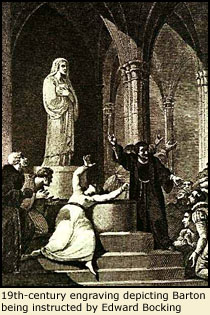
Much later, the next archbishop of Canterbury, Thomas Cranmer, known for his skepticism and dislike of superstition, wrote this eyewitness account of Elizabeth’s fit: “Then there was a voice heard speaking within her belly, as if it had been in a tun, her lips not greatly moving, she all that while continuing in a trance. The which voice, when it told everything of the joys of heaven, it spake so sweetly and heavenly that every man was ravished with the hearing thereof. And contrary, when it told anything of hell, it spake so horribly and terribly that it put the hearers in great fear.” In our modern minds, these bizarre breakdowns in health would hurt her credibility. But in the medieval era, holy women were often traumatically ill at the time of experiencing visions.


Elizabeth Barton became famous before Henry VIII launched his famous quest for a divorce from Catherine of Aragon. She already had enemies, though. Elizabeth called for obedience to pious works and traditional worship, tenets that were under attack in a Germany transformed by Martin Luther. All of Europe was in turmoil over the spreading religious reform. 


Henry VIII derided Luther in writing and was rewarded by the pope’s proclaiming him “Defender of the Faith.” What’s hard for us to grasp is that, before 1527, it was unthinkable to the world that the king of England would discard his longtime queen or that he would break with Rome. He was an orthodox ruler, an obedient son of the church. Reformer and scholar William Tyndale, living in exile, called Elizabeth a “false, dissembling harlot.” (Protestant opponents often accused Barton of sexual misconduct, without any foundation whatsoever.) Since Henry VIII opposed, hunted down, persecuted and finally killed Tyndale--who died in the flames crying, “Lord, open the king of England’s eyes”—Henry Tudor and Sister Elizabeth Barton were on the same side.
Until they weren’t.


The "Holy Maid” did not publicly prophesy against the king. She repeatedly tried to warn him against his course of action, first to his ministers and finally to him in person. In 1528, Barton told Cardinal Wolsey that God commanded her to tell him that if he furthered the king’s marriage to Anne Boleyn he would be “utterly destroyed.” (Wolsey was disgraced after he failed to get the king his divorce and died on way to trial.) John Fisher, the churchman who supported Catherine of Aragon, wept with joy when he heard Sister Elizabeth’s visions. Sir Thomas More was more cautious, telling her that her words were “reckless.” Catherine of Aragon herself was careful to never meet or corresponded with Elizabeth, her champion. The embattled queen could see the danger that Elizabeth and her many followers seemed oblivious to.


"The Maid of Kent"

Although he knew of her activities, Henry VIII did not move against the nun for a long time. During one stage he tried to pacify her, even to bribe her. He offered to make her an abbess of her own priory. She refused the offer.


Elizabeth’s fame and influence continued to grow. She met with foreign ambassadors and the papal representative in England. She wrote letters to the pope, urging him to stop the king from divorcing. She had secret meetings with English nobility, including Gertrude Courtenay, the marchioness of Exeter, wife to the king’s first cousin. Collections of Sister Elizabeth’s prophecies were printed and widely circulated.


Barton herself said that she prevented Henry VIII from marrying Anne Boleyn in Calais, as he was rumored to be planning to do. When they did marry, it was in great secret.


It was widely known that Sister Elizabeth predicted if Henry VIII wed Anne, he would soon lose his kingdom and die. After several months had passed and he was very much alive, the king moved against her. Barton and her most devoted followers were arrested and harshly questioned in late 1533. There is no proof of torture, although another woman, Anne Askew, would be racked nearly to death for her religious “crimes” a decade later.


Whatever the means of persuasion, Elizabeth Barton supposedly told her captors what they wanted to hear. She recanted her visions and said, Cranmer wrote, “all was feigned of her own imagination, only to satisfy the minds of them which resorted unto her, and to obtain worldly praise.” This did not save her. Henry VIII directed Parliament to pass a special act condemning her for treason without a hearing. The punishment was death.


Elizabeth Barton, around 30 years of age, was hanged and then beheaded on April 20, 1534, her head fixed on Tower Bridge, the only woman known to be so displayed after death. The head of Cardinal Fisher was later mounted as a warning to others when he was executed for treason, in part because he was charged with conspiring with Elizabeth Barton. Five men were executed with her the same day, all of them priests, monks or parsons who had believed in her prophecies.


This same spring of 1534 was when Henry VIII demanded that the church and the people follow him into schism with Rome. The terms of the Act of Succession were proclaimed everywhere. People were warned that if they said or wrote anything against the king’s marriage to Anne Boleyn or his lawful heirs by her, they would be guilty of treason, punishable by death.


All the records of Sister Elizabeth’s confession come from the crown. In 1536, Queen Anne Boleyn would also be turned into a nonperson after execution: letters, documents, portraits destroyed. Because her daughter grew up to be a great queen, Anne’s reputation was restored. This never happened with Elizabeth Barton. She is usually dismissed as a tool of religious plotters, or mentally ill. The possibility that this was a young woman who felt compelled to have a say in the affairs of the kingdom, and possessed the courage to try to interfere, is rarely acknowledged.


-----------------------------------------------------------------------

Nancy Bilyeau is the author of the Tudor mystery trilogy The Crown, The Chalice and The Tapestry, on sale in North America, the United Kingdom, German, Spain, and Russia. The main character is Sister Joanna Stafford, a Dominican novice.

Monday, April 11, 2016

Twitter Contest to Win My Trilogy

I'm delighted to share that my publisher, Touchstone, is running a contest for my entire trilogy in paperback. If you retweet, you are entered. :)

The link is here.


Good luck!


Nancy

note: as of April 18, the contest is over

Sunday, April 10, 2016

Henry VII and the Danger of Prophecy

By Nancy Bilyeau

The Yorkists were a hard-headed lot, basing their right to rule on bloodline. When their last king, Richard Plantagenet, was slain at the Battle of Bosworth on August 22, 1485, his devastated Yorkist supporters--as well as the rest of the country--waited to hear what claim to the throne the victor, Henry Tudor, earl of Richmond, would put forth.

It was a delicate question.


Henry VII
Tudor was the leader of the Lancastrian house, but strictly by default. Stronger claimants had been mown down a while ago. Yes, he'd won the crown in battle but there were laws in England. To hold the crown, he'd have to convince everyone he was the legitimate king. Tudor's father, Edmund, had not a drop of English royal blood; he was the son of French Queen Dowager Katherine of Valois and her Welsh servant, Owen Tudor. (And so half-brother to the last Lancaster king, Henry VI.) Through his mother, Margaret Beaufort, Henry Tudor had a stronger claim, as she was in direct descent from Edward III, but the Beauforts were barred from the succession.

We can imagine there was a certain level of suspense as the country waited. Most assumed that the newly declared Henry VII would swiftly marry Elizabeth of York, oldest living child of the dead Edward IV, and attach his weak claim to her greater one. But he did not marry her right away--it was important to him to claim the right to rule on his own.

When he invaded England with French-financed troops, Tudor had marched through his family stronghold of Wales, gaining support and men, under the banner of the red dragon: the battle standard of King Arthur and other Celtic leaders. Now it was announced that Henry Tudor was descended from Arthur himself through Cadwaladr and the Welsh chieftains who were ancestors of Owen Tudor. Genealogists had confirmed this, the skeptical court was informed. Henry's ascension was the fulfillment of prophecy.

Despite such grandiose claims, Henry married Elizabeth of York. But he did not drop the Arthur business. Far from it: He insisted that his first child be born in Winchester, sometimes identified as Camelot in legend. And when that baby boy was born, he was named...Arthur.


Le Morte D'Arthur
What could not be accidental is that in 1485 something else happened in England besides Bosworth. The first printing of Le Morte d'Arthur appeared, a compilation of tales by Sir Thomas Malory of Arthur and Guinevere, Launcelot, Mordred, and the magician Merlin. The tales were so popular, they were reprinted.
Henry VII would not be the first ruler to seize on the romance of Camelot to bolster his regime.  But the direct connection of his legal claim to rule England to a work of mythic entertainment is bold indeed. It was as if, in 1977, the year  "Star Wars" hit theaters, a president appeared who announced himself descended from Luke Skywalker.

But there was a darker element to this claim to Camelot. In legitimizing a mystical prophecy, Henry VII was unleashing a certain kind of power that would reach across the entire 16th century and into the 17th, bedeviling his great-great-grandson. Rebels against various Tudor regimes would repeatedly use their own prophecies to rally support. They effectively co-opted Henry VII's modus operandi, down to the symbolic banners. A frustrated Henry VIII sought to ban prophecy from his kingdom after he was nearly engulfed by seers, witches, and necromancers spouting predictions, many of them derived, allegedly, from Merlin and yet coded and obscure, open to many interpretations. The prophecy whispered in the 1530s was "When the cow doth ride the bull, Then, priest, beware of thy skull." To those obsessed with wizards' predictions, this "ancient" bit of wisdom foretold the rise of Anne Boleyn ("the cow"), whose domination of Henry VIII ("the bull") spelled doom for the Catholic priests.

The Pilgrimage of Grace, and its many banners
"The craving to gaze into the future arises naturally in times of great danger and distress," said Madeleine Hope Dodds in the paper "Political Prophecies in the Reign of Henry VIII." It would be hard to imagine more distress caused than the Reformation and Dissolution of the Monasteries. Some of the rebels who rose up in the Pilgrimage of Grace spouted the "wisdom" of Merlin to lead them. Henry VIII was certain it played a part in the rebellion. In the same letter in which he ordered the Duke of Norfolk "you must cause such dreadful execution upon a good number of inhabitants, hanging them on trees, quartering them, and setting their heads and quarters in every town, as shall be a fearful warning," he commanded the duke "send to us the Witch of York."

Again and again, strange prophecies emerged in times of political distress in the Tudor era. After a young nobleman named Anthony Babington was arrested for a treasonous conspiracy to murder Elizabeth I and replace her with Mary Queen of Scots, a book of Merlin prophecies was found in Babington's London home.


John Dee and Edward Kelley
More than any other Tudor ruler since Henry VII, Elizabeth tried to harness prophecy, to understand it through her consultations with Dr. John Dee and his colleague, the bizarre necromancer Edward Kelley. She is the hard-headed queen, the ruler who said she had no desire for a "window into men's souls." However, she picked her coronation date based on what Dr. Dee told her to do.

It is with James VI that the brew of prophecy and the occult overflows. James was a Stuart king of Scotland, but part Tudor too, descended through both his parents--Mary Queen of Scots and Henry, Lord Darnley--from Margaret Tudor, the oldest daughter of Henry VII. 

Scotland was already a place uneasy with such fears before James VI was born. The Act of 1563 forbade anyone to use witchcraft, sorcery or necromancy or to claim any of its powers, the penalty for both witch and client being death.


James VI overseeing witch trials

As a young man, James VI became convinced that witches were trying to kill him, specifically creating storms to drown him and his bride, Anne of Denmark, as he tried to bring her to Scotland. Afterward he oversaw witch trials, ordering torture of suspects, that led to a flurry of executions. In 1597 James personally wrote an 80-page book called Daemonologie expounding on his views on the dangers of sorcery and magic. Shakespeare drew from it when writing Macbeth, considered by many a tribute to King James, with its three witches spouting eerie prophecy that would change men's destinies.


The witches in 2015 film of  Macbeth

In the speeches of the witches of Macbeth, the ideas of both King James VI and Henry VII can be seen. One witch is angry at the wife of a sailor and her friend says, "I'll give thee a wind." But the most damage they do is telling Macbeth his future: All hail, Macbeth, thou shalt be king hereafter!

His entire life, James VI was tormented by fears of a violent death. He waited for "something wicked this way comes." In the end he died in his bed, the king of England and Scotland. But fears of prophecy and of witchcraft, which he'd done so much to whip into a frenzy, did not die with him; instead, the frenzy led to the deaths of more English victims, and traveled to America with the Puritan settlers, before finally loosening their hold.

-------------------------------------------------------------


Nancy Bilyeau is the author of the historical mystery trilogy The Crown, The Chalice, and The Tapestry, set in Tudor England and published in nine countries. The Crown was an Oprah pick for 2012 and was shortlisted for the Crime Writers' Association's Ellis Peters Historical Dagger Award.


For the month of June, The Crown is discounted 70 perecent on amazon and Barnes & Noble. Go here.

Anne of Cleves is a character in The Chalice and the third book in the trilogy, The Tapestry, which was published by Simon & Schuster in March 2015. The Tapestry is a finalist for the RWA Daphne du Maurier award for Best Historical Romantic Suspense.