Saturday, February 13, 2016

Celebrating the Trilogy's Publication in Spain

I was ecstatic when, after years of effort, a Spanish publisher was found for my Joanna Stafford novels.  My main character is half-Spanish, after all. :) It sets her apart in Tudor England, makes her special. Joanna's mother, a Castile-born maid of honor who came to England with Catherine of Aragon, appears in The Crown. And in The Tapestry, the Holy Roman Emperor himself, Charles V, ruler of Spain, enters the plot, along with a few of his Inquisitors.

The publisher, Siruela, is an excellent one. Their chosen title is El Caliz, which is close to the English of "the cup." The catalog page is here.

I'm always intrigued by the covers designed in other countries. This one is, I think, quite interesting.


The Spanish edition of The Chalice, now on sale.

Thursday, January 14, 2016

Nicholas Carew: The Fatal Friendship of Henry VIII


Those who study the Tudor era are often astounded by how Henry VIII could spurn, exile or kill his wives, sometimes without much evidence of a conscience. But it was just as dangerous to be the king's friend.


Sir Nicholas Carew was placed in the household of Prince Henry at age six. They were close friends for almost forty years, sharing a passion for jousting. Carew was knighted by 1517, made a Knight of the Garter, and held the important post of Master of Horse. He was a member of the Privy Council and served as a trusted diplomat. His beautiful wife, Elizabeth, was rumored to be the king's mistress before Nicholas married her. Henry VIII had given her some jewelry, including diamonds and pearls.

Although related to Anne Boleyn, Nicholas Carew worked with Thomas Cromwell to turn the king against Anne and replace her with Jane Seymour in 1536. It's unclear if he was motivated by personal dislike of Anne or sympathy for Katherine of Aragon and Princess Mary. Eric Ives, Anne Boleyn's biographer, describes Carew as "one of her most bitter enemies." But whatever motivated him, he was a key member of the "Aragonese" faction. They would all of them deeply regret forming this alliance with Cromwell.  In the next few years he dedicated himself to their annhilation.

 In 1538 several of the king's relatives on his mother's Yorkist side were accused of plotting against the king. The evidence was very weak; nonetheless, Henry Courtenay, marquis of Exeter, and Henry Pole, Lord Montagu, were arrested and executed. (Pole's mother, the countess of Salisbury, was beheaded in 1541. His young son disappeared in the Tower, never to be seen again. Courtenay's son, Edward, was imprisoned until the reign of Queen Mary.)

Carew was disturbed by the arrests in the "Exeter Conspiracy" and the methods Cromwell used to destroy these men he'd known nearly as long as Henry VIII. He said, "I marvel greatly that the indictment against the lord marquis was so secretly handled and for what purpose, for the like was never seen." Around the same time Henry VIII and Carew quarreled over something, and Carew told his old friend  "an answer true rather than discreet."

On this "evidence," Carew was arrested. On Jan. 14, 1539, he was indicted, and on March 3rd he was taken to Tower Hill for execution, as had been Henry Courtenay and Henry Pole before him.

In his speech to the crowd, "he made a goodly confession, both of his folly and his superstitious faith." And with that, the king's oldest friend was killed.

--------------------------------------------------------------------------------------------------------

The Exeter Conspiracy is central to the story in my second novel, The Chalice.


Thursday, January 7, 2016

The Death of Katherine of Aragon

The first wife of Henry VIII, born a Spanish princess, married to him for more than 20 years, died this day in 1536. She was far from the court, in pain, abandoned except for those friends and servants brave enough to console her, without family by her side. The king had forbidden their daughter Mary from seeing her for years. The king himself rejoiced at her death, with his second wife, Anne Boleyn. There were many lessons in his treatment of Katherine, ones that most of his subsequent five wives chose to ignore.

She is buried at Peterborough Abbey, now Peterborough Cathedral. Her husband would not give her a queen's funeral. She was buried as the widow of his long-dead brother, Arthur Tudor.


The Peterborough Cathedral community embraces their role as the caretaker of the proud queen. This year there will be a festival throughout the month celebrating her, with services and lectures. Dr. James Foyle will give a talk on Friday January 29th on "The Forgotten Origins of the Tudor Rose." To learn more, go here.

Katherine is a character in my book The Crown, and plays a central, mentoring role in the life of my protagonist, Joanna Stafford.

A young and beautiful princess


Sunday, January 3, 2016

My Interview With Ian Rankin

I write novels.

I'm also a magazine editor and nonfiction writer. As the editor in chief of The Big Thrill, the online magazine of International Thriller Writers, I edit stories on the suspense-fiction genre and interviews, LOTS of interviews. A few of them I write myself, such as Sue Grafton in October.

This month I am proud to share my story on Ian Rankin, whose crime-fiction novels capture modern-day Scotland (they call it tartan noir!) with intricate stories. I'm struck by his complex views on morality, and during our hour-long conversation, I learned that he is someone who thinks about the reality of evil. He may not have obsessed over Thomas Aquinas' writings, as I did when writing The Crown, but man's capacity for darkness is on his mind a great deal

His new novel, Even Dogs in the Wild, "is about having to pay for past sins," he told me.

To read the interview, go here.


Monday, December 14, 2015

Was Prince Eddy Jack the Ripper?

On November 9, 1888, the body of Mary Kelly was found in her rented room off Dorset Street on London's East End by a landlord assistant sent to collect overdue rent. Mary, a young prostitute, was brutally slain--most agree, by Jack the Ripper.

The identity of this depraved murderer was never been solved, although many, many people have tried.

Along the way, some startling suspect names emerge. One is Prince Albert Victor, duke of Clarence and grandson to Queen Victoria.


Read my blog post on English Historical Fiction Authors to discover the strange baseless origin of this myth.

-----------------------------------------------------------------

Sunday, December 13, 2015

When January 1st Wasn't the First Day of the Year

By Nancy Bilyeau


In less than two weeks it will be the first day of 2019. Time to hang your freshly bought calendars and write a new year on your checks.
         But strange as it may seem, January 1st did not always signal the beginning of a new calendar year. Up to 1752, the two were separate things in England and its colonies. Until that point, people began each calendar year on March 25, which was Annunciation Day—or Lady Day. This was the day the Angel Gabriel appeared to the Virgin Mary to deliver the news that she had conceived and would give birth to Jesus in nine months.
         
        
It took an 18th century act of Parliament for England to officially begin each new calendar year on January 1st. The centuries of discrepancy cause lots of headaches for historians and genealogists. There’s no question that it’s strange, not least because England lagged behind much of the rest of Western Europe. Why did this Protestant nation cling to Annunciation Day—by its very definition a day revolving around the Virgin—as the time to change the calendar when most Catholic countries had already shifted to January 1st in the 16th century or 17th century?


         The reason for the January 1st controversy has a lot to do with England’s refusal to take orders from a pope after Henry VIII’s break from Rome in the 1530s. It was Pope Gregory XIII who replaced Julius Caesar’s calendar, devised in 45 BC, with a new one in 1582—and it’s the Gregorian calendar we all use today.  Reform was unquestionably needed. There were too many days in the year; the equinoxes were out of whack; the Julian calendar had strayed 10 days from the solar calendar.

         Among other things, the pope’s new calendar established that each calendar year begin on January 1st. Once it was issued, Italy, Spain and Portugal instantly adopted the Gregorian calendar, followed by France and the other Catholic countries of Europe. But England, Germany and the Netherlands refused. So for centuries, there were two calendars in Western Europe. It wasn't a strictly religious-led decision either. In Protestant Scotland, they changed to the Gregorian calendar in 1600. But England stubbornly refused.


         The first step to understanding this furor is to realize that Pope Gregory XIII was not simply someone who cared about calendars. Born in Bologna as Ugo Buoncompagno, he was a transitional pope. Certainly not as venal and corrupt as the Borgias a century earlier, he was a gifted teacher and administrative talent who nonetheless had an illegitimate son before marrying and really liked to spend money. 

         Once he became Gregory XIII, he spent huge sums on not only Catholic colleges but also displays such as the Gregorian Chapel in St. Peter’s. To pay for all this, he resorted to papal confiscation. Most relevant to our story, he supported the overthrow of Henry VIII’s Protestant daughter with Queen Anne Boleyn, Elizabeth I.


         Gregory’s predecessor, Pope Pius V, had already excommunicated Elizabeth and declared her a usurper in 1570. During his papal office, Gregory put intense pressure on the Spanish king, Philip II, to invade and dethrone England’s queen. Gregory personally financed an armed force of 800 men to land in Ireland to join a Catholic rebellion against Elizabeth (it fizzled). Moreover, a Jesuit led the papal commission to devise the Gregorian calendar—and the Jesuits were the religious order specifically created to fight the Protestant Reformation. This all fueled Elizabethan England’s refusal to accept anything that originated in the Vatican.

         The fierce clashes between Catholic and Protestant in the 16th century are the tumultuous background of my historical thrillers. The heroine of my novels, The Crown, The Chalice, and The Tapestry, is a novice in the Dominican Order at Dartford Priory, outside London. But it’s not just the Christian splintering in early modern Europe that fascinates me. I also love studying what came long before the Renaissance.

         One October, as Halloween approached, I researched the roots of the holiday’s celebration in Tudor England and made some discoveries. I learned that the roots of Halloween reach back to the Dark Ages Celtic festival of Samhain (“summer’s end”), when people lit bonfires and put on costumes to scare away the spirits of the unfriendly dead. All-Hallows-Even, which was shortened to “Halloween” in the 16th century, was a complex blend of Celtic and Catholic customs. After all, the holiday was the run-up to All Saints’ Day on November 1st, an occasion to venerate all the Catholic martyrs. Not surprisingly, the Protestant Reformers took a dim view of Halloween, but its popularity was so great that they were unable to stamp it out.

         My  blog post on Halloween (http://englishhistoryauthors.blogspot.com/2011/10/truth-about-halloween-and-tudor-england.html) stirred up so much attention that it made me want to keep reading about the distant and complex roots of what we celebrate today.

         I began thinking about the origins of Christmas and New Year’s Day the morning of December 20th one year, when I stood outside my apartment building with my son, waiting for his school bus to arrive. Although it was 7:15 a.m., dawn had barely broken; the Christmas lights that the superintendent had strung over the bushes glowed yellow in the purplish-gray light. A hazy fullness hung in the air—and it seemed to carry a strange potency. Almost like something magical. I had no idea as I stood there that what I sensed would connect to January 1st and the fascinating furor over when to begin the calendar year.


         I snapped a photo and posted it on my Facebook page, along with sharing a description of the strange feeling all around me. A high school friend, D.K. Carlson, offered an explanation: “The solstice is almost here.” It made me shiver to think it was the power of the winter solstice that touched me that morning: the approach of the shortest day of the year, the moment when the earth is in a point of its orbit farthest away from the sun. I find it very interesting that Julius Caesar established December 25th as the date of the winter solstice. It was—you guessed it—Pope Gregory XIII who made the adjustment to December 21st.

         Long before the time of Julius Caesar, man honored the solstice. Bronze Age archaeologists have uncovered symbols and signs that reveal awareness of the shortest day of the year. The monuments of Stonehenge and Newgrange in Ireland are believed to have solstice alignments. In 2000 BC, people may have gathered at Stonehenge in mid-December to pray for the sun to return again, the source of all life.
        

         Again and again, in many societies and religions, the solstice has great meaning. For the Druids, it was Alban Arthuan, the Light of Winter. As part of the celebration, priests cut the mistletoe that grew on winter oaks and blessed it. Germanic pagans launched the tradition of burning the Yule log and decorating a home with clippings of evergreen trees.

         In Rome, not surprisingly, the celebrations became more debauched. Saturnalia, which took place in mid-December, ran the gamut from heavy drinking to gambling to reversing society norms, with masters waiting on slaves. Lighting candles was very important. So was the tradition of children going house to house, offering small gifts, such as wrapped fruit, in exchange for other tokens.

Saturnalia was so popular that not even the Fall of Rome could kill it. It morphed into the Feast of Fools, celebrated from the Fifth Century until the Renaissance in much of Western Europe on January 1st. The servants became the masters, with a lower-echelon “Lord of Misrule” chosen to preside over all drunken festivities beginning in late December and concluding on the first of January.
  
         Not surprisingly, the early Catholic Church did not look kindly on the parties--stimulated by the winter solstice--that marked January 1st. The church leaders didn’t want something as important as beginning a new year to take place on that same day. In 567 AD, a Council of Tours decreed that the first of January was abolished and the blameless Annunciation Day was chosen. It took a while for this to be accepted, but by medieval times, people in England looked on March 25th as the beginning of the year. And this tradition stuck through the Plantagenets, the Tudors, the Stuarts, and into the time of the Hanoverians.


         Until finally, in 1751, in the reign of George II, England—and its colonies in the Americas—gave in and made the change, moving from the Julian Calendar to the Gregorian. Parliament passed An Act for Regulating the Commencement of the Year; and for Correcting the Calendar now in Use. To make this work, 16 days were dropped from 1751, and January 1, 1752 was officially deemed the beginning of the year.

----------------------------------------------------------------------------------

 Nancy Bilyeau is the author of the new bestselling historical thriller The Blue, a spy story set in the art and porcelain worlds of the 18th century.

Wednesday, October 28, 2015

Thetford Priory: Murdered Monks and a Desperate Duke

By Nancy Bilyeau

This post is one in a series on the monastic ruins of England, "In Lone Magnificence, a Ruin Stands" *

Thetford Priory


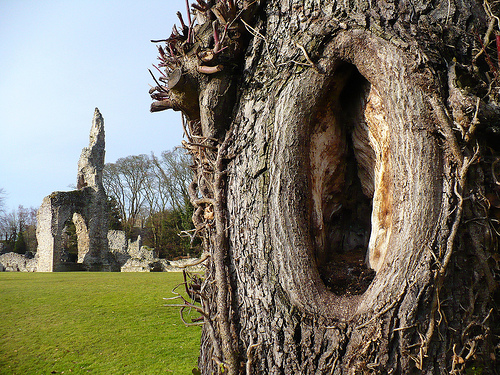
One of England's oldest ruins, Thetford's Priory of St. Mary is rich with drama. It was an East Anglian priory important to not only the Cluniac monks who lived there for 436 years but also the aristocratic family that buried their dead there. A powerful duke's struggle to protect Thetford from Henry VIII's Dissolution of the Monasteries proves just how impossible a quest that was.


The Founding: Hugh Bigod was a knight of Normandy who crossed the channel with Duke William. As one of the victors in the Battle of Hastings, Bigod reaped rewards of land and title, becoming the first Earl of Norfolk. He had at some point vowed to make a pilgrimage to the Holy Land. In his old age, Bigod was allowed to commute his vow to the founding of a monastery. By 1103, twelve monks arrived in Thetford, and Bigod and the new prior developed an ambitious plan. The buildings were arranged around a central cloister, enclosed by covered walkways. There was a church, dormitory, chapter house, prior's lodgings and barns.

But the eighth day after the stone-laying, Bigod died. What should have been a somber entombment of a noble patron turned into an angry dispute. The monks claimed the earl's body, saying that he should be buried in the priory as was specified in their foundation charter. But the Bishop of Norwich insisted that his cathedral, founded in 1096, had jurisdiction. The monks buried Bigod in the priory anyway; the bishop retaliated by stealing the body in the middle of the night and dragging it to Norwich.

It was the first time that a corpse was forcibly removed from Thetford Priory. It would not be the last.

Cluniac habit
The Order: The Order of Cluny formed in 10th Century Burgundy as an offshoot from the Benedictines. They were determined to follow a more rigid interpretation of the Rule of St. Benedict and to steer clear of political and military matters of the world. More than 30 Cluniac priories were established in England. Some became wealthy. Thetford's fortunes waxed and waned. In the early 14th century, the king had to take the priory into his protection because of its "poverty and indebtedness." Later the monks were able to run the house again with some efficiency.

The Glory: In the mid-13th century, an artisan of Thetford, suffering an illness, dreamed that the Blessed Virgian appeared and told him that he should persuade the prior to build a chapel on the north side of the church. Moved, the prior set to work on a stone Lady Chapel.

When it came time to place a statute of Mary in the chapel, the monks selected an old wooden image that had been in storage. But when they removed the statue's head to restore it, they discovered a cache of relics, including the "grave-cloths of Lazarus," along with a letter from the Church of the Holy Sepulchre in Jerusalem. Thetford became a center for pilgrimages to see the statute and relics, and pilgrims claimed many cures.

The gatehouse, best-preserved structure
But the priory witnessed violence too. The second prior, Stephen, turned Thetford into "a house of debauchery" and caroused with local knights. An enraged Welsh monk stabbed the prior to death; the monk, in turn, was arrested and spent the rest of his life in the prison of Norwich Castle.

Even more disturbing, in 1313, a riot broke out in the priory. A mob forced its way in, assaulted the prior and murdered several monks at the high altar who were trying to protect their valuables from being stolen. An inquiry in town did not reveal why such a horrific attack took place, but protection was increased for the prior and surviving monks.

The Dissolution: The Howards assumed the titles of Norfolk in 1483, when Richard III, grateful for the family's support as he seized the throne, made John Howard the 1st duke of Norfolk, in the third creation of the dukedom since the Bigods. The first duke was the commander of Richard III's vanguard at the Battle of Bosworth, and was slain alongside his king. Howard was buried in Thetford Priory.

His grandson, Thomas Howard, third duke of Norfolk, was one of the senior peers and most important councillors of Henry VIII. He was a major landholder of East Anglia, possessor of many castles and titles, a feared military commander. His first wife was a princess of the House of York; his second was the eldest daughter of the duke of Buckingham. Norfolk is today perhaps best known for being the uncle of both Queen Anne Boleyn and Queen Catherine Howard, two alluring women whom, it was said, he helped place in the king's circle.

Thomas Howard, 3rd duke of Norfolk
Norfolk held conservative religious views, but that didn't stop him from eagerly taking possession of monasteries that fell during the break from Rome and the Dissolution. The king handed out fallen abbeys and their surrounding property to courtiers to strengthen their loyalty to the crown. But as more and more priories and abbeys "surrendered," the duke began to fear for Thetford.

The priory held enormous spiritual value for the Howards. In the medieval age, a person's achievements would be honored and their soul remembered if a certain number of Masses were said. If that person were buried by his heirs with care and splendor in a place of significance, then eternal peace was ensured. The first and second Howard dukes were interred in Thetford's grand church, connecting them to the earliest holders of the Norfolk titles. In 1536, the king's illegitimate son, Henry Fitzroy, the duke of Richmond, was buried in the church, too, since he was also the son-in-law of the duke of Norfolk and the king had ordered Howard to take charge of the funeral.

 The duke of Norfolk knew Henry VIII as well as any noble could fathom the Tudor king. Howard had served his monarch with great fervor. It was Norfolk and his father who defeated the Scottish army in Flodden; more recently, the duke suppressed the Pilgrimage of Grace. Still, the king was ungrateful to those who served him, and treacherous. He was unlikely to grant the Howards favors. So in 1539, the duke formally proposed to Henry VIII that the priory be converted into a church of secular canons. This privilege has been granted to several cathedrals. If the conversion were approved, the tombs would not be disturbed. It was not all that much to ask.

Framlingham tomb of Thomas Howard, 3rd duke of Norfolk
The king agreed to Howard's plan. But in 1540, the same year Henry VIII made teenage Catherine Howard his fifth wife, which everyone assumed would make the Howard family preeminent, the king changed his mind about Thetford. It would have to be dissolved like dozens of other monastic houses--no exceptions--even though his own illegitimate son, Henry Fitzroy, was buried there. Upset, the duke of Norfolk had no choice but to remove the remains of the dead dukes and duchesses (Richmond too) and transferred them to the Suffolk Church of St. Michael in Framlingham.

When, 14 years later, Thomas Howard died, he was buried there as well.

As for the Cluniac monks of Thetford, 13 signed a deed of surrender and were ejected with pensions. The church and all other buildings of Thetford were stripped of value and began their centuries of decay.

The specters: Sightings of ghosts have been reported for years, including that of monks chanting Latin or performing acts that were somewhat more frightening. When television camera crews set up one night at the priory, though, the ghosts did not see fit to show themselves.

The preservation: Thetford is an English Heritage sight and its existing buildings--a 14th century gatehouse, many of the walls of the church and cloister, and part of the prior's lodgings--can be visited most days of the year. For more information, go to http://www.english-heritage.org.uk/daysout/properties/thetford-priory/.

-----------------------------------------

"In lone magnificence a ruin stands" is contained in The Ruins of Netley Abbey, by 18th century poet George Keate.


-------------------------------------------

Nancy Bilyeau is the author of The Crown, The Chalice and The Tapestry, mysteries set in the 16th century and featuring a Catholic novice. They are published by Simon & Schuster in North America and the United Kingdom.