Showing posts with label blog hop. Show all posts

Wednesday, September 30, 2015

What was the Life of a Medieval Nun?

By Nancy Bilyeau


Anyone who writes historical fiction acts as a time traveler. What was life like for our characters? How much an author tries to enter the mind of a person who lived centuries ago depends on the author--and the subject. When it comes to lives of long ago, their thoughts and desires and expectations, some of the people seem like us, just wearing different clothes and eating different food.

But then there are the late-medieval Dominican nuns. And they are not much like us.

While researching the history of the Dartford Priory for my trilogy of mysteries, I found myself intrigued, awed, puzzled and impressed by the nuns who lived within the cloister walls. The sole nunnery for Dominican sisters opened its doors in 1372 and was demolished by order of Henry VIII in 1538. It was one of the twenty wealthiest priories in the kingdom, with nuns whose families came from the local gentry, the aristocracy and even royalty. Edward IV and Elizabeth Woodville's youngest daughter, Bridget, lived and died at Dartford. But while the priory owned a great deal of property, to provide for both the nuns and the friars at a nearby Dominican order, the women's existences were humble.

Their lives were ruled by custom--by religious doctrine set by the Dominican Order and adhered to meticulously. The sisters took vows of poverty, chastity, charity, and obedience. Dartford was an enclosed order, meaning the women could not leave. The doors were locked from the outside every night. They had chosen to live apart from the world.

Allow me to share just a few other aspects of what would have been expected of Sister Joanna, the protagonist of my series of historical mysteries.

They prayed more than you could possibly imagine  

The Dominican sisters worshipped in their chapel up to eight hours a day.  That's right. Eight hours. Using the same liturgy as all of their order's friaries and priories, the women "sang the offices." The Divine Office extended the prayer of the Mass throughout the day. Also known as the Liturgy of the Hours, the Divine Office is a “sacrifice of praise” in hymns, psalms, and canticles.

They wore uncomfortable clothing.

The Dominican habit they all wore was a white tunic and scapular, a leather belt, a black mantle, and a black veil. The habit was made of unfinished wool, expressing the penance, purity, and poverty of the order. Women and men could only wear linen by special permission. In 1474, Prioress Beatrice Eland petitioned to be allowed to wear linen instead of unfinished wool because she was debilitatem et antiquitatem (elderly and debilitated). She was granted a special license to do so.

The habits worn at a New Jersey Dominican order today. 


They slept and ate very little. And it was cold.

In a modern-day Dominican nunnery, the sisters usually gather for Lauds (morning prayer), Vespers (evening prayer), and Compline (night prayer). But in the early 16th century, at Dartford Priory, the sisters would have followed the custom of the full monastic schedule.

Whenever the bell rang, the 16th century sisters had to rise from sleep or work and proceed to where they'd sing the offices.  Matins and Lauds opened the day at midnight in the summer and at 2 am in the winter. The next time for prayer was dawn: Prime. Some members remained in the chapel between Matins and Prime. Which meant the only sleep they obtained was between the end of Compline, the night prayer, and Matins, at midnight, perhaps three hours total.

As for meals, the word often used is "meager." They practiced perpetual abstinence from meat. There were two meals a day in the summer and one meal a day in the winter. On Fridays at the very least--perhaps three days a week--they fasted, consuming only bread and water. All meals were consumed in silence.

Obviously, there was no central heating in a Tudor-age abbey or priory. Often the buildings had a large cloister garden in the center, where medicinal herbs where grown, and open passageways extended from the quadrangle into the main building. This meant in the winter they moved around in the open air routinely, wearing only their habits. Did most rooms have fireplaces? Nope. Besides the kitchen, often there was one room set aside in the entire abbey or priory with a fire lit, called the Calefactory, or warming room.

This cloister in Croatia shows the open passageways surrounding the garden

------------------------------------

To us, this all may seem hard to fathom. More like prison than a religious house. But their daily lives should be compared not to ours but to those of people who lived outside of the priory walls. And life was rough in the 16th century, especially for women. Many found profound fulfillment in their enclosed orders.

After the prioress was forced to "surrender" the priory to Henry VIII and the buildings were demolished, some of the sisters lived together in small groups, attempting to continue their spiritual community. When Mary I came to the throne, she attempted to return the kingdom to the Catholic faith. Dartford was one of two women's religious houses chosen for restoration. Fifteen years had passed, yet more than eight nuns joyfully returned to Dartford, to resume the way of life I've described above and follow to the letter each detail of their spiritual customs.

As Catherine of Siena, a 14th century Dominican saint, wrote, "There is nothing we can desire or want that we do not find in God."

To learn more about the real-life women of Dartford Priory, go here.

-----------------------------------------


Wednesday, December 17, 2014

Blog Hop: Christmas After the Priory


Hello and welcome to a special Christmas Day hop! Organized by Helen Hollick, more than 20 historical authors are sharing snippets of their work. Details about the hop and links to their wonderful stories are below.

My series of historical thrillers tell the story of Joanna Stafford, a Dominican novice struggling to survive the turbulent reign of Henry VIII. This excerpt comes from the second novel in my series, The Chalice. It is Christmas 1538. Sister Joanna and her fellow nuns and the friars have lost their home--Dartford Priory was demolished as part of the Dissolution of the Monasteries--and they are trying to make new lives. It's difficult ... and it's dangerous.

And here is my snippet: some faith, some history, and some suspense - and a bit of romance too :)
--------------------------------------------------------------------------------------------------------

The Chalice, Chapter 33:

At Mass on Christmas Day, there was not an empty seat to be found in Holy Trinity Church. The church had been stripped of its adornments, its beautiful images painted over, but something significant was added: long wooden pews. As Father William Mote told the story of Our Savior with as much vigor as he was capable of, I sat in a pew halfway down the middle of the church, next to Arthur and Sister Winifred, with Brother Edmund on the other side. We were no longer relegated to the chantries chapel.

But then there was the chain.

As Father William expounded, he stood next to it--a platform nailed to the altar and, attached to that platform by a long and heavy chain, the first English translation of the Great Bible, written by Myles Coverdale. "I am exhorted by Lord Privy Seal Cromwell to gently and charitably exhort you to read this Bible for yourselves," Father William announced to us two Sundays ago.

Ironically, the only parishioner  who made it his business to study Coverdale's Bible was Brother Edmund. "I do not fear the Scriptures and will not be corrupted by misinterpretation," Brother Edmund reassured Sister Eleanor, who begged him not to put himself at risk. Faulty translation from the Latin, leading to heretical belief, is what we Catholics feared. After a few days of reading, he commented, "Coverdale acquits himself well. He was an Augustinian, after all."

My problem was not with the book itself but the chain. Every time I looked at it, I feared I was being dragged back to London, to the court and prison and scaffold of King Henry VIII. As I listened to Father William's sermon, I put both my hands around my throat and closed my eyes.

When Mass was finished, Brother Edmund asked, "Sister Joanna, may I have your assistance in the infirmary for a short time?"

"Of course," I said. My little cousin Arthur, excited about the coming feast, skipped off with Sister Winifred. We had pooled our pence and purchased mutton so that Sister Winifred could make a mince pie.

Brother Edmund's small infirmary on the High Street, tidily kept and stocked with potions, pills, plasters and herbs, was empty. As Brother Edmund lit a small fire in the back, I thought it was doubtful that someone from town would require the services of an apothecary on Christmas Day.

"Sister Joanna, I must speak to you in confidence about something important," he said, gesturing to the stools set next to his oak work table.

"Yes, Brother?" My breath quickened. I wanted to be important to Brother Edmund.

He pulled his stool close to mine so that we were inches apart. I had not been alone with him since I reached for his hands in the calefactorium at Blackfriars, in London.

He said, "I must know if you have noticed anyone following you."

I drew back, surprised. "What do you mean?"

Running those hands through his ash-blond hair, he said, "I believe that someone watches me. I see a shadow in the doorway and turn--the shadow is gone. It could be anyone, not a man following me. But the last time it occurred, when I heard the footsteps, I slipped between two shops and waited. No one appeared for a very long time, and then it was the butcher and son. The man had been clever enough to know what I was doing and turned back."

I stared at Brother Edmund, struggling to take it all in.

"Are you absolutely sure that no one watches you?" he pressed.

"I cannot be sure, of course, but no, I've..." the words died in my throat as a most fearful speculation took hold.

----------------------------------------------------------------

And that is all for my blog hop!

Note: I traveled to London and Dartford to research my novels. I went inside the same Holy Trinity Church where the characters worshiped in the chapter you just read. The church was built in the year 1080 and still stands in Dartford:


Holy Trinity Church, Dartford


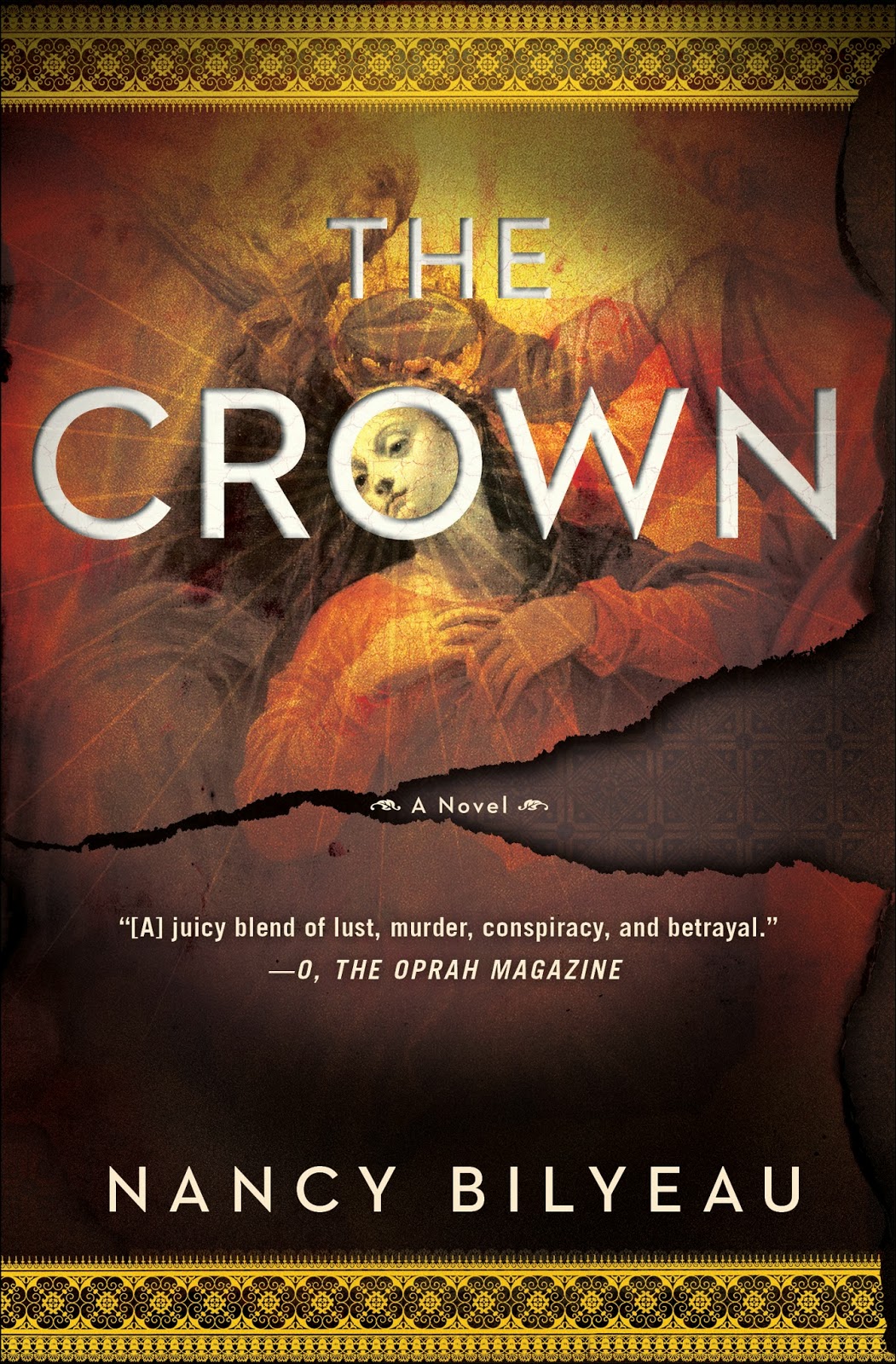
If you would like to read more about Joanna Stafford, please enter the giveaway contest for the first book in my series, The Crown. It was an Oprah magazine pick in 2012. The review said: "Bilyeau deftly weaves extensive historical detail throughout, but the real draw of this suspenseful novel is its juicy blend of lust, murder, conspiracy and betrayal."


If you would like a free signed copy of The Crown, leave your name and email address in the comments below. The book can be shipped anywhere in North America.

Now, carry on with the Blog Hop, set to go on December 20th


1. Helen Hollick : “You are Cordially Invited to a Ball” (plus a giveaway prize) -  http://tinyurl.com/nsodv78  
2. Alison Morton : "Saturnalia surprise - a winter party tale”  (plus a giveaway prize) - http://tinyurl.com/op8fz57
3. Andrea Zuvich : No Christmas For You! The Holiday Under Cromwell - http://tinyurl.com/pb9fh3m
4. Ann Swinfen : Christmas 1586 – Burbage’s Company of Players Celebrates - http://tinyurl.com/mwaukkx
5. Anna Belfrage :  All I want for Christmas - http://tinyurl.com/okycz3o
6. Carol Cooper : How To Be A Party Animal - http://wp.me/p3uiuG-Mn
7. Clare Flynn :  A German American Christmas - http://tinyurl.com/mmbxh3r
8. Debbie Young :  Good Christmas Housekeeping - http://tinyurl.com/mbnlmy2
9. Derek Birks :  The Lord of Misrule - A Medieval Christmas Recipe for Trouble - http://wp.me/p3hedh-3f
10. Edward James : An Accidental Virgin and An Uninvited Guest -  http://tinyurl.com/o3vowum and - http://tinyurl.com/lwvrxnx 
11. Fenella J. Miller : Christmas on the Home front (plus a giveaway prize) - http://tinyurl.com/leqddlq
12. J. L. Oakley :  Christmas Time in the Mountains 1907 (plus a giveaway prize) - http://tinyurl.com/qf6mlnl
13. Jude Knight : Christmas at Avery Hall in the Year of Our Lord 1804 - http://wp.me/p58yDd-az
14. Julian Stockwin: Join the Party - http://tinyurl.com/n8xk946  
15. Juliet Greenwood : Christmas 1914 on the Home Front (plus a giveaway) - http://tinyurl.com/q6e9vnp
16. Lauren Johnson :  Farewell Advent, Christmas is come - Early Tudor Festive Feasts - http://tinyurl.com/mmclaey
17. Lucienne Boyce :  A Victory Celebration - http://tinyurl.com/ovl4sus
18. Lindsay Downs: O Christmas Tree O Christmas Tree http://lindsaydowns-romanceauthor.weebly.com/
19. Nicola Moxey : The Feast of the Epiphany, 1182 - http://tinyurl.com/pewcu6f
20. Peter St John:  Dummy’s Birthday - http://tinyurl.com/nsqedvv
21. Regina Jeffers : Celebrating a Regency Christmas  (plus a giveaway prize) - http://tinyurl.com/pt2yvzs
22. Richard Abbott : The Hunt – Feasting at Ugarit - http://tinyurl.com/o9vhn8m
23. Saralee Etter : Christmas Pudding -- Part of the Christmas Feast - http://tinyurl.com/lyd4d7b
24. Stephen Oram : Living in your dystopia: you need a festival of enhancement… (plus a giveaway prize) - http://wp.me/p4lRC7-aG
25. Suzanne Adair :The British Legion Parties Down for Yule 1780 - http://tinyurl.com/oc5496a


Thank you for joining us 

Sunday, September 29, 2013

Nancy Bilyeau Historical Fiction Giveaway


I'd like to give away one of my books in this fun historical-fiction hop!

I'm writing a suspense trilogy set in the 16th century, published by Touchstone/Simon & Schuster in North America and Orion Books in the United Kingdom. The fictional protagonist is Joanna Stafford, a daughter of an English aristocrat and Spanish lady-in-waiting who is drawn to the spiritual life and becomes a novice at the only order of Dominican nuns in England, just as the religious orders of England face a violent destruction. Each novel tells a suspenseful tale, with the backdrop of the harrowing Dissolution of the Monasteries-- from a point of view rarely seen in fiction.

The Crown takes place in 1537 and 1538, when Henry VIII's break with Rome throws hundreds of monasteries and convents into turmoil. To save her father and her way of life from destruction, Joanna is forced to find a mysterious relic but then must decide who can be trusted with its powers.

The Chalice covers 1538 to early 1540, when Joanna along with thousands of other men and women  expelled from their orders are struggling to find a place for themselves. In this book, a traumatized Joanna discovers she is part of a prophecy about the fate of the kingdom, and she must decide between her conscience and a violent act that could bring back her beloved way of life.

The Covenant, which plunges Joanna into the court of Henry VIII during one of his most lethal years, 1540, will come out in 2014. I'm finishing it now. :)

I will share a few reviews of the first two books:

The Crown:

“Bilyeau deftly weaves extensive historical research throughout, but the real draw of this suspenseful novel is its juicy blend of lust, murder, conspiracy, and betrayal.” – O, The Oprah Magazine

“An engrossing thriller…[the] extensive historical research shines.” – Entertainment Weekly

“Bilyeau weaves her breathtaking story though a string of events to a pleasing conclusion while giving the reader a more thorough understanding of a complicated bit of history. Historical fiction as it should be.” – Florida Times-Union

The Chalice:
"English history buffs and mystery fans alike will revel in Nancy Bilyeau's richly detailed sequel to The Crown." -- Parade

“Bilyeau continues from her first novel the subtle, complex development of Joanna’s character and combines that with a fast-paced, unexpected plot to hold the reader’s interest on every page . . . history and supernatural mysticism combine in this compelling thriller.” -- Historical Novel Society

“The novel is riveting, and provides fascinating insight into the lives of displaced nuns and priests during the tumultuous Tudor period. Bilyeau creates fully realized characters, with complex actions and emotions, driving the machinations of these historic personages.” -- RT Book Reviews (Top Pick))
-----------------------------------------------------------------------------------------------

For this giveaway, I will send a signed paperback of The Crown or a signed hardcover of The Chalice to anyone in North America. To enter, see below!


a Rafflecopter giveaway