Showing posts with label The Tapestry. Show all posts

Saturday, February 17, 2018

Historical Novel Society: Announcement of My 18th Century Thriller


I'm so pleased that Historical Novel Society, in it quarterly publication Historical Novel Review, released the news of my upcoming novel, The Blue. I'm moving from the 16th century to the 18th century with this book, which revolves around a woman artist, a French Huguenot living in London, who gets caught up in a spying conspiracy to steal the formula for a new shade of the most beautiful color in the world.


The publication date right now is Fall 2018. Exact date to follow!

From HNS:

"Endeavour Ink, a new imprint of Endeavour Press, has bought Nancy Bilyeau's fourth novel, The Blue, a suspense novel set in the porcelain-workshop race for supremacy in 18th century England and France, for publication in the UK and US in print and digital formats." :):


2018 is going to be exciting. I will be sharing all sorts of things for the rest of the year--an extra chapter of The Tapestry that was cut from the book, one that contains Princess Mary; a prequel to the trilogy I've written; and special advance tidbits of The Blue. I'll release all of the information on how to get the goods through my newsletter, so if you haven't already, please sign up here. It will take just a minute. :) 

And stay tuned!!


Sunday, March 26, 2017

My Bookstore Buddies

I was delighted to see two photos of my books, on sale at independent bookstores. I love the thought of readers browsing the tables and discovering my work! I've haunted bookstores since I was a grade-schooler and have found countless treasured novels that way.

Yesterday, my friend Diane Wilshere, whom I've known online since we were part of the same yahoo discussion group on Tudor England, sent me a photo that made me cry "Yippee!": My novel The Chalice is on sale as a "staff pick" at Powell's Books, in Portland. Powell's is one of the most influential bookstores in the U.S., a chain of stores actually, often called a "city of books."


The "Staff Pick" note says, "A little bit like The DaVinci Code...except the main character is a woman! Joanna Stafford was a novice in the Catholic Church until Henry VIII dissolved it; she's a nun on the run. Prophecy & Mystery!"

Last week, I received a wonderful email from some in a city closer to home. Melodie R. Winawer, author of the upcoming historical thriller The Scribe of Siena, spotted The Tapestry on the table of a bookstore in Saratoga, New York.


Thank you, friends, for sending me these snapshots from the front, and thank you, bookstores, for supporting my novels and bringing readers to the world of Joanna Stafford.


Tuesday, November 29, 2016

Excerpt of 'The Tapestry' and a Giveaway


By Nancy Bilyeau


The holiday spirit is upon us! I'd like to give away seven (yes, seven) signed hardcover copies of The Tapestry. To enter the giveaway, comment at the end of this post.


And I'd also like to share an excerpt from the book: Chapter 11. I've selected a fateful dinner:  my main character, Joanna Stafford, dines with Henry VIII and Anne of Cleves at Whitehall. If you've read the first two books in the series, The Crown and The Chalice, you may be wondering how the heck that would happen. If there is one man Joanna hates, it's her second cousin, Henry Tudor! To set the stage, Joanna was summoned to Whitehall at the beginning of the novel, and with little choice, traveled to Westminster. Her talent with tapestry weaves drew the attention of Henry VIII, an obsessed collector. Since that day, she's fended off an attack on her life, earned the ire of Thomas Cromwell, Thomas Howard, and Stephen Gardiner, and renewed her friendship with the queen's maid of honor, Catherine Howard. Yes, she's been busy. :)

And now...the excerpt:


            I was flooded with relief to see the new Queen Anne—the fourth of his consorts— followed by a group of ladies. Lady Rochford, her shoulders thrown back, took her place in the queen’s train.

            I made my deepest curtsey, one that would have made my mother proud.

            “You are welcome to court, Mistress Joanna,” said Queen Anne, with a dignified tilt of the head. Her accent was thick, her words halting. But I was impressed that after four months, she spoke English this well. On the boat from Calais to Dover, she had possessed not a single word.

            She looked different and it was not just her wardrobe. Anne of Cleves wore English fashions now; that strange hat and sleeves were gone. She was still a pleasant-looking young woman—the widespread rumor that the queen was too plain to attract the king were nonsense. But she was paler than I remembered. And thinner too.

            “Will you stitch with me?” she asked. “With stitches, you… are good.”

            “I would be honored,” I said, curtseying again. I could not help but be flattered that she remembered my fondness for embroidery.

            And then came the king. Henry VIII filled up the room with his presence:  tall, broad, a crown atop his red hair, and draped with a diamond-laden pendant. We all of us made our obeisance, and he limped to the table, nodding. Queen Anne sat at the other end of the table from her husband, with my place halfway between.

            At first the king said little. His attention was on neither the queen nor myself but on the food. He was quite intent on a certain course—the stuffed capon—and visibly relaxed when it appeared, just after the civet of hare. Some worry he’d had over its sauce disappeared with the first bite, and his heavy jowls shook as he consumed slice after slice.

            Six ladies attended the queen, bringing her food and serving her wine. Catherine was not among them, but Lady Rochford was. George Boleyn’s widow saw to my dinner service as well, which meant that I was frequently treated to that unfortunate smile. Such heavy dishes were not to my taste, but I did not want to appear rude and so did my best to keep up. The odors of the food mingled with the burning wax of many candles and the king’s own scent, the musk and lavender and orange water—this was not conducive to appetite.

 Peeking down the table, I detected, even in candlelight, a tenseness in Queen Anne’s expression. A certain wariness. She ate even less than I did.

            “Madame, you have met our guest before?” said the king to his wife after the capons were cleared. “We are told that our cousin Joanna made your acquaintance in France.”

            Queen Anne swallowed and said, “Yes, Your Grace, I knew—I knew…” She paused, faltered and a man surged forward. He listened to a flood of Anne’s German and then explained to the king the circumstances of my meeting her.

            “You are fortunate to be able to travel abroad,” the king said to me. “In truth, we envy you. If we leave the kingdom, it’s assumed we are planning war. We’d have to raise taxes, muster an army, and set fire to the Scottish border before we go. A high price to pay for trying out the stuffed capon in Calais.”

            The room erupted in laughter, and, to my own amazement, I joined in. I had heard from my Stafford relatives that King Henry had the power to charm, that he was witty. Now I experienced it for myself.

            One person failed to laugh. Queen Anne’s translator had conveyed the king’s joke to her, but perhaps the humor did not survive translation. She did nothing but frown.

            I was not the only one who noticed that the queen was at a loss. The king sighed and then drained his goblet. “More wine,” he called out sharply, as men scurried to obey. A silence fell over the table again.     

They were so ill at ease with each other.  Would this have been a harmonious couple even if he hadn’t been sickened at the outset? There was no way for me, for anyone, to know.

            As soon as his goblet was replenished, King Henry sipped from it, nodded, and then turned to me.  “Cousin, we should now like to hear about your tapestry enterprise. First of all: Who precisely taught you to weave?”

            Henry VIII had ordered the destruction of the monasteries, had ended a way of life held sacred in England for a thousand years. How could I tell him that it was nuns who taught me to weave? But as he drummed his fingers on the table, growing impatient with my silence, I had no choice.

            “I learned it while I served as a novice at the Dominican Order of sisters in Dartford,” I said.

            I waited for him to erupt, to bellow. Here would come the famous, feared temper. But the king stroked his beard and said, “They had a loom, correct? Your work was not done with needles, I think.”

“No, Your Majesty. I mean, yes. We used a loom.”

“Your work was first-rate on the phoenix tapestry that the queen our wife purchased,” said the king. “It shows a certain delicacy, an interpretation of myth, that is too often lacking in these triptychs from Brussels.”

            My cheeks hot, I said, “Thank you, Your Majesty.”

“And you have begun another?” he said, leaning toward me across the table, his eyes alight with interest.

I explained that I’d ordered the design for The Sorrow of Niobe, a Greek queen who lost everything to the Gods.

It would not seem possible for King Henry to look at me more intently, but that piece of news seemed to trigger some deep contemplation.

“Hubris, ahhhh,” he said.  “You have made an interesting choice.”

“Pardon me, Your Majesty?”

A smile playing on his lips, the king said, “Niobe’s children were slain by the gods because of hubris. She defied them, saying that her children were superior. For her pride and arrogance, for her over-estimation of the importance, she was punished.”

I had seen the word hubris in relation to this myth but not understood its full meaning. Now my stomach twisted as I realized my choice could be seen as celebrating defiance of the gods. If King Henry saw himself as a sacred being—which seemed quite likely—then this tapestry would offend him.

“Pride is a sin, Your Highness,” I said.

“Very true, Cousin.” He sipped some wine and asked, “Will you use a living woman as your model for Niobe the queen?”

“I know that near the end of a weave, when finishing the faces, some have been known to use paintings or even living subjects as models,” I said, relieved at the change in course of conversation. “I suppose it is possible.”

The king beckoned for a servant, who shortly after darted away, and suddenly Master Thomas Culpepper appeared at the table. He bent over so that the king could say something to him alone. He nodded and then withdrew from the table. I tried to catch his eye—it felt wrong to fail to acknowledge Culpepper, my greatest friend at Whitehall after Catherine Howard—but he did not look in my direction.

“There is no substitute in art for experience,” said the king, approvingly. “Bearing that in mind, tell us what you think of our collection of tapestries. You see only a portion here at Whitehall, but we are proud of what is so displayed.”

            And so went my discussion of tapestry with the king of England. As the sovereign worked his way through three more courses of food, we talked of the series I had seen thus far. He was eager to hear my opinions. The one in the main hall turned out be called The Fall of Troy. Most of the king’s tapestries told tales of classic Rome or stories of the Old Testament. “Our prize is still The Story of David, we purchased it twelve years ago,” he said. “We’ve assigned a man in Brussels. And scouts in Italy and France and Flanders. We hate to think of missing a good tapestry, particularly if it’s to the king of France.”

            This was a world I had not imagined. Of course I knew that the largest tapestries were woven in Brussels and that the wealthiest families prided themselves on their possessions. But this sprawling community of artisans and weavers, fueled by new ideas and techniques, financed by the competitive kings of Europe—I’d had only an inkling.

 “Our grandfather, Edward the Fourth, built up a strong collection,” the king explained as he dove into the next course, one of roasted pig. “The king our father added to it; he had a perceptive eye for tapestry, as he did for all things. When he died, the crown owned four hundred pieces of tapestry.”

            “Four hundred?” It did not seem possible.

            He smiled proudly. “We had it inventoried. We do so periodically. We like to know exactly what we own.” He turned his head to the group of servants standing behind. “Fetch Sir Anthony Denny.”

 Not a moment later, a thin, red-haired gentleman appeared, and the king ordered him to commence with a new inventory of the tapestries of Whitehall.

“Your Majesty, if I may?”

With a start, I turned toward the queen, who had called out to her husband in her quavering, heavily accented voice. I was overcome with shame at my incivility. I had been embroiled in conversation with the king for some time, and had made no effort to include the queen.

“Sire, I know—that you love the music,” she said, slowly. “I have surprise.”

The doors swung open and four men strode in, carrying musical instruments. They were all dark, resembling each other to an unusual degree. With one graceful movement, the quartet bowed low to the king and queen.

The queen’s translator announced on her behalf, “These are the Bassano brothers, come to court from Venice at the queen’s invitation, to entertain Your Majesty.”

King Henry looked truly taken aback. But he gathered himself and pointed at one of the brothers and asked what instrument he carried.

“It is called the violin, Sire,” the man answered in French.

I will never forget the performance of the Bassano brothers in the queen’s privy chamber. It could have been the potency of the wine, or my jangled nerves over conversing with King Henry, or my constant and underlying fear of the Palace of Whitehall. Perhaps it was all of those things. But I found the piercing, soaring, aching sound of that violin, the principal instrument in the quartet, so powerful that I found it hard to draw breath.

I loved music—I used to play a vihuela, taught by my mother—but it had been a long time since I’d heard instruments play. When was the last occasion? It took me a moment, and then I remembered, with a twist of my heart. The wedding of Agatha and John Gwinn just a year ago. I danced at that wedding, the last one with Geoffrey Scovill, who admitted more than he should have of his feelings for me. Although I had always known--always. How much Geoffrey and I had hurt each other. And the Gwinns said he would leave Dartford. What if he’d already done so—and I’d never have the chance to speak to Geoffrey again.

The Bassano brothers finished, and the queen clapped her hands, well pleased. As for the king, he had gone still as a statute, his small blue eyes a touch bleary in his fleshy face.

We waited for his reaction. Surely he must be impressed.

Henry VIII cleared his throat and said, “Such music is not appropriate for a small dinner of family in a privy chamber.”

The queen’s face fell. I could not believe that His Majesty, known for his passion for music, did not appreciate what his wife had done. Standing behind her, Lady Rochford smirked.

The king continued, “Still, we shall be sure that these brothers from Venice are fairly compensated.”

I was in an odd way grateful for his coldness to Anne of Cleves, for it broke the spell. During the long discussion of tapestry, I had found it hard to hold onto my hatred of the king. It had almost seemed as if we were family, speaking of a common interest. His depth of knowledge of tapestry, his references and insights, were so exceptional that I had been quite carried away. But now I’d returned to earth. The king was a tyrant who had ordered the deaths of people I loved. He could never be my family.

The king rose to his feet with a groan, pulling himself up by gripping the top of his high-backed seat. He had eaten and drunk so much. It was surprising he was able to rise without assistance of strong-backed menservants.

“We bid you good day, Madame,” he said to his wife. “We have another matter of tapestry to discuss with our kinswoman, Joanna.”

Anne of Cleves said quietly, “Good day.”

I rose and curtsied to the queen. To prolong my time with the king was a daunting prospect. I’d hoped to be free of him by now. But at least this meant we would soon finish our business and I’d be able to leave for Dartford.

The king moved with difficulty from the queen’s privy chamber. He had been sitting a long time; his leg seemed now a source of utter agony. I wasn’t sure what was wrong with him—Master Culpepper had said something about open sores on the king’s leg requiring constant physician attention. 

We passed a portrait of his third queen, Jane Seymour, hanging on the wall. How pale and pensive she looked, as if she knew she would die before the marriage was two years old. I wondered which ghosts walked with King Henry along the passageways of Whitehall: the first wife he spurned; the second one he had killed; or the third one he lost after she did her duty and produced a male heir. Perhaps it was not so strange the king showed no interest in Queen Anne, for he could well be a man worn down from being husband to the trio who proceeded her.

Now that I stood close to him, that singular odor filled my head. Aside from the fruit and floral extracts and the musk was the same indefinable smell—familiar and animal-like and yet somehow disgusting. At dinner I’d thought it came from one of the myriad dishes of meat. But we were far from the table now. In trying to place it, my mind skipped to a memory of Edmund treating a wound in the Dartford infirmary and then I had it—what I smelled was infected flesh. As much as he tried to cover it up, the king’s leg wound stank.

We finally arrived at the destination the king had in mind: the chamber housing The Story of David. It was undeniably magnificent, each glittering tapestry in the long series depicting an episode of the ancient king’s life. We stood side by side, saying nothing, for a few moments.

“We come here often, for only this King of the Israelites could understand our destiny,” said Henry VIII, very solemn. “We are another David, chosen by God.”

I stole a glance at him. Did he truly believe this? King Henry’s face was red and slick with sweat, whether from the long meal in the candlelight or the stabbing pain of his leg, I did not know. “I must lead the people from the darkness and ignorance of Papal superstition to truth and goodness,” he announced.

I clutched my hands tight, to keep them from trembling.

Although he did not turn from The Story of David to look at me, the king must have sensed my fear. “Do not be troubled, Joanna, for you were not at fault for seeking to become a nun. You are clearly a woman of intelligence. What you require is instruction.”

I did not like the sound of that, but there was nothing I could do but pray that soon I would be freed from royal company.

Sir Anthony Denny approached, and to my relief, reminded the king of a council meeting, but Henry VIII waved him off. “We shall be there soon enough,” he said in that high, sharp voice. Then, his tone gentler, he said to me, “Tell us, cousin, what you think of the paintings of Whitehall. You are knowledgeable about tapestry, we would like to discover what else you can speak to.”

“I appreciate art but know little of its technique, Your Majesty,” I said. “When a painting moves me, I am not sure of the reason.”

“And has a painting of mine moved you?” He turned to inspect me. “Ah, yes, one has.”

When I described the painting I had seen in the hall just before dinner, the king laughed a little. “You are a woman of surprises,” he said. “That is one of our favorites. It is part of a series done years ago by our court painter, Hans Holbein, called The Dance of ‘Death.”

“Then the skeleton in the painting is…”

 “… death.” Henry VIII finished my sentence. “It appears in each one of the series, but to different people: a nobleman, a poor man, a merchant, an abbess, even a king. You see, Joanna, death comes to all.”

I felt a chill. And for a fleeting second I thought I glimpsed fear in the king’s face too. To believe yourself chosen by God to be another David, and yet to quake before mortality, what a strange state. Or was it guilt that haunted him, guilt for the monasteries he’d destroyed, the parade or martyrs he’d created?

The king said firmly, “We did not ask for your company after dinner to speak of death. Put Holbein and his fancies from your mind. We wish to commission your next tapestry, The Sorrow of Niobe, but we have a condition. We would choose the subject whose face you model Niobe’s on.”

It took me a moment to grasp what he was saying. “But Your Majesty, my loom is in Dartford. I do all my weaving there. Unless you plan to send this person to Kent, I don’t understand how it will be possible.”

“We have a proposal on where you will weave,” he said. “Many thoughts have come to us on that. But first, we would have you meet your Niobe, we think you will agree she is worthy of admiration.”

To my shock, a fond smile played on his lips, the like of which hadn’t seen this entire day.  It was in anticipation of the Niobe I would now meet.  Once he learned of my tapestry, he’d arranged for her to be brought to this unknown room.

So he was not weary of women. Although he was a man of some fifty years of age, married to a fourth wife, fat and near-lame, Henry VIII was behaving like a love-struck swain.
The king gestured, impatiently, for a servant to open the door to a room on the passageway. With a dread approaching sickness, I walked toward it.  

 Inside was a small, windowless study. A cushioned stool was put in the center of the room, and a young woman perched on it, her skirts spread in a perfect circle, her cheeks flushed as her eyes met mine.

It was Catherine Howard.

------------------------------------------------------------------------------------------------------------------------


So ends Chapter 11 of The Tapestry. If you are interested in receiving a signed novel, please comment below and include your email. I will pick the winners on December 7th and mail them shortly afterward!

Before you go, I have an important request to make. My husband wrote a modern thriller set in New York City, it was accepted into amazon's Kindle Scout program for reader-powered publishing. For 30 days, the book's first two chapters are posted and information on the novel. The more nominations his book receives, the better his chance of winning his first book contract. So please take a moment to vote! It means a great deal to me. Thank you.

To vote, click here. It takes less than a moment.


Tuesday, March 22, 2016

'The Tapestry' Goes On Sale as a Paperback Today!


I'm delighted to tell you that today, March 22nd, The Tapestry is available in paperback. The entire trilogy, The Crown, The Chalice and The Tapestry, is out in paperback, hardcover, ebook and audiobook.

Yes, I'm feeling emotional. This all began with the publication in 2012 of my debut, The Crown, which was fortunate enough to be an Oprah pick and earn reviews in Oprah, Parade, Entertainment Weekly, and Woman's Day. It's been a lot of work and, if you'll excuse the cliche, a roller-coaster ride: thrilling highs and teary lows. I'm very grateful to the team at Touchstone (S&S) and to the friends who supported me and the experts who helped me with fact checking. 

 Now it's the turn of The Tapestry!


About THE TAPESTRY:


April 1540: Henry VIII's Palace of Whitehall is the last place on earth Joanna Stafford wants to be. But a summons from the king cannot be refused! After her priory was destroyed, Joanna, a young Dominican novice, vowed to live a quiet life. That all changes when the king takes an interest in her tapestry talent. With a ruthless monarch tiring of his fourth wife and amoral noblemen driven by hidden agendas, Joanna becomes entangled in Tudor court politics. Her close friend, Catherine Howard, is rumored to be the king's mistress, and Joanna is determined to protect her from becoming the king's next wife—and victim. All the while, Joanna tries to stay ahead of a plot against her own life, directed by men in the shadows with power and access. Who can she trust—the constable who once saved her life or the friar she can’t forget? Wife or nun, subject or spy, Joanna must finally choose her fate.


Reviews:


“Nancy Bilyeau's passion for history infuses her books and transports us back to the dangerous world of Tudor England. Vivid characters and gripping plots are at the heart of this wonderful trilogy, and this third book will not fail to thrill readers. Warmly recommended!” (Bestselling author Alison Weir)


“Bilyeau’s rendering of the court and its diverse personalities and the very smells and sounds of the streets are intensely evoked. A lot of fun, and highly recommended.” (Historical Novel Society, Editor's Choice)

“Fans of the Tudor era, you’re in for a treat!” 
—InStyle magazine

“Illuminated by Bilyeau’s vivid prose, minor players of Tudor England emerge from the shadows.”
—Kirkus Reviews

"This final book in the Joanna Stafford series brings more mystery, danger and intrigue in Tudor England. Readers familiar with the story of Henry VIII and his many wives will recognize some of the events. However, Bilyeau gives us more. She provides historical detail of conditions in England and Europe and treats us to lesser-known possibilities and motives for the tragic events that unfold. Bilyeau creates a fascinating framework for this story of a popular historical period." 
—Romantic Times review

"This is a true historical thriller. It's a Tudor novel full of suspense, intrigue, brutality, and death, It's a well researched page turner. If you're looking for an exciting historical read, this will be on your list."
—medievalists.net review 

“A master of atmosphere, Nancy Bilyeau imbues her novel with the sense of dread and oppression lurking behind the royal glamour; in her descriptions and characterizations . . . Bilyeau breathes life into history.”(Laura Andersen, author of The Boleyn King) 


"A rip-roaring Tudor adventure from Nancy Bilyeau! Novice nun turned tapestry weaver Joanna Stafford returns to the court of Henry VIII. She's that great rarity of historical fiction: a fiercely independent woman who is still firmly of her time. A mystery as richly woven as any of Joanna's tapestries." (Kate Quinn, author of Lady of the Eternal City)

"The Tapestry takes its history seriously, but that doesn't stop it from being a supremely deft, clever and pacy entertainment. This is Nancy Bilyeau's most thrilling - and enlightening - novel in the Joanna Stafford series yet." (Andrew Pyper, International Thriller Writers Award winner of The Demonologist and The Damned)


-------------------------------------------------------------------

The trilogy is on sale in the U.S., Canada, Great Britain, and Australia. The Crown and The Chalice are on sale in Germany, Spain, the Czech Republic, the Netherlands and Poland, with publication of The Tapestry coming soon in Germany.

Wednesday, March 16, 2016

Taking a Chance On An Indie Bookstore

I went to Virginia last weekend, to visit my mother in her memory-care unit and spend time with my sister, who lives nearby.

Seeing my mother, who doesn't know her grandchildren's names or ages or what day of the week it is, can be very hard. This is a woman who watched Wall Street Week in Review every Friday, traveled to China, read every serious political biography.  I follow my sister's guidance on coping with the visits, which is to surround them with positive experiences: a garden tour, a museum, a walk by the river. 

This time I suggested stopping by a bookstore I'd wanted to find for over a year: One More Page Books, in Falls Church. I met one of the managers at Book Expo America, when I signed paperbacks of my second novel, The Chalice, at the Mystery Writers of America booth, and she seemed nice.

"This is always a risk," I warned my sister on the way to One More Page in her car. Some independent bookstores don't care for historical mysteries and fail to order them. Once I took my tender-hearted young son along when checking out a literary bookstore in Manhattan. When the clerk snootily said "Oh, no," to my question whether they'd ordered my first novel from Simon & Schuster, he cried on the sidewalk later. "They don't like you," he said. I hastily pointed out that it's nothing personal. But I hadn't taken a family member along on one of my expeditions to brick-and-mortar land since that tear-stained day.


It was a cool, cloudy Saturday morning when we slipped inside One More Page. Feeling nervous, I made my way to the fiction shelf, zeroed in on "B," and spotted The Chalice. I sighed with relief. My work was there. I decided to "out" myself and say hello to the manager, not the same person I met at BEA. She couldn't have been friendlier, and we had a lively conversation about historical novels on her sales table, from books by Lyndsay Faye and Leslie Parry to Sophie Perinot and Stephanie Dray. This is a store that happily carries historical fiction. Whew! I hope that when The Tapestry paperback comes out, they will stock it too.

My sister snapped a picture, and we were back in the car, on our way to see our mother. It was still a tough visit. Afterward, we headed for the National Gallery in Washington DC, and I tried to soothe my troubled soul by looking at Rembrandt and Holbein. 

But I'm grateful to One More Page, for starting the day with a feeling of warmth and welcome. It's not only for professional reasons that I support the independent bookstores, a vital force in the health of the publishing industry. It's also because personally, it feels nice to be part of their world.


Monday, September 14, 2015

My Love of Atmosphere

It always makes my day when a reviewer, whether it's a professional book critic or a reader sharing thoughts on amazon and goodreads, remarks on my love of creating atmosphere in my books. I do aim to immerse readers in the sights, sounds and smells of Tudor England. I almost feel like the mistress of a time-travel machine. The next stop is 1540. :)


From the respected website crimereview.co.uk:

"In this final chronicle of the Joanna Stafford trilogy, Nancy Bilyeau’s vivid prose, mastery of atmosphere, a deft and pacey plot involving two kings, greedy and ambitious barons and bishops, influence seekers, religious fanatics, spies and killers, set against a background of Europe-wide uncertainty, dread and oppression, bring the Tudor period to thrilling life."

For the rest of the review, go here. 


Sunday, June 7, 2015

I Am Not a Historian

I AM NOT A HISTORIAN

There. I said it.

I’m still alive.

More and more, it appears that historical novelists are positioning themselves as historians. Readers demand accuracy in their fiction set in the past—authors certified in history can supply it.

Philippa Gregory’s website begins with this statement:  “Philippa Gregory was an established historian and writer when she discovered her interest in the Tudor period and wrote the novel The Other Boleyn Girl which was made into a TV drama and a major film.”

I’ve seen other websites and interviews and book jackets in which the novelists either proudly proclaim it or weave the word into their background: “historian.” It’s become something of a magical word, and not just because it was the title of one of my favorite books: Elizabeth Kostova’s The Historian.  (That book mixed digging for obscure historical facts in quiet libraries with…Dracula!)

I’ve never made this claim for myself because I believe I lack the necessary credentials…don’t I?

Let’s take a look at the description in Merriam Webster: 1. “a student or writer of history; especially: one who produces a scholarly synthesis.  2.: a writer of compiler of a chronicle.”

Another definition: “historian: an expert in or student of history, especially that of a particular period, geographical region, or social phenomenon.”

OK. I studied history for my bachelor’s degree at the University of Michigan. After I “broke the curve” of a test given in the early 20th century American history class taught by Professor Sidney Fine, himself a nationally known historian and a Guggenheim Fellow, Professor Fine invited me to his Ann Arbor house. He offered me lemonade and we drank it on his elegant wooden porch as he suggested that I pursue a master’s degree in history. I realize now that this was it: the secret handshake, the door opening to the chamber in which dwelled historians.

But I didn’t pass through the door. I was eager to launch myself on the world of work, not remain at the university, pursuing another degree. (I know: Nuts!)

Without advanced degrees in history, one cannot claim to be a historian. At least, that’s what I’ve always assumed. If you read those definitions above one more time, they don’t specify any sort of degree. Still, I shy away from putting this word on my website, bio, book jacket or facebook page. Just doesn’t seem right.

Here’s the experience I do offer readers of my work:

Journalist—at newspapers and then at magazines, I learned on the job how to assess facts, assimilate information and structure a story. I’ve always had an image in my mind of being trained by a historian—a distinguished older man, bearded of course (looking like Professor Fine!), leans over a student at work on the thick table, chiding, “No! Can’t you tell that those are discredited documents? What am I going to do with you??” But I do seek accuracy and practice skepticism. In my years in media, if I made a mistake it did more than earn the disfavor of the bearded professor. It could lead to a printed correction and maybe the boot!

Working as a reporter also made me rather…assertive. When I was frustrated with my research on The Crown, trying to find elusive details about being confined in the 1530s in the Tower of London, I decided to go to the source. I used the “contact” email on the website for the Tower and didn’t stop bothering them until they referred me to someone with access to documents. I’ve since worked my way through two curatorial interns. One emailed me a PDF of Edward Seymour’s diet sheet while he was imprisoned, another pulled together every contemporary fact about the beheading on Tower Hill of Thomas Cromwell. (Don’t let anyone tell you he died at Tyburn!)

History lover—I did like my study of history at the University of Michigan. But since I was 11 years old I have loved reading on my own about centuries past, primarily stories set in Europe and, of course, Tudor England. I pored over every biography I could find on Catherine of Aragon, Henry VIII, Anne Boleyn, Mary I and Elizabeth I. The historical fiction that first captured my heart was written by Norah Lofts, Jean Plaidy, Mary Stewart and Anya Seton. Later on, I devoured Mary Renault, Robert Graves, Margaret George, Bernard Cornwell, C.W. Gortner, Kate Quinn, Patricia Bracewell and Mary Sharratt.

Storyteller– As a writer of narrative nonfiction for 20 years, I learned a great deal from my editors on clarity, pacing and the need for the right descriptive detail. I’ve tried to pass these lessons on to the writers I edit too. I also wrote three screenplays before beginning The Crown, and learned from teachers such as screenwriter Max Adams how to write visually and describe characters with the right evocative phrase.

I always wonder what other historical novelists feel about the “historian” question. For this blog post, I decided to ask a few. (Remember, I am assertive!)

Erika Robuck, author of fantastic historical fiction like Hemingway’s Girl and The House of Hawthorne, says, “"I think an historian is an expert in a time period or culture, and holds a degree to support that level of expertise. I am an enthusiast, not an historian.”

Eva Stachniak, who has written two of my favorite historical novels, The Winter Palace and Empress of the Night, says, “As a writer of historical novels, I have to know my history, in and out, understand it on many levels, political, social, cultural. I have to be able to imagine how everyday life was lived at the time when my novel is set. For my two Catherine the Great novels, I studied the life of the Russian court, not just its politics, but also its everyday routines. I researched spies and spying, dressmaking, bookbinding, medical procedures and the ins and outs of 18th century renovations. Does it make me a historian? I am not convinced. But it makes me a student of history. It makes me re-imagine the exiting research in a creative way. However, even if I make no claims to being a historian, I claim my passion for history and my ability to make it seem alive for my readers.”

My friend Sophie Perinot, author of Sister Queens and Medicis Daughter: A Novel of Marguerite de Valois (pub date: December 2015), has thought about this question even more than I have. She had some fascinating things to say:

“I am not a historian, despite having a BA in history—at least when I have my novelist hat on—because my work isn’t driven by history, or entirely limited by it.

“I've had to give serious thought to the line between what I call 'H'istory (academic history) and history as portrayed by novelists. I've discussed the subject in a pair of lectures given to university history students during their unit on the uses of undergraduate history degrees after graduation. And I think most historical novelists grapple with the "who is a historian" question because Historical Fiction is undeniably a pop culture way that people today consume history, and those of us who write it are keenly aware that lots of fans blur the line between NON-FICTION HISTORY and the FICTIONALIZED HISTORY OF HISTORICAL NOVELS.

“Let me start by saying that I have a background in history having graduated with a BA in that subject—but I don’t write BIG “H” history, nor, in my opinion does any other writer in my genre. Professors write BIG H academic history ( I have a sister who is a professor of history so I have tremendous respect for academic historians)

“Why do I say this? Well first and foremost a novelist's work is not driven by the overt goal of educating readers on a particular period or by presenting an overview of a historical issue or time. The historical novelist's work is driven by considerations of plot and theme—by the desire to tell a universal story that is set in the past but transcends it.

“So, I am not a historian, at least when I have my novelist hat on, because my work isn’t driven by history, or entirely limited by it. BUT if I write first rate historical fiction – and I’d like to think I do – then in telling my story I want to be true to historical facts as we know them. Good historical novelists use the same sorts of resources that students of history would use to write an academic paper—JSTOR, scholarly journal articles, primary sources, and secondary sources (biographies, prior histories).”

I hope that when you read my historical thrillers, or the fiction by Erika Robuck, Eva Stachniak or Sophie Perinot, you’ll relish not just the story but the awareness that we take our history very seriously—even if we don’t call ourselves historians.

Of that, I think, even Professor Fine would approve.

Monday, June 1, 2015

June 'Romantic Times' Reviews 'THE TAPESTRY'

I was thrilled to receive the RT Reviews Award for Best Historical Mystery for THE CHALICE last year. Obviously, RT Reviews is aces with me!

I'm pleased to share the June issue's review of THE TAPESTRY:

"This final book in the Joanna Stafford series brings more mystery, danger and intrigue in Tudor England. Readers familiar with the story of Henry VIII and his many wives will recognize some of the events. However, Bilyeau gives us more. She provides historical detail of conditions in England and Europe and treats us to lesser-known possibilities and motives for the tragic events that unfold. Bilyeau creates a fascinating framework for this story of a popular historical period..."

To read the full review, go here.


Sunday, May 17, 2015

Four Stars From the 'British Weekly'

Very excited to share that The Tapestry received four stars from the publication The British Weekly.

"Bilyeau is masterful in creating details that move the narrative story forward and in creating real dilemmas for Joanna Stafford in this book. Bilyeau’s words transport the reader back to the English court at a time when you had to be careful what you said or risk losing your head. The author Bilyeau tries to strike a balance between the politics the King Henry VIII’s court and Joanna’s personal life. For the third book, you don’t have to read the first two books in the series, but it makes more sense if you do...."

To read the rest, go here.


Friday, May 8, 2015

Guest Posting on NunBlog

I'm honored that Sister Anne of the Daughters of St. Paul asked me to post on her website about my series of novels.

She wrote:
"A few weeks ago, I mentioned the TV series "Wolf Hall" and its inaccurate presentation of St Thomas More, recommending a series of novels set in the same time frame that offer a very different (and more true to life) perspective. Today NunBlog is honored to welcome author Nancy Bilyeau, Twitter's @TudorScribe, as a guest blogger":
To read the guest post on nunblog.com, go here.


Thursday, May 7, 2015

A Review from Mystery People

I'm delighted that the UK crime fiction group Mystery People has reviewed The Tapestry. This is a wonderful group that posts reviews and events and shines the light on authors' work! Here is the review on the website of Lizzie Hayes, who also runs the blog Promoting Crime Fiction:


"....Nancy Bilyeau has woven a most complicated tapestry as Joanne picks her way through the court intrigues, trying to keep clear of the whims of the awful Henry, and away from the clutches of the nasty Thomas Cromwell. Ingeniously plotted, the book makes for gripping reading, portraying a young woman struggling to keep her sanity and beliefs during a most appalling period of British history."


For the full review, go here.


Sunday, May 3, 2015

The Strange and Beautiful World of Tapestries


In the year 1540, in the city of Brussels, a team of men worked indefatigably at their workshop looms. Using wool, silk and the most exquisite--and astoundingly costly--threads of gold and silver gilt, they wove the story of Hercules, a demi-god of ancient Greece, for the pleasure of a man who had made himself the head of the church of England and may well have considered himself close to a god: King Henry VIII.


The drawing they placed on the looms to guide the weave was created in the school of Raphael. Born Raffaello Sanzio da Urbino, he is the third artist in the triumvirate of Leonardo da Vinci and Michaelangelo--the High Renaissance geniuses. Befriended by Pope Leo X (who excommunicated Martin Luther), Raphael produced transformative paintings such as The Madonna of the Meadow. In 1516 Raphael created 10 drawings of St. Peter and St. Paul that were to become tapestries to hang in the Sistine Chapel. He died in 1520 of a fever supposedly following a night of vigorous sex with his mistress.

Read the full post on tapestries  here


Tuesday, April 14, 2015

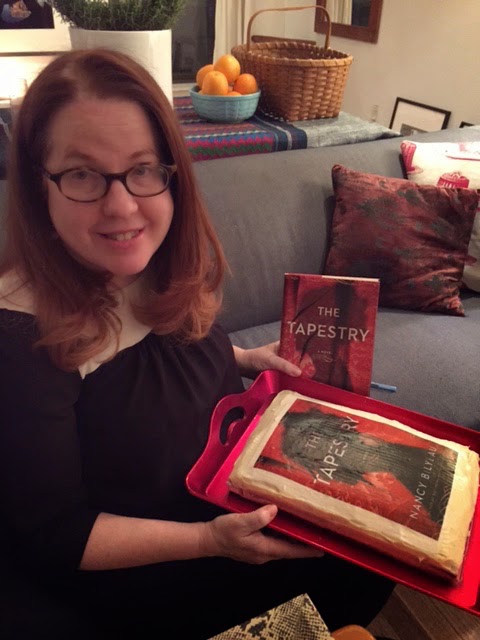
This Takes the Cake!

My friends from the magazine world convened in an apartment in Tribeca to celebrate the publication of The Tapestry.

I am absolutely floored by the wonderful cake my friend Donna made.


It took me five years to write my first novel, while I was employed by Ladies Home Journal followed by InStyle magazine. I am deeply appreciate of the support of my media friends!

Sunday, April 12, 2015

"Mystery Scene" Magazine: THE TAPESTRY is "Meticulously Researched"

I love "Mystery Scene" magazine and so was delighted to see this review of THE TAPESTRY:


"This is Nancy Bilyeau’s third installment of the trials and tribulations of former novice of the Dominican order and aristocrat Joanna Stafford. After having her priory demolished by decree of King Henry VIII during the English Reformation, Joanna finds herself living contentedly in the small English town of Dartford, weaving elegant tapestries that provide her an income.
When the king, who is a distant cousin, orders her to the Palace of Whitehall in London to receive a commission for a tapestry, she has mixed emotions. She’s not a fan of King Henry, but she is anxious to see her cousin, Catherine Howard, who is one of the queen’s maids of honor. And she knows it’s not wise to ignore a kingly order.
While she travels, she feels watched, but sees no one. Upon arriving at Whitehall’s gatehouse, a page offers to take her to the Keeper of the Great Wardrobe, who is in charge of tapestries. Instead he leads her to an outbuilding where he attempts to kill her. She’s rescued by Thomas Culpepper. It’s clear someone wants her dead, but she doesn’t know why. The royal court is filled with rumors, treachery, and intrigue, and men—and women—with hidden agendas. Not knowing whom she can trust, Joanna sets to unravel the mystery with the help of Constable Geoffrey Scovill, a friend and former suitor from Dartford.
It’s obvious that the award-winning Bilyeau knows her English history. In this meticulously researched Tudor thriller, the names of the real-life characters who populated Henry VIII’s court come fast and furious. In addition to Catherine Howard and Thomas Culpepper, figures include Lord of the Privy Thomas Cromwell, Bishop Stephen Gardiner, Archbishop Thomas Kranmer, Sir Walter Hungerford, and Anne of Cleves, the king’s sad fourth wife caught in a six-month unconsummated marriage. With the many references and situations that refer back to the first two books in the series, it’s recommended that those books be read first."


The full review is here.


Wednesday, April 8, 2015

THE TAPESTRY on InStyle's Bookclub List for April

I'm ecstatic that InStyle magazine picked The Tapestry for its April book club. Other novels include Sara Gruen's At the Water's Edge and Hallie Ephron's Night, Night, Sleep Tight.

Says the magazine:

"Fans of the Tudor era, you’re in for a treat. In the third installment of Bilyeau’s dramatic trilogy, we once again meet Joanna Stafford, a former nun who is determined to protect both her beliefs and her friends from the dangerous politics that surround King Henry VIII’s reign...."


To read the full review and see all seven recommendations, go here.

Thursday, April 2, 2015

THE TAPESTRY Review: "Best of the Best Historical Fiction"


I'm very excited about this review from Library of Clean Reads, which gave The Tapestry a "G" rating and said, "Is it possible that this third book in the Joanna Stafford series of fantastic historical fiction is the best yet? If you have read The Chalice and The Crown you may wonder how it could get any better, but it has."


 "...It’s obvious that the author has done meticulous research, as usual. And that she is well versed in the Tudor era. Apart from Henry VIII and Catherine Howard, other historical figures appear throughout the novel, ie. Cromwell, Anne of Cleves (Henry’s fourth wife), Thomas Cranmer, Archbishop of Canterbury, Hans Holbein. I learned about the Henry’s Act of Six Articles forbidding persons who had taken vows of chastity in a religious order from every marrying, on pain of death. I loved the list of characters (useful to readers unfamiliar with the era) as well as the extensive bibliography.


"Look for royal intrigue, murder, friendship, love, treachery, religious/political turmoil in this best of the best historical fiction."


To read the full review, go here


Saturday, March 28, 2015

THE TAPESTRY book launch makes it onto SHELF AWARENESS


On Wednesday I celebrated the release of my novel, The Tapestry, with 100 friends and readers at The Mysterious Bookshop in Tribeca. I shared the launch with M.J. Rose, bestselling author of 15 novels who has just come out with The Witch of Painted Sorrows.


I really enjoyed the Q&A section, answering questions about my writing routine and whether the characters have grown over the series.

It was a lovely evening, and, the next day, a picture from the party made it onto Shelf Awareness as Image of the Day. Go here!


Tuesday, March 24, 2015

The Downfall of Katherine Howard

Katherine appeared briefly in The Crown, for a few chapters in The Chalice, and now she plays a large part in The Tapestry.


I have a different opinion of Katherine than most other historical novelists--and nonfiction writers too.

She has been the dirty joke of the Tudor period, but I feel there is a lot more to Henry VIII's fifth queen.

See the post here.


Sunday, March 22, 2015

A TAPESTRY Party Online Monday Night!

I will be celebrating with my readers and writer friends on Facebook Monday, March 22nd, from 6:30 to 7:30 pm on a Facebook page created for this by Amy Bruno, who runs the Historical Fiction Virtual Blog Tours.

Stop by and say hello!

The Facebook address is here: https://www.facebook.com/events/389250371260299/

It should be fun...


Thursday, March 19, 2015

Alison Weir Endorses THE TAPESTRY!

I'm ecstatic to report that Alison Weir, the bestselling author of more than a dozen biographies and historical novels, has contributed the following quote for THE TAPESTRY:


"Nancy Bilyeau's passion for history infuses her books and transports us back to the dangerous world of Tudor England. Vivid characters and gripping plots are at the heart of this wonderful trilogy, and this third book will not fail to thrill readers. Warmly recommended!"


I've been reading Alison's work since The Princes in the Tower (1995) and consider her an inspiration. I believe I own every single one of her books--in hardcover. :) Several months ago I devoured her biography of Elizabeth of York.


We "met" over email three years ago, and she graciously recommended my novel THE CROWN, saying, "A stunning debut. One of the best historical novels I have ever read."


I'd love to re-post my interview with Alison as she was publishing her novel A Dangerous Inheritance. She's fascinating on Plantagenet and Tudor history. To read, go here.