Researchers investigating the remains held in six mortuary chests in Winchester Cathedral, one of the most important religious establishments in medieval England, recently made a discovery: the body of Queen Emma, married to two consecutive kings of England in the 11th century.
Emma of Normandy, while a teenage princess, was married to the older Saxon king, Ethelred, and after he died she was wed to the Viking ruler, Cnut. She had children by both husbands. Medievalists.net said, "Daughter of Richard I, Duke of Normandy, she was the wife of two successive Kings of England, and the mother of King Edward the Confessor and King Hardacnut. She was a powerful political figure in late Saxon England, and her family ties provided William the Conqueror with a measure of justification for his claim to the English throne."
 |
| Winchester Cathedral |
Emma was a direct descendant of Rollo, a Viking warrior who became the first duke of Normandy and died in 930 AD. Cnut invaded England, intending to rule the country, and one theory is that Emma, a widow, married him to save the lives of her children. However, historians believe her second marriage turned out to be happier than her first. Cnut was also the king of Denmark and Norway.
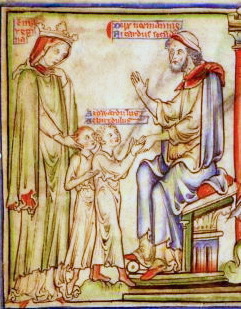 |
| Queen Emma and her sons being received by Duke Richard II of Normandy. |
Emma died in Winchester in 1052. She was buried alongside her Viking husband, Cnut, and their son, Hardacnut, in the Old Minster, Winchester, before being transferred to a cathedral built after the Norman Conquest. Her son by her first husband, Edward the Confessor, was among the last Saxon kings of England. When he died childless in 1066, it led to the overthrow of the Saxons by the Normans.
At Winchester, the contents of six chests have been analyzed and radiocarbon-dated. University of Bristol biological anthropologists found they contained the remains of at least 23 individuals, which is several more than originally thought, according to the BBC.
"It has long been believed that the six mortuary chests contain the mortal remains of Anglo-Saxon kings and bishops, but for many years this has merely been the subject of speculation," said medievalists.net. "The bones had been co-mingled over the centuries and it was clear that the chests did not contain whole skeletons."
The chests had inscriptions saying who was supposed to be contained within, but the names did not accurately describe the contents. Historians believe the contents became mixed in the mid-17th century when the cathedral was ransacked and the bones were scattered by soldiers during the English Civil War in 1642. "They were repacked by locals so it was not known whose remains were replaced, or if they were the same bones," said the BBC.
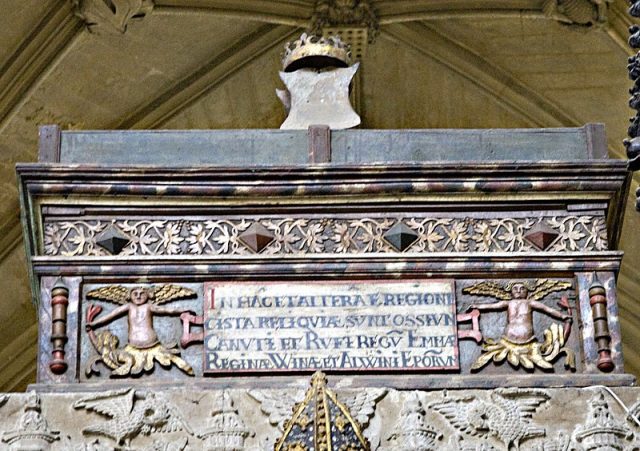 |
| Mortuary chest from Winchester Cathedral. This is one of six chests near the altar, and claims to contain the bones of Canute and his wife Emma. Photo by Ealdgyth CC BY-SA 3.0 |
Diet was a factor in analyzing the bones. The results of the radiocarbon dating were evaluated by estimating the "marine reservoir" effect for each person, "since high status individuals ate large quantities of fish from the rivers and the sea which contain older radiocarbon," said medievalists.net.
The age of the individuals was also concluded after studying dental formation and attrition, changes in the bone surfaces, and the closure of the cranial (skull) sutures.
A version of this story appeared on The Vintage News.


